BEIMA collective. Bridging radical empathy.
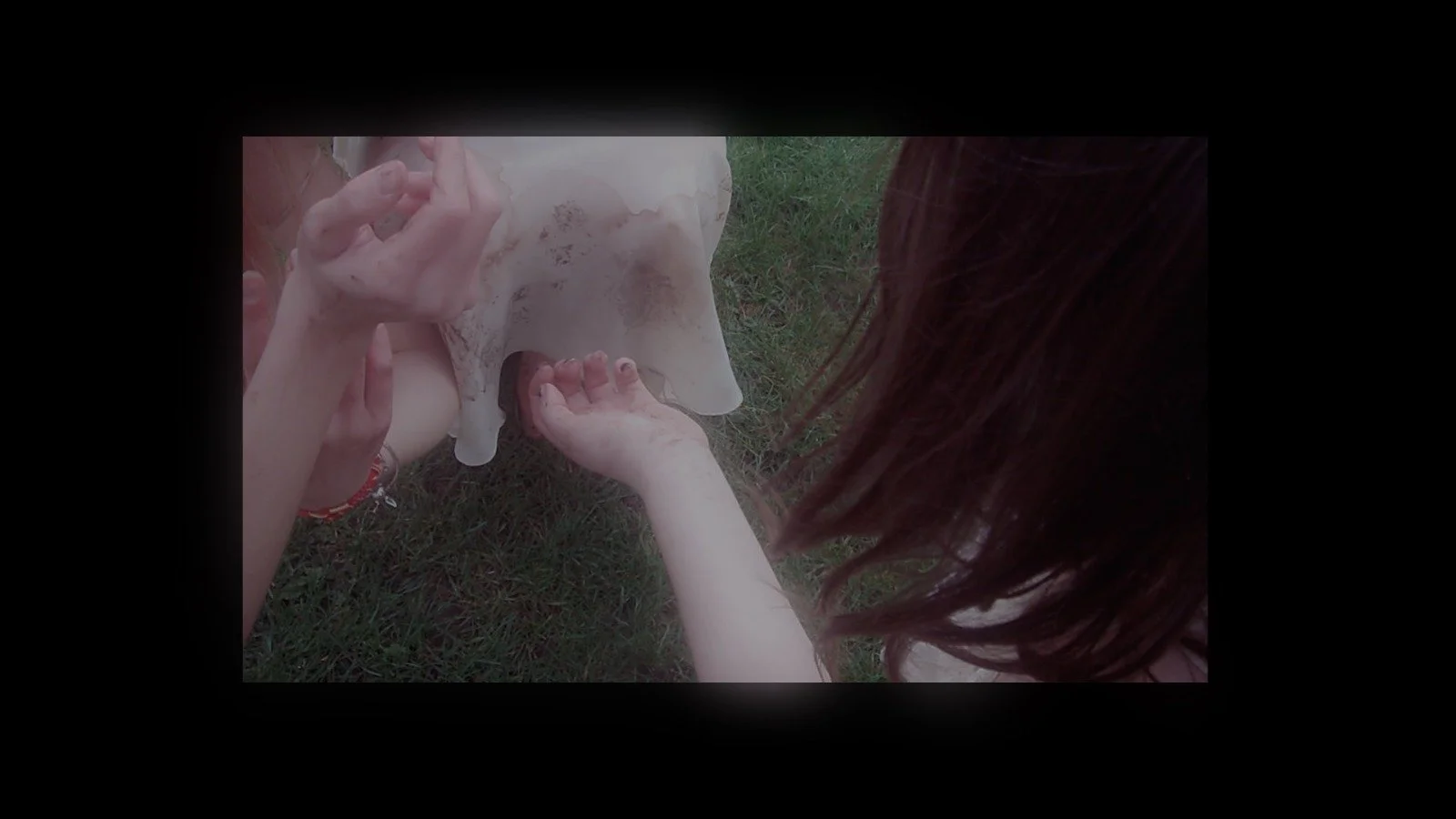
Film Still: Two Truths and a Lie about Snowdrops, Cinematography: Lijin An, Miriam Austin
PATRYCJA WOJCIECHOWSKA: Thank you for agreeing to speak with me. So I wanted our conversation to begin with a closer look at the origins of your collaboration. Xinyue, this is a slight turn in your practice- up to that point your storytelling was rooted in moving image and visuals associated with it. Now, you tell the story in collaboration with others, through bodily movement. It’s a different process, not only when you think about the medium itself, but also in terms of dynamics with other people, and with other beings too. So let's lay the ground with the collective’s beginnings; how did you come together to work together?
DR Alice Baldock: Xinuye, I guess, is the original mastermind behind the collective. But I truly believe we came together, the three of us, through dance. We all come from distinctively different dance backgrounds. I initially met Xinyue when she started attending my lyrical dance classes. Mingyu is a semi-professional hip-hop dancer.
Mingyu Zhu: (laughing) No, not there yet.
AB: Although we are all coming from different directions in terms of our dance background, we are all connected by our interest in expression through movement. When Xinyue’s idea of this collective came out, it was initially intended for a specific dance film. After we made it, it kind of evolved into a live performance and ongoing collaboration as well.
Dr Xinyue Liu: Yes, definitely. I see both Mingyu and Alice as my mentors. My supervisors asked me to justify using bodily movement in my PhD. To me, it's such an intuitive process. I let it evolve. We understand each other very well, because of our shared experiences at the Dance Society, but also because we're just such good friends. And I think we just understand each other's style. If I look at how I move these days, the result is very much influenced by my wonderful collaborators.
PW: Something occurred to me when I was looking at you all at BEIMA, and especially, performance: Two Truths and a Lie about Snowdrops . I was looking at these images and the number three, along with its connection to the ecstatic movement of female bodies, came to mind. There is a cultural recurrence of the association between the number three, divine and female bodies. And there are many figures within the ancient world, mostly Neolithic, or Chthonic deities, where the primary female deity is one of three, or more precisely one made out of three. For example, Hecate, the Greek Chthonic goddess of magic, had three aspects represented through a sort of one body made out of three that was looking in 3 separate directions. So all the aspects of the world were under the gaze of the three different aspects of the same entity. When I was looking at the Two Truths and a Lie about Snowdrops, it reminded me a little of one being consisting of three, or one and three beings at the same time. It felt like one of these instances, one of many, or one and three, individual and collective at the same time.
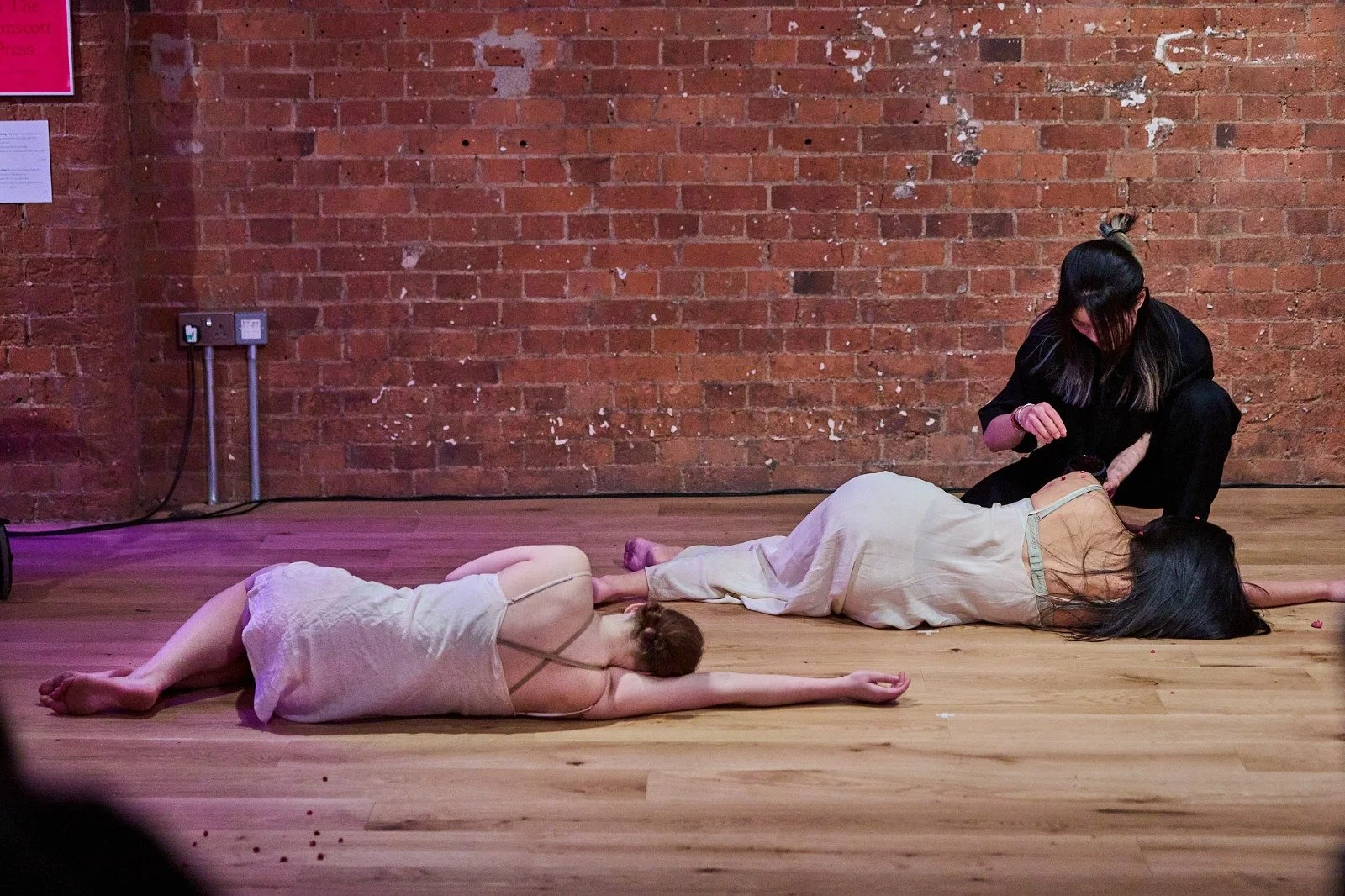
Performance at Modern Art Oxford, Photography: Tim Hand
AB : Talking about myth and history, and how they influenced our work, and particularly the last piece that we did, we ended up drawing on quite a few different archetypes, I would say, but also on stories from a multitude of different cultures. We drew on, for instance, on the image of Persephone and pomegranates quite heavily, which served as a conceptual thread binding the story.
Mingyu and Xinyue danced ina duet, which was inspired by a story from China about a scholar falling in love with a dolphin. The Story initially appeared in Liao Zhai Zhi Yi (《聊斋志 异》), a Qing Dynasty collection of folklores and myths. And so I think the notions of archetype and myth are really interesting and important, but also Xinyue's concept positions our practice, in the idea of the future. Within the frame of performance, we are in the future and are looking back. From this point of view, having these timeless references is a really helpful and interesting way to play with time, of what is changing and what is fixed throughout that sort of timespan.
PW: That's really beautiful. I wanted to speak about the notion of other in the context of your work. I don't think of the other as only the other than myself, or something, someone that stands outside of accepted notion of normality.
I think of it also as something or someone standing outside of normality from the anthropocentric point of view. Beyond human, and not necessarily alive in biological carbon- based terms. The other can be rock, the other can be sky or anything, anyone else for that matter. For me it emerges from the practice of othering nature and my internal sense of recognition of the diversity of being, and polyvocality in the world. I quite like recognising a place across all life and non-life in these terms.
In my opinion, in the Two Truths and a Lie about Snowdrops you advocate on behalf of the snowdrop. You tell its story, but at the same time, you are the snowdrop. It reminds me again of what we were speaking about, archetypes and cultural references. There is also something else to consider; the female body being the other. It is always strange. An ultimate stranger. Female bodies are embodiments and advocates of the other. And then, as we mentioned before, you become this one body of three, one being of multiple aspects, something that's more than just yourselves, more than just one individual. And that also is the other. And you achieve it through the process of dance. But I also think you do this through the process of your collaboration. It starts at this point where three people come together, and decide to act out their investigation and intuitions.
In a way, that also is the other, as we live in a culture that, until very recently, pretty much took as an absolute truth that the individual is one, singular. One person and one mind. And the rest is just to be discarded in terms of ideas. So I wanted to ask, how do you experience this, in terms of your experience of coming together to work on performance and the experience of performance itself?
XL: I think we all have very different understandings of who we are representing and what sort of awareness we have of the other bodies. I can only speak for myself in terms of this collaboration coming from trying to grapple with the idea of representing nature. I think it is very much a dilemma of wanting to really represent it well, and knowing I can't claim any authority over nature.
We can never know how the others really feel. Even when we're together, working closely, we can never truly understand each other. So I think what I do is try to honour the difficulty of coming together, the togetherness, and also imperfection of trying to understand the other's umwelt-the idea of each being’s unique surroundings defined by the late biologist Jakob Johann von Uexküll, where each being has its own unique world, based on their different sensorial and cultural experiences one can never speak truly on behalf of the other. I also draw a lot from my supervisor's work—Onyeka Igwe—and her idea of critical approximation. She derived that concept from Bruno Latour, but she understands it as an archival process, whereby one sits in the archive and recognises that they will never truly gain access to how a certain historical figure felt at the time. And one’s job as a historian, as a scholar, is very much a work of fabulation. One makes up a story and then tries their best to represent, or bring to life the other person's presence. The point, I think, is a persistent attempt even though the other, across historical or biological divides, can never be understood.
MZ: I think this is how I try approaching it. We're doing a lot of fictional work and we also understand that this is fiction. And I think that sci-fi as a context actually holds that quite well, because you can do this sort of fictional work and pretend it to be some form of historical truth, even though you know that it's just a story that you're telling.
For me, the idea of the other, well, aside from dancing, comes from my background in STEM. From a psychological or neuroscientific point of view, I feel that when it comes to the others, as Xinyue said, there's no way of ever being able to completely experience the other's experience. But what is possible, is to approximate this through empathy, or to try to picture yourself in the other's sensory experience. But that kind of empathetic experience is also very limited, by your own subjective past history. Personally, I think of dancing as a way of trying to bridge that through this shared experience of bodily movement. Actually, it is a really powerful tool to allow people to empathise with each other more than just through, for instance, language or describing what we/they feel. And that is a very powerful way of bridging emotional empathy. And by bridging emotional empathy, you build upon that to do cognitive empathy. The other reason why we come together is not just because we're good friends and we're dancers. I think it's also because we do have shared values when it comes to certain topics or themes. And that has been quite intertwined throughout our work. I feel like what we want to do, I can't speak for the three of us, but I think our work, is not just an exploration on what we can do with our dancing, but it is also an application of what it can show the others, or people that are watching the dance, how we can represent, for instance, nature. And maybe that is also a way to bring out empathy for nature as well. Although, I will agree it's limited, but I think through movement, it's adding another layer to, other medium, like language.
PW: I think it can also be a question of the attitude. The way you think of other. I agree with your understanding of empathy and how it is used in the context of your work. And for two reasons. So over this weekend, I was at the Ambika in London at the hearings for the Court of Intergenerational Climate Crimes, the project by Jonas Staal. And it was set in this sort of warehouse-like space with a raised platform acting as a courthouse, surrounded by seats for the witnesses, and Jonas was an acting clerk. The hearing and presentation was focused on the East India Company and explored the company’s activities in terms of intergenerational climate crimes. In the court space were installed representations of different plants used by the colonial forces in order to produce the sense of indenture, servitude and slavery, and those plants were referred by Jonas as comrades, as they were considered sentient, live beings and as such part of community, comrades.
At the centre of the stage-courthouse, there was also an actual plant growing, an indigo. Towards the end of these three-day-long hearings, Staal was closing the proceedings of the court after the public voted, agreeing that, yes, the East India Company was guilty of everything it was accused of, and he thanked everyone, but he thanked not only all the humans. He also thanked other beings. He thanked comrade indigo for agreeing to take part in the hearing and witness the proceedings. And he said how looking at comrade indigo growing leaves and sprouting its seeds made him feel as if it was a sign of participation and agreement. I understand this as a message, as a sign of a way to reach out, to encounter and exchange. And it was quite touching, but it also points to the impossibility of ever completely translating one mind onto a different kind of mind. But it also showed that one could try translating across the difference in means of communication by the change of attitudes. It was actually quite beautiful, and the people were picking seeds to probably plant them later.
MZ: Can I just add a point on that? I feel like humans have this natural tendency to empathise more with people, or with beings that are similar to themselves. So that's how, for instance, we tend to find humans comforting, and tend to find things that we are unfamiliar with, as scary. For example, this natural fear of things like molluscs, or spiders, or some form of female representations, actually. And through just getting to know these strange things better, you learn to actually empathise with them more. I feel like maybe us trying to do our work here, our dance, is a way of also making people become more familiar with certain things that are not so similar to them.
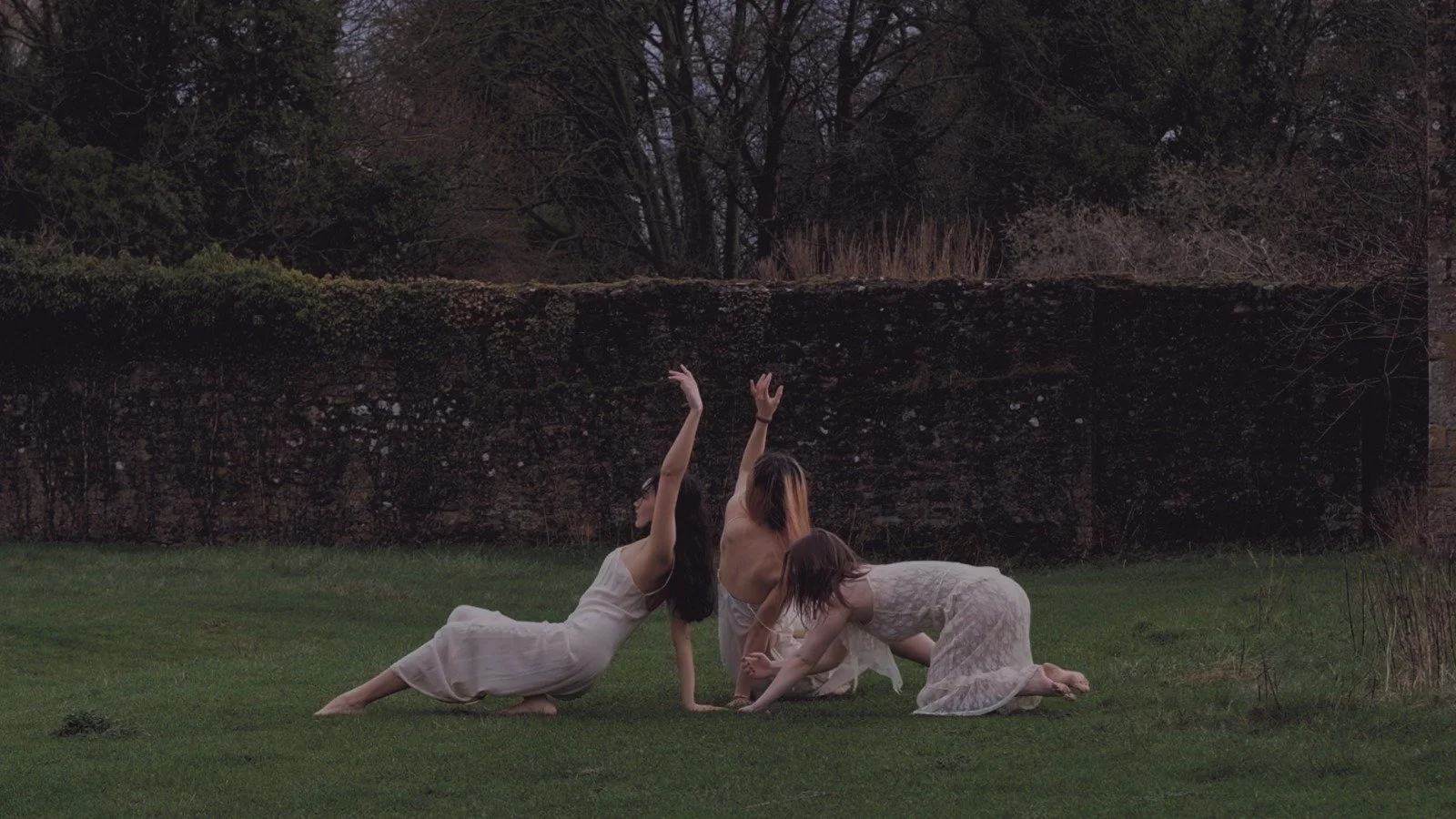
Film Still: Two Truths and a Lie about Snowdrops, Cinematography: Lijin An, Miriam Austin
PW: This sort of leads me to my third question, which is about monstrosity. I think it would be good if I could give you some background. Some time ago, I was in Salento researching a cultural phenomenon of tarantism. The famous Salentinian dance Tarantella, is sort of a vulgarized version of it. Historically, it has been documented at least since the Middle Ages. Now, officially, the phenomenon is dead. To me, it was pretty obvious that it started probably in the time when humans dwelled in caves, that it has been around for a very, very long time. There are Neolithic monuments in the region that are associated in folk history with the Tarantata, for example; a cave art called the Dancing God.
Tarantism is a phenomenon that was affecting women, and almost solely women who were marginalised in a society in a certain way, the victims of domestic violence, of forced marriages, and so on. It was a very poor area, land was very difficult to work, there was a shortage of water. The story was that a woman was becoming lethargic, unresponsive and withdrawn, the classic signs of depression. Dedicated musicians were sent to play for her in order to exorcise this state through dance. The story was that she was bitten by a tarantula, a European Black Widow spider. The malady was not caused by social or cultural problems, but by this very, as you said yourself, scary other, the spider. Sometimes those proceedings lasted for days.
There is a documentary film from I think,1959, made by the anthropologist Ernesto de Martino. And it looks like women filmed were experiencing a complete sense of abandonment. Everything was highly ritualized, but the woman really did go somewhere else. De Martino, who researched the phenomenon, and I agree with him, wrote that the woman became the spider that bit her. The official interpretation was that the possession was the malady and the dance was the remedy.
I, on the other hand, read it as an abuse, because for me, the woman voluntarily left some space within herself free in order to invite the other and become a place, this somewhere else, escaping her reality by moving even further, by becoming something more than just herself. And the dance was, in a way, the procedure enforced to return to normality. Means to become subjugated once again. I was thinking about this moment, when you become the snowflake, or when you think about the pomegranate, and how all of this means that you make a space within yourself for the other, and then you become monstrous.
AB: I'm a dancer, but I'm also a historian, and I read a history of a dance called Butoh, which originated in Japan, and which has some overlaps with this kind of thing. A lot of the dancers who were practising it originally in the 1950s, were very interested in trance and shamanism, in shamanistic dance, and particularly, the female rituals associated with these processes.
There's a really great dancer called Evangeline, who differentiates a little bit between what becomes Butoh and what becomes ecstatic dance. This is just an example of many different approaches to this form of experience. But in each case, the performer goes somewhere else with their mind. They are physically in a different mental state; their body is in a different kind of sympathetic state, with the parasympathetic nervous system being activated. And that process of becoming something else is very present in all of these instances. And so there's an idea of transformation, which happens in most Butoh practices. Even though I'm not a Butoh dancer, I like to take that idea as an important content in my work.
And then it bled through into this work here. This idea of, as you said, of making space for something else, and not just making space, but almost, completely emptying yourself, and your mind, at least in terms of becoming that other thing, is one of the ways to really access the kind of radical empathy that we've been talking about. So I think definitely, this example that you have is a really interesting one, but I find the most fascinating is Black Widow, who is the culprit. Again, even the non-human is still gendered as the monstrous feminine. We played quite a lot with monstrosity recently, like spitting out seeds on the stage and stuff like that. So I think it's quite a fun way to access the ideas of othering, and a way to show how ridiculous they are, is to take them to the extreme. Almost to a different level.
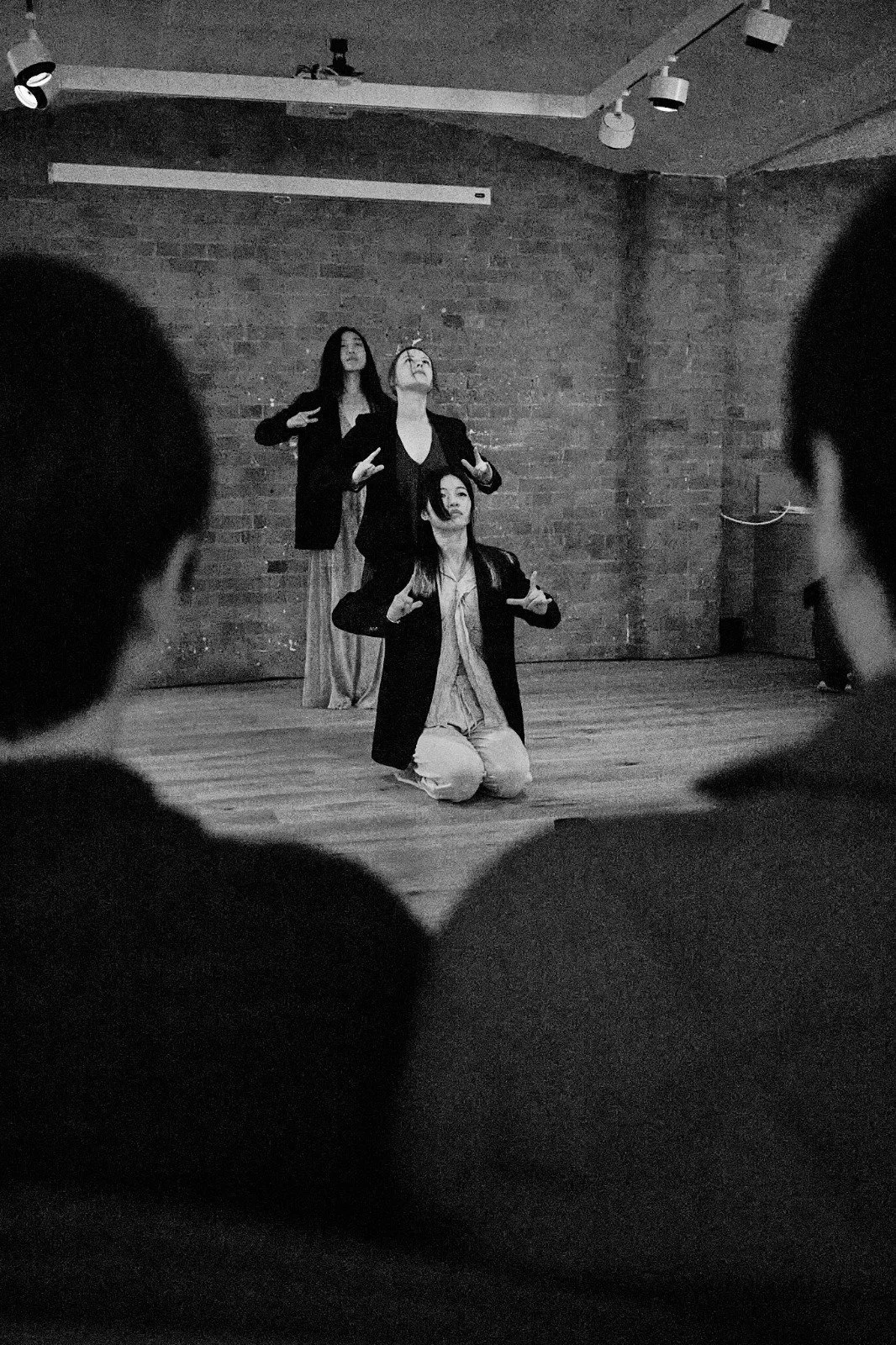
Performance at Modern Art Oxford, Photography: Tim Hand
PW: I also wanted to speak about the notion of elsewhere, which I sort of stole from artist Riar Rizaldi. Riar often works with genres of science fiction and horror, and forms of mysticism. In his work, he explores this place that he defines as elsewhere. Possession is an example of elsewhere. Jumpscare is elsewhere. In connection with interviewing him, I discovered something that I think is very interesting- the Indonesian custom of showing, for example, horror movies to the forest, spirits, place. So the target audience is non-human, and the human audience is sort of collateral of the entire process. So when I was watching you, and when you spoke about the Butoh, I thought of that place, which for me was very intuitive (during my research). I thought that the space was not a space in itself, but a form of a void ready to be filled. But it was also a process. It's something that's happening. It has a duration. It's almost as if it gained another dimension, that I kind of took from ideas explored in quantum physics, where multiple different states of things are simultaneously possible. This way they can become something else than just the time, the location itself, or the body itself. Instead, something that is connected emerges, and it has a timespan.
XL: If I were to touch more on that, I'm also thinking about how our performance perhaps creates elsewhere, or maybe this is a bit of an exaggeration, because I think it depends on the audience and their individual experience. But I do think these public performances could potentially create this, what I call, conditional apparition. The way I approach these so-called more-than-human others, or the idea of the monster, is to create a condition under which these beings could be perceived as real. When I arrived at that term; conditional apparition, I was looking into ghost species, and my act was with Mingyu, where we performed the possibility of a dolphin falling in love with a human, evoking the imagery of the now-extinct Yangtze River dolphin. Even though it is no longer here, it is temporarily brought to the viewer’s awareness—revived in mind.
It is an aesthetic containment, but I am thinking perhaps performance could be visceral and felt in the immediate sense. I suppose that is what I think of the idea of monstrosity, as beckoning and conjuring.
MZ: From the performer's point of view, I do find the process as indeed, a very radical sort of empathy. For the moment when you're performing, you feel as if you're emptying yourself and embodying this other being; whichever one they are trying to embody, I guess. I also feel that that kind of experience doesn't leave you after it's finished, because the fact that you could do that, the fact that you could empty yourself, is in itself the transformation. I think it means that the ability to empty yourself will stay with you after that period of time. And that is something that I think extends beyond just the performance itself.
PW: There are highly commercialized reenactments of the Tarantata rituals in Salento. Of course it's not an actual possession, but the dancer playing the part of the possessed. I spoke with one of them, since the practice gets a lot of criticism, because it's something that is done for tourism. And of course, people say it's not real. I have a different argument. I believe it's real. It's just changed. The circumstances have changed. The times have changed. It evolved. The Black Widow has gone extinct; the pesticides killed the spider. Nature is feral now in a different way. The dancer I have met said to me that as she goes through this ritual of re-enactment, in a way, she does become possessed. She used this expression, she said, “I go somewhere else. My body becomes some place else.” So I think you have a very valid point, when you say that the performance itself is this process of radical empathy that stays with you. It changes the ability to move away from the idea that we are just our bodies and just individuals, that the borders are sharpened and firmly drawn.
And so, my last question is about the aesthetics, the way it manifests in your movies and translates itself onto the dance performances. I want to ask about the use of lyrical artistic language. I was watching Two Truths and a Lie about Snowdrops, and I was thinking about Huxley, and videos of quality of early video movies, or super 8 that had this very visceral quality to it, but at the same time it was looking very poetic. And its quality feels like a nod to something that is gone, but it's not really gone yet. Absence of presence. I don't know how else to describe it. I was just wondering whether my intuition was right?
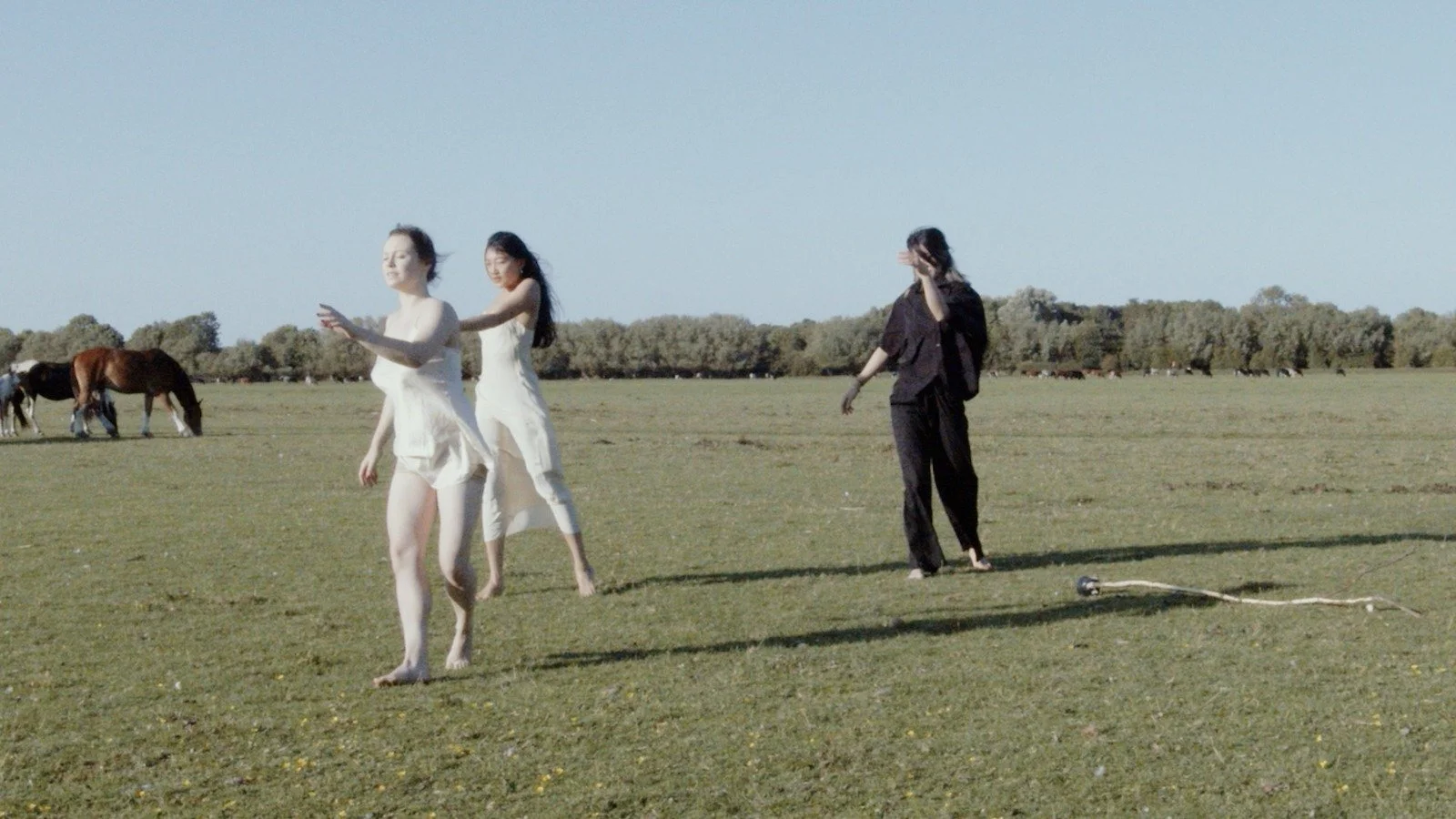
Screenshot, BEIMA: Three Scenes, Cinematography: Sarah Caterall, Ab Brightman
XL: I recently had a very similar conversation with my examiners, who were talking about the aesthetic qualities of the work that I produce. More specifically, about the setting, which is this barren kind of futuristic landscape. They wanted to know why I chose this particular style. For one, there are certain things that I pick up from my surroundings, my background and my interaction with people and things that I'm influenced by the artists that I admire, including Larissa Sansour and Saodat Ismailova. And then, I really quite enjoy this sort of barrenness. The future that I'm trying to portray is not a very optimistic one. I think a lot of the work that I do is a form of a response towards anthropocentric optimism, or towards the so-called Anthropocene opportunities, where even though the climate crisis is so bad right now, the future actually would be prosperous somehow, because with each destruction, there will be new opportunities. I feel like perhaps we don't think about the potential downside of that very well. I'm kind of borrowing this from an art critic Heather Davis. She speaks of the performative quality, or rather, the performative archive of the now. So if we're looking back, imagining ourselves looking back to this present moment, we can then examine ‘right now’ as an archive. And then drawing from a very sterile environment, where the preservation of memory can look very neat and isolated, as if it existed in a vacuum.
This is kind of the mindset that I have when I create these images—a bleak future landscape of remembrance. I'm theoretical in a way I work, but a lot of it is also just impulses. Intuitively, I do gravitate towards these rather lyrical qualities of the images. And I can't really rationalise it.
AB: It is one of the things that is tricky to get around, but I think also very important, and that is irrationality. And it is irrationality as a reasonable source of knowledge. I think that a lot of Western modernity is set up around colonial constructions of science and data and methodologies. There's always a need to respond with a why, and provide a rational answer. Why was this choice made? What was the rationale behind it? And sometimes there is one. And sometimes there's a very clear point that is trying to be made. But I also think of the presence of a kind of extra layer to that. There are these elements of irrationality that we bring that come from just being; things like, what do we think? When we come together, we improvise for 30 minutes or so, and then draw on what felt right, what felt good. And sometimes we're starting from impulse. I think when we started working, we were thinking a lot about ecological grief. And we were thinking a lot about what is a feminist way of mourning. And we went from there.
We ended up working in a very intuitive way. So I feel that the intuition and the way the aesthetics have come out, resulted a lot from this starting point, but not necessarily sticking very well to it. And then the only kind of rational bit is sort of at the end, how do we make sense of all of this, of what was coming up? ‘Oh, there was this myth, there was this reference eventually arranging everything into a story, which we later performed.’ But the whole process, I think, was very much led by the body, led by impulse. I think that method was irrational, but at the same time, the rationale is present, if that makes sense.
XL: Logically, it makes sense to us.
MZ: I agree.
PW: Personally I completely reject the idea of being led purely by rationality, accepting only one form of knowledge production. I actually think that knowledge production can happen through different things. I can wake up from a dream. And that's also a knowledge, it just hasn't been officially certified as good enough. I disagree with this model.
For me, what you do is essentially a form of female mourning, something very powerful, not only because of its history and the cultural references, but also, I think, women feel a little bit more at peace with their own bodies, even if they are being constantly altered and changed into something that's strange. This is not an easy process, though. But the attitude is different, the starting point is different. I think of what you described as if you go through the process of mourning, developing it and feeling it. You ritualize it later on, in the performance. So you first mourn. And then you mourn again, in a slightly more constructed manner.
XL: As a grief person, I think I could briefly comment on that. I'm really influenced a lot by Judith Butler. She talks about mourning, and the ritualistic aspect of it. She draws from Antigone, and how, in her mourning, her rage becomes disruptive. So I think mourning itself is performative in many ways. You do not cry for the already deceased, because they can't hear you. You essentially cry for the ones around you. And in that wailing, in that outrageous display of your own sadness, you create a gathering. Butler also talks about the gathering aspect of mourning, of everybody coming together. And I think that corresponds really well with a public performance. You really are carving out a space, where people can be temporarily emptied of themselves to sit down and watch you, and collectively, all create something that is a semblance of solidarity, maybe, at least just in that moment.
PW: There are multiple timelines layered in your practice; of developing the performance, performing, and then performing again, and later showing the documentation of the performance. In a way, they all converge. But it's also time modes within the Anthropocene. Time lines are conflicted. We don't mourn only complete extinctions and the lives that are already gone. We also mourn the ones that are pretty much gone, but still sort of going. We mourn the lives that still exist, but are marked to become extinct in the future. The idea of the future extinctions and the future ghosts is frequently discussed by Anna Lowenhaupt Tsing as presence of absence haunting the landscapes of the Anthropocene.
That's essentially what it is, really. It reminded me, again, of Salento. I met this woman who told me that when she was a kid, she witnessed one of the Mediterranean wailing women, (they were paid to wail at the funerals). That was also something that was dying out. But she did see it firsthand, and she also said something that I didn't know about, and it was quite interesting, is that she was a kid. And at that time, that was a taboo for children. You were not allowed to see it. So there was also a sense of secrecy about this very ecstatic ritual that was happening to mark a passage and loss.
MZ: I was just thinking about something. Personally, I feel like a lot of times, or, I guess, in the case of humans in general, when we experience grief, it's probably not as rounded, because it just came up in our souls. Probably because there is a conflict in our memories. We have the memory of the deceased, which we cherish a lot, and the memory of them not being there anymore. And that conflict is very hard to dissolve in our brains. As part of the ritual, we come together to grieve for that. It's a way to allow an opportunity for others to acknowledge this conflict. And acknowledgement is a very emotionally powerful tool to resolve sadness, or grief.
PW: You put the timelines back together, in a way, too.
MZ: Yes. To resolve your inner conflict. It's probably not a well-rounded conclusion.
PW: What you said made me really think. There has been so much said about grief, and the rituals of mourning. That they're supposed to be healing, being the acts of care. But I think we also should acknowledge the fact that it is a sense of abandonment that comes from pain. That you need to go through this very violent act, in order to heal, or to put the timelines back together, so to speak, as you said. To reconcile with the memory. That is in a way, a haunting.
I find it very interesting, because you do it in such a ritual way, and yet, it is something that's essentially a very powerful, and very violent process. I mean by violence in this case a movement that's a shift out of stasis. Into life.
AB: I really love what Mingyu said about just holding each other in our minds for a little while, even if we know the other is not there. I think that's what memory does for us.
XL: I also similarly don't have a conclusion. I really enjoyed the conversation. There were many points where I felt there was illumination, and to me, it's enough.
PW: There is this book that I really love, Miss Mila Feeling for Snow by Peter Hoeg. It's this 1990s murder story that is, in a way, a meditation on Danish colonialism, and it is partially set in Greenland. The main protagonist, who is this fearless and very difficult non-conformist woman, at the end is being asked by the police to summarize everything that happened. They ask her to draw a conclusion. And she says, "We draw a conclusion when we fully understand things”, in terms that we get to rationalise them in this very enlightened form. And she says: “There is no conclusion.” For her it is tragic. She finds no understandable reason for the crime and loss. But I think it's true. I think there is no conclusion. And we don’t need to always understand things.
AB: I feel like we're still at the beginning. We started working together a little over a year ago. And it's the start of a slow kind of collaboration, but we're building up practice, and we are building up a method to create with the sense of empathy, of feminist empathy, coming from our different dance disciplines and different academic disciplines. Hip hop and neuroscience, history and contemporary dance, like Butoh; with Xinyue as an artist, and a lyrical contemporary person. We look at how to bring those things together. As you said at the start, it's still very much like an ongoing conversation. And every time we meet, something different happens.
So, there's no conclusion. Yes.
XL: I'm really excited to keep working, to keep on developing this project. I feel like these two dance pieces, perhaps had a quality of initiation. I think we were trying to foreground Alice and Mingyu’s thoughts, because I really very much love to see how all of our differences can guide us in different ways rather than just having one dominating arc.
PW: Thank you very much.
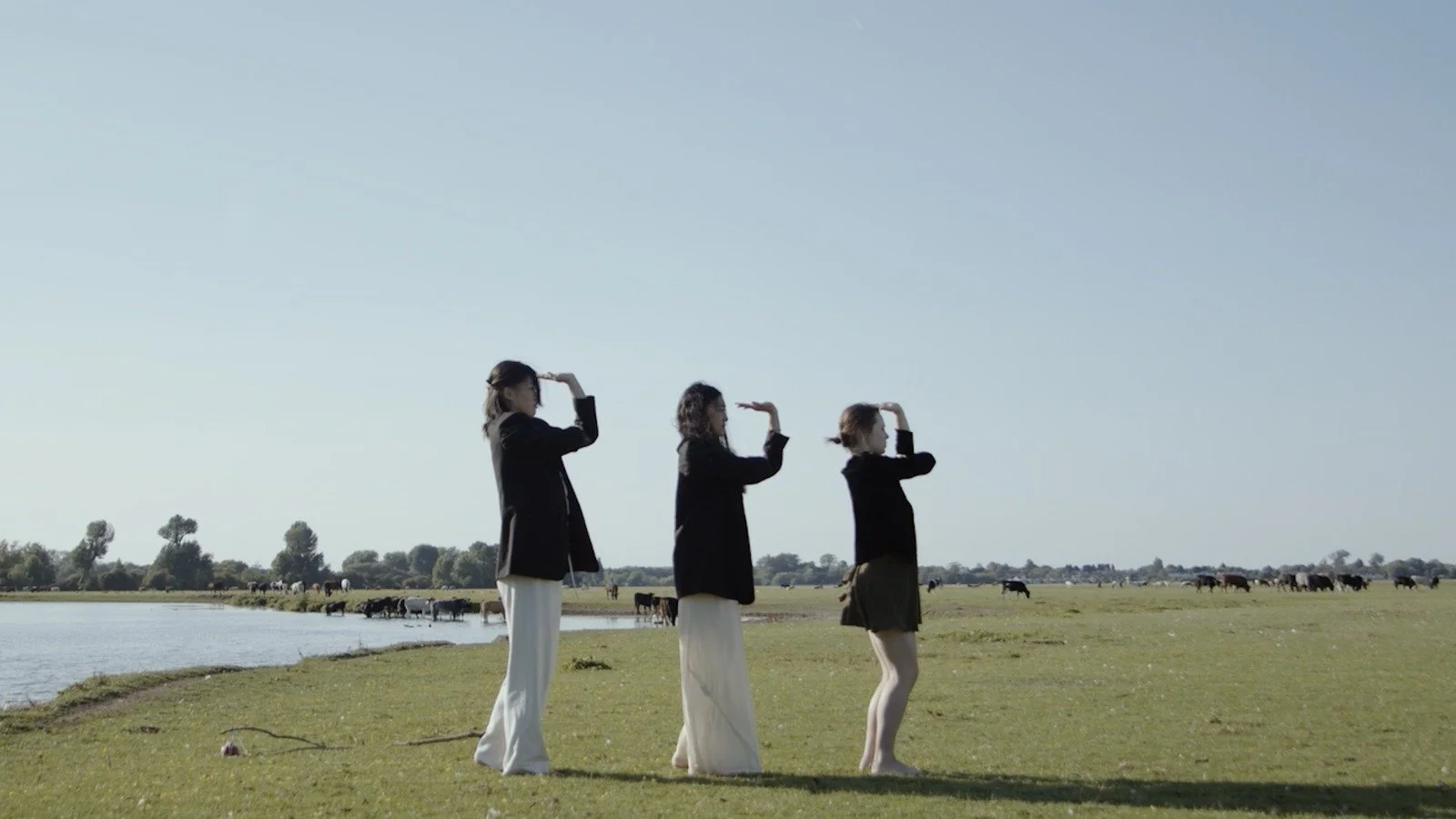
Screenshot, BEIMA: Three Scenes, Cinematography: Sarah Caterall, Ab Brightman
The interdisciplinary collective consists of three members: Dr Alice Baldock, a Junior Research Fellow in Japanese Studies, University of Oxford, whose work explores the history and embodied practice of women butoh dancers. Dr Xinyue Liu is a Research Fellow at the Glasgow School of Art, who researches ecological grief and its representation in contemporary art. DPhil candidate Mingyu Zhu is a neuroscientist studying the neural mechanisms underlying memory, generalisation, and flexible behaviour.
