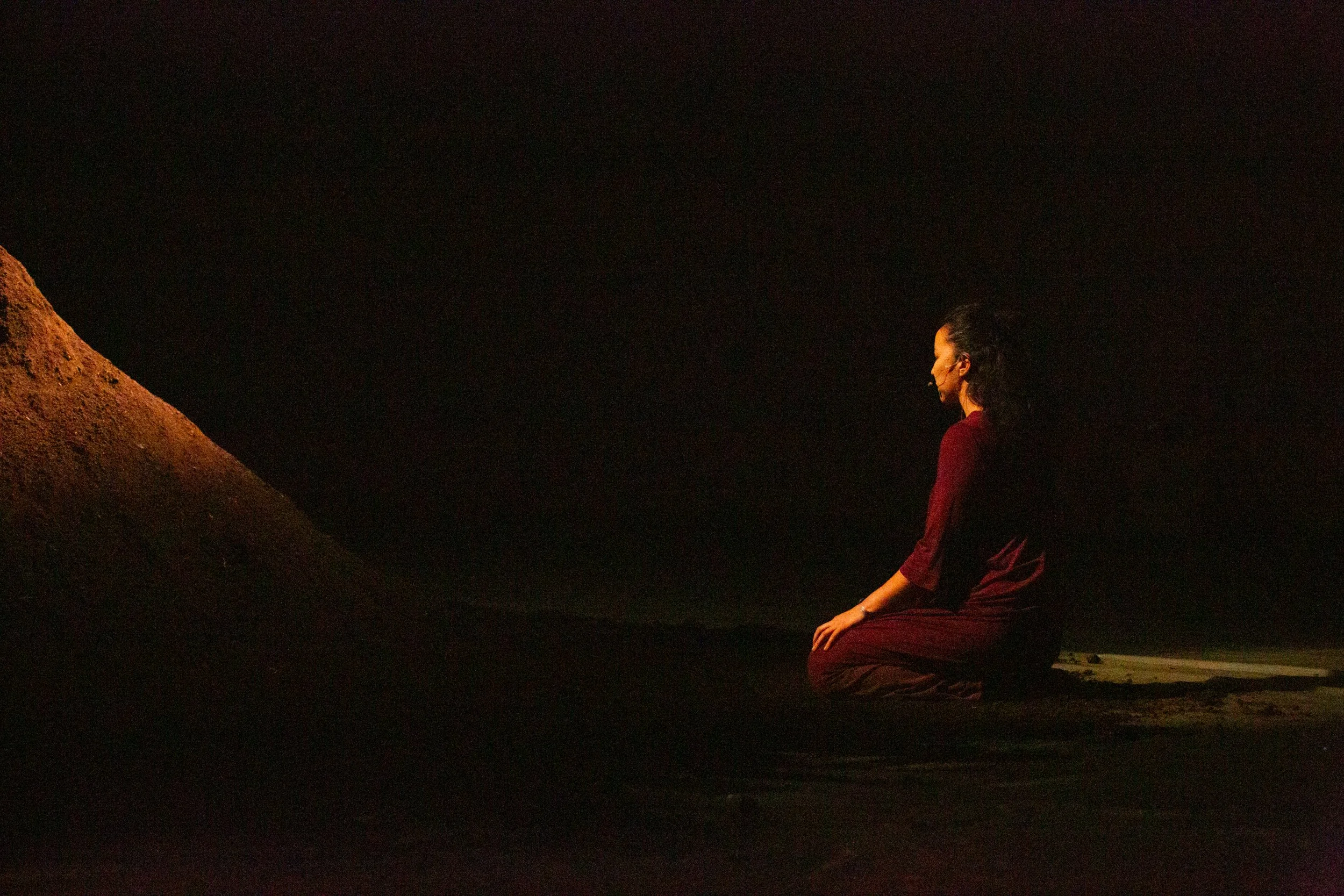
A Rite of Fallen Mountain, perfomance commissioned by the II Korkut Sonic Arts Triennale, Rites of Eternal Wind, Korkut Tselinny, Kazakhstan, 2026, Image courtesy of Korkut Tselinny.
For Jazgul Madazimowa creative practice is a ritual. She investigates loss, memory and migration, looking at them through a prism of personal experience and trauma. The artist's mother emigrated for work to Russia, like a whole generation of Kyrgyz women seeking economic relief from the consequences of USSR collapse, when the artist was 13. Driven by this absence Madazimowa reaches out to female energy. She collaborates with women reaching out, by inviting them to participate. She investigates how the female is reflected in the fabric of the natural world, and creates rituals performed by women, exploring remaining traces and residues.
Patrycja Wojciechowska :
Hi, I am very excited about our conversation. Ever since I encountered your work, I have had this impression that the essence of your practice lies in work with women, with female energy. And that your way of working encompasses different forms of collaboration. I am especially interested in this collaborative aspect of your practice in the context of work with women, and with the nature of womanhood. In some instances it is very direct, happening through participation and exchange. Other times you work with female artists as a member of a collective, for example when you made works within the Davra collective for Documenta 15 (a research group from Central Asia), at the invitation of Saodat Ismailova. Further, your work addresses motherhood, the relationship with your mother.
Collaboration and womanhood are reflected in the materials and in media you select. For example, you frequently use headscarves, like in “The scent of your memory”, work dealing with the bond between mother and daughter, and with loss. You work with mourning, lamentation, lullabies, which are again, predominantly collective female rituals. In “A Thousand Prayers”, a project at Bukhara Biennial, you invited women who lived and worked in Bukhara and at the Biennal, to initially donate their headscarves, which you subsequently passed on to other women in the city.
I wanted to ask, how do you feel about positioning yourself, and these different aspects of your practice and way of working,within the realm of female energy? How do you see collaboration in this context?
Jazgul Madazimowa:
For me this is intuitive. I have always been surrounded by women — my mother most of all. Art became my way of processing what I can't say directly.
My work with grief and loss isn't only about my mother's migration when I was young. It also carries my grandmother's absence — she died when my father was a child. During a breathwork practice in India designed to access deeper, prolonged emotions, I realized how much her death still shapes me, even though I never met her. I believe trauma passes through generations — my father witnessed his mother's death and I believe did not fully process it. I'd never cried over her loss before that session. After the breathwork practice, I imagined holding my father in his childhood, letting him finally cry on my shoulder. It was healing to me and helped to understand what memories my body carries.
The body remembers longer than the mind does — I sometimes feel an ocean of sadness inside me, something easier to express through the body than rationalizing. That's what draws me to working with women: understanding them as carriers of memory, labour, love, and unspoken experience. It starts with my mother, then reaches my grandmother, and further on — I recently learned my great-grandparents were persecuted in the Soviet Gulag, and my maternal grandmother was orphaned and married off at thirteen. I think about what happens to a body that survives that, and what gets passed to the children after. Talking about these things is hard. Art gives me room to scream, cry, write, sing, carve or simply to sit with it with intention.
I pay attention to what moves me most. My mother had to migrate to Russia to earn money — she had no higher education, so better-paid work wasn't available to her, though she always pushed us toward education and self-sufficiency so we wouldn't face the same limitations. That attention led me to the women who cleaned the Bukhara Biennial grounds before dawn, always in headscarves — the same invisible labour, just like my mother, the same fabric. Those were the women I collaborated with on the last day of the biennial, by redistributing the headscraves collected for ‘A Thousand Prayers’. My mother always wore headscarves too.
My collaboration in the Davra collective happened just as naturally. Saodat Ismailova created the collective, and working within it felt easy — she's deeply intuitive and aligned with her own feminine energy, drawing heavily from her grandmother, just as much as I do from mine from the female side of my family. That common ground made it natural to be part of Davra and create new works with the girls in it.
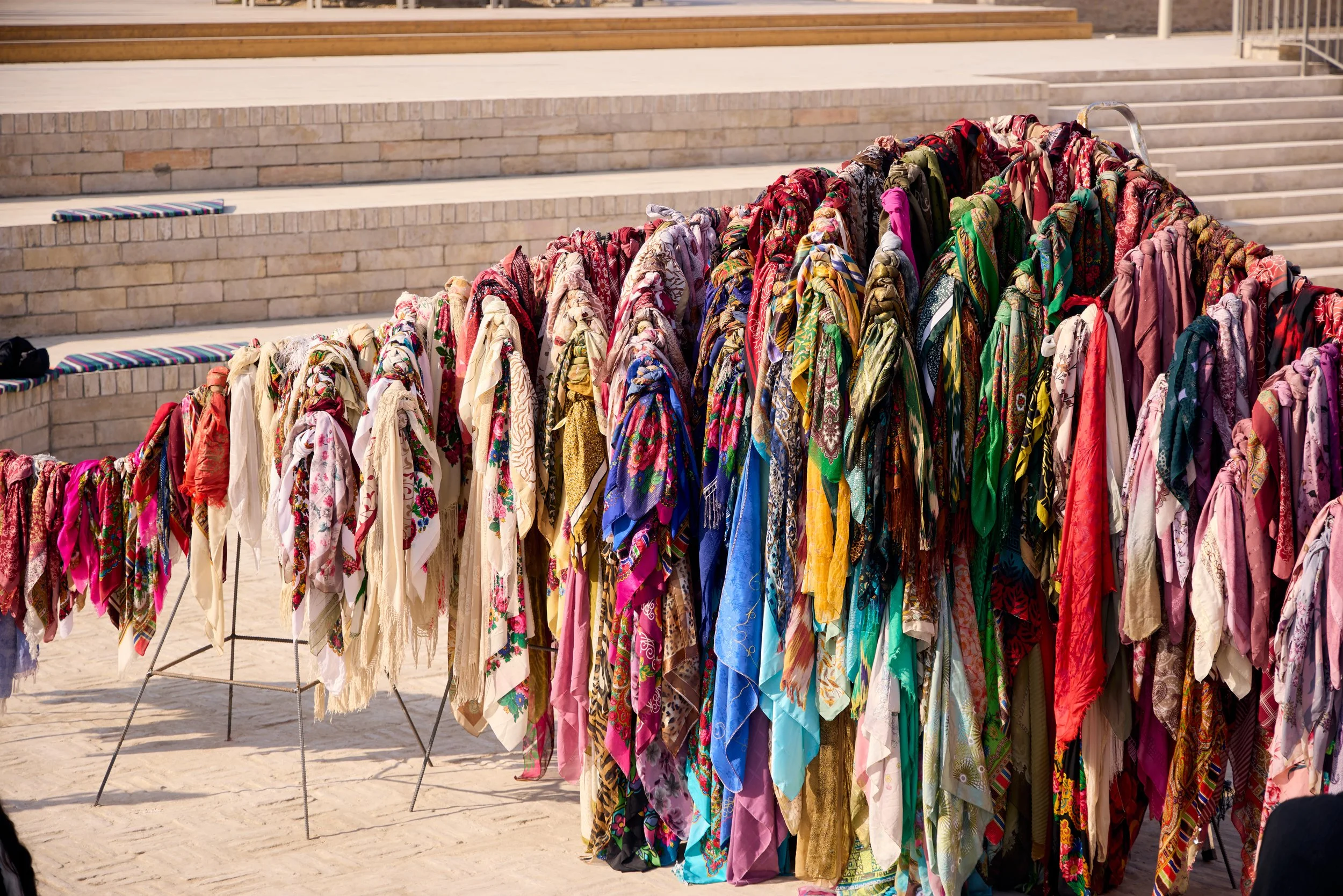
A Thousand Prayers, Bukhara Biennal, 2025, Image courtesy of ACDF ( Art and Culture Development Foundation of Uzbekistan).
PW: It's kind of funny, I remember you referring to the ‘A Thousand Prayers’ installation as an animal. When I was looking at this work, it made me think of a whale, or a dragon. I had this strange sensation like it wasn't an object. It felt alive. It was the spine of a living creature.
This leads me to my second question, and it is about the polyphony of female voices. There are many voices that reside in the work, and those voices manifest a different level of encounter with you. The vocalisation you work with is a lament, it's a lullaby, it's a hum. They manifest within waves, inside vibrations that sound creates. But there is another vibration, more spiritual, and it is a vibration of memory. When you say that the wind carries memories, or that the scarf contains them, it merely represents another wave and another sound that is metaphorical, manifested in somehow tangible manner. Almost as if you were creating a passage of voices, happening within the space that you often talk about, the space of in-between, liminal, the space that you can't speak about, and can’t express in any other way aside from unspoken, but yet it has a voice. I don't know how else to say it. And so I think about your work as a practice of of ‘sounding out.’
JM: Are we speaking about the wind being another version of sound that carries?
PW: Metaphorically speaking, yes. In terms of physics, sound is a wave. And memories come in waves.I think of it as another way to collaborate. In this instance it is collaboration with non-human, like a wind. In ‘A Thousand Prayers’ wind was the agent that dispersed the prayers. It sent all stories and memories contained within residues of lives secreted on headscarves that you locally collected, and made a main element of your work, go further and further on.’ How do you work with the Other?
JW: That's a question I hadn't fully asked myself: is collaboration something I deliberately build into my work, or something that simply happens as my projects evolve? Honestly I orient toward it without planning to. It's just how my ideas take shape.
In ‘A Thousand Prayers’, the headscarves were the core material, and working with them meant working with the women who'd actually wore them — a scarf only became a prayer once I knew it carried someone's real presence, their scent, their life. So we reached out to local women directly, and receiving each scarf from someone felt like a kind of consent: she was letting her presence become part of the work.
The headscarf itself comes from my childhood. Like all women in Kyrgyzstan, my mother wore one. When she left for work in post-Soviet Russia, her headscarf — its smell — became an extension of her presence: a symbol of her absence, but also a way to feel her close. So when I began thinking about a work inspired by Buddhist prayer flags, reclaimed headscarves came to mind immediately, rooted in that loss.
The more I sat with it, the clearer it became: this intimate object, a token of Central Asian women's domestic labour, was the right conduit for prayer — a thousand scarves for a thousand prayers, each carrying the scent of the woman who wore it, a residue of presence. That intention pulled the work naturally into collaboration — artists, local women, the everyday life of Bukhara itself became part of the piece.
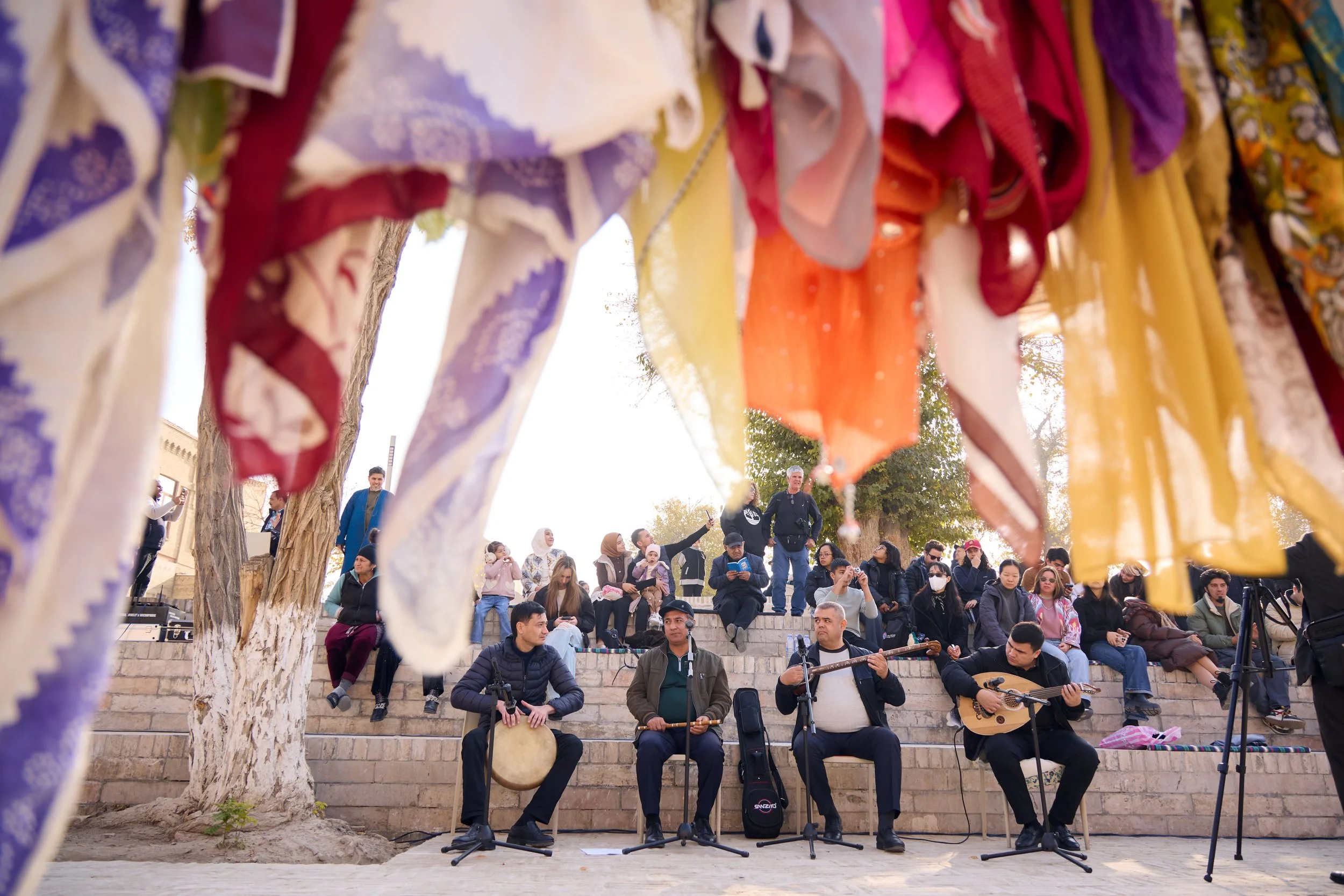
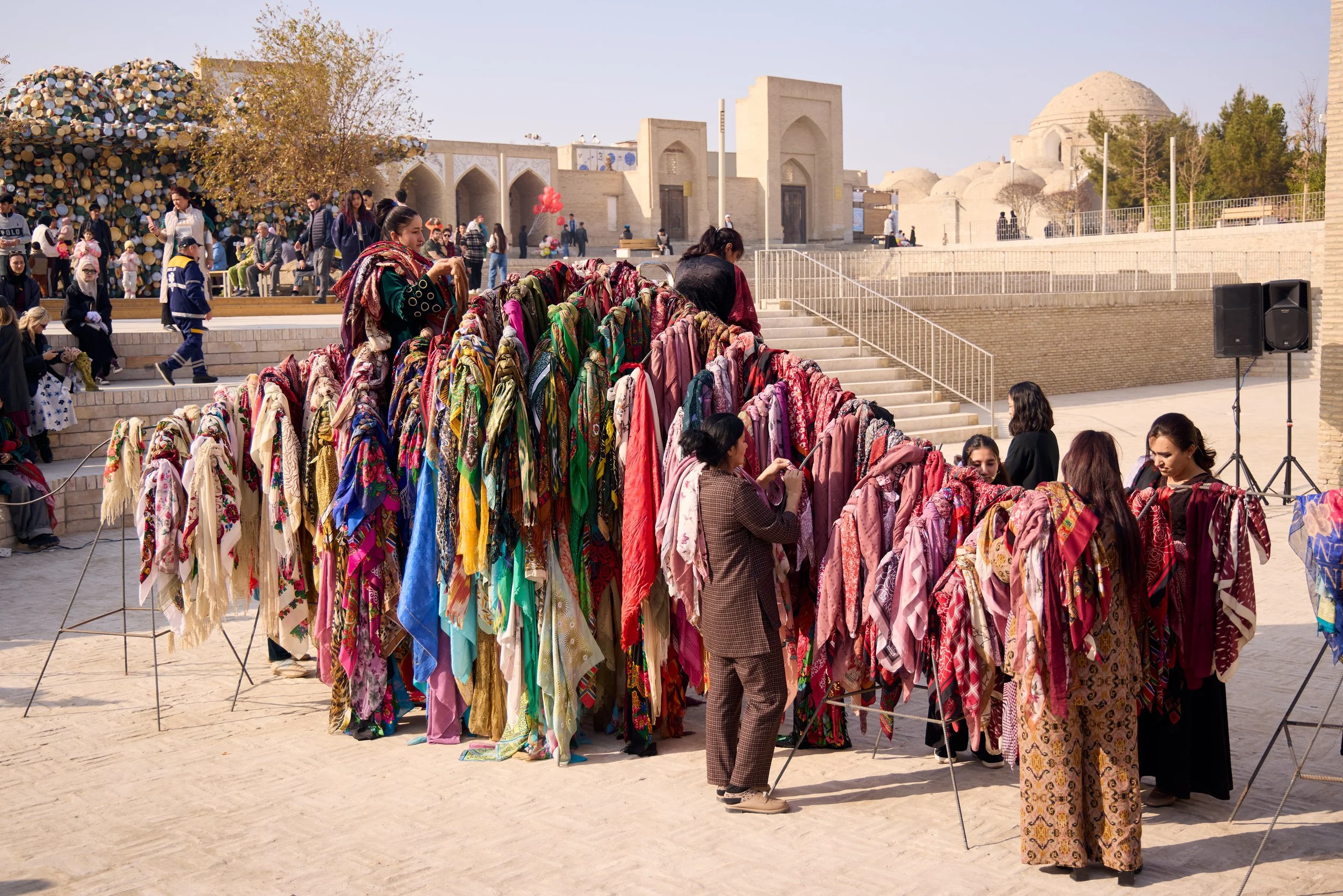
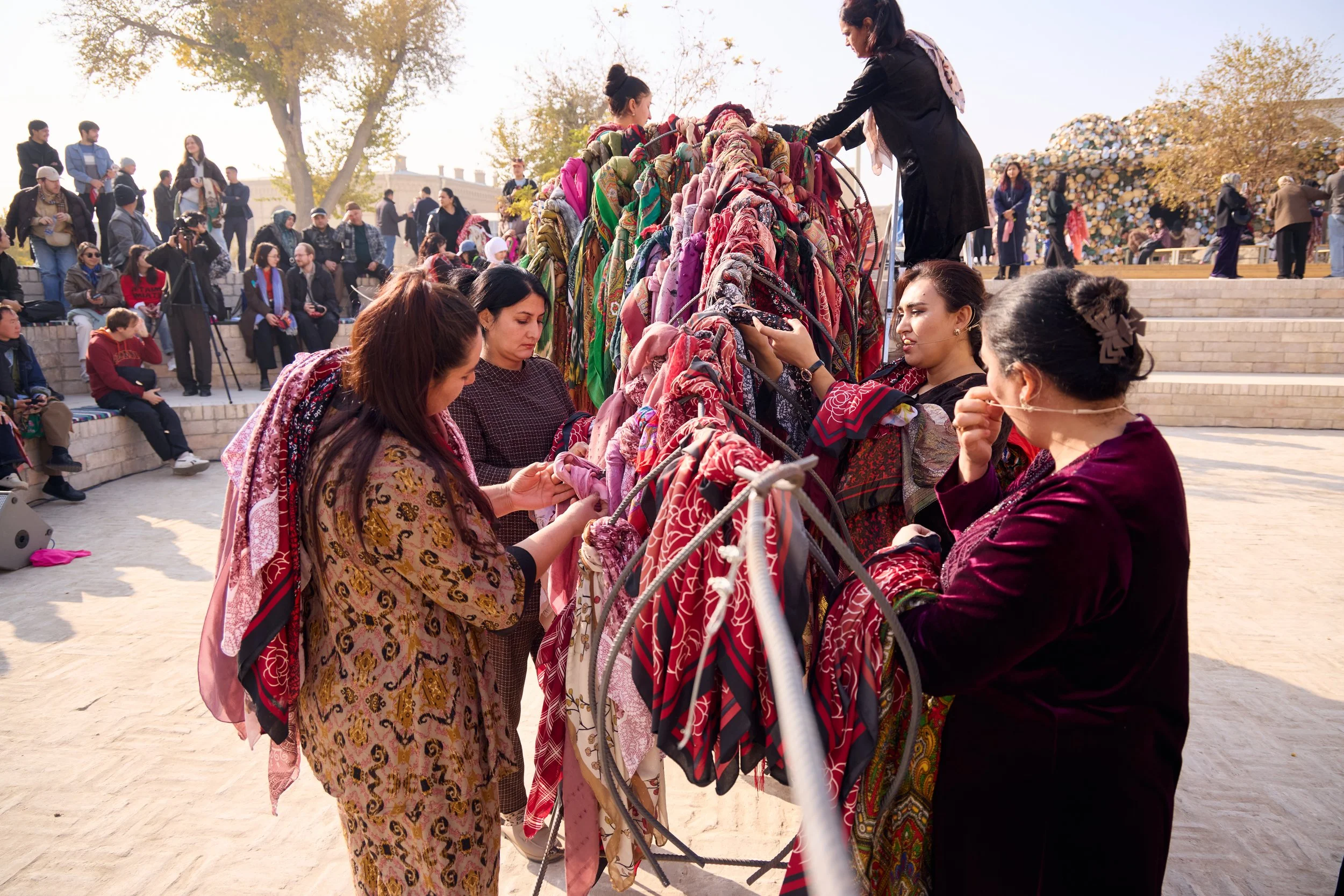
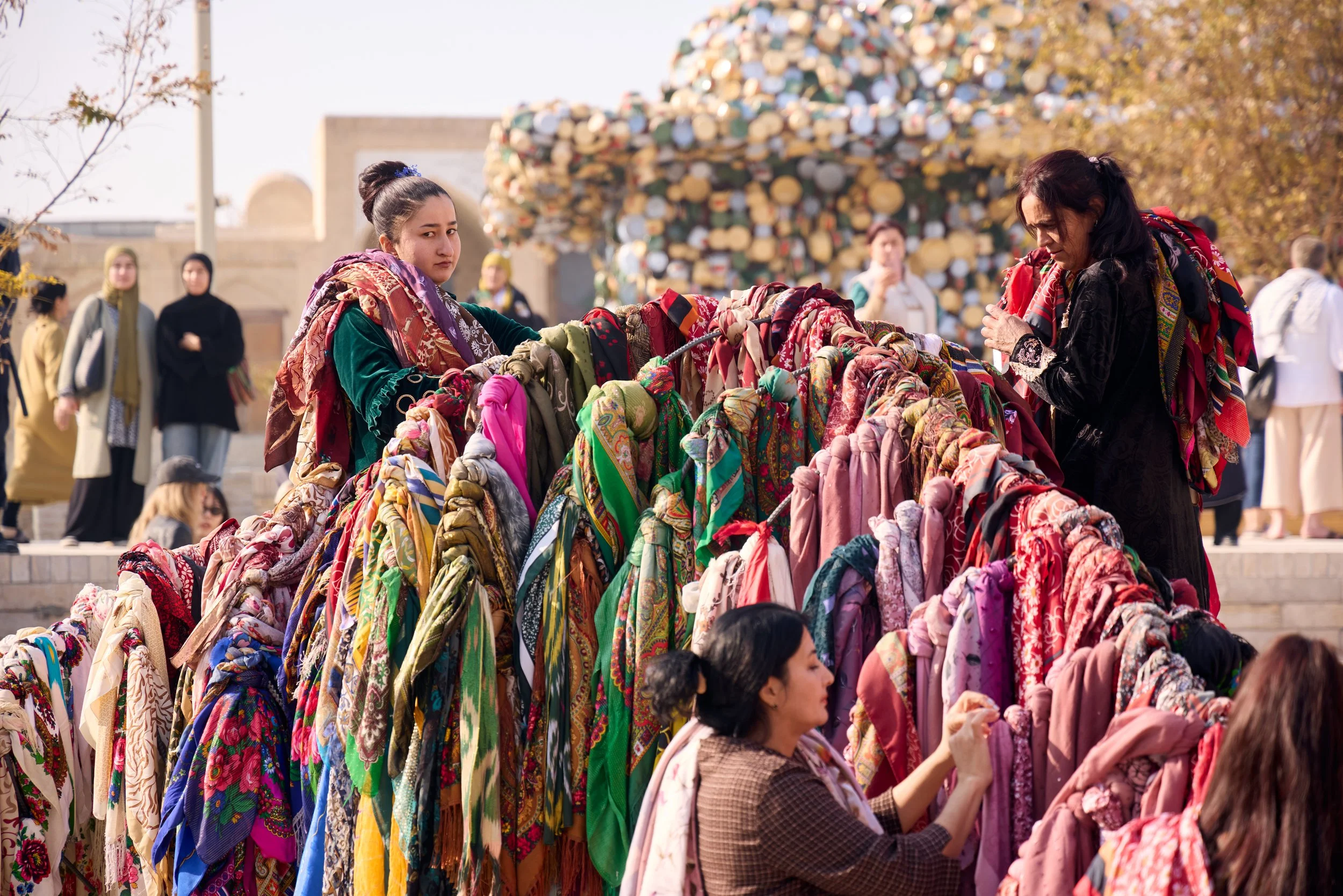
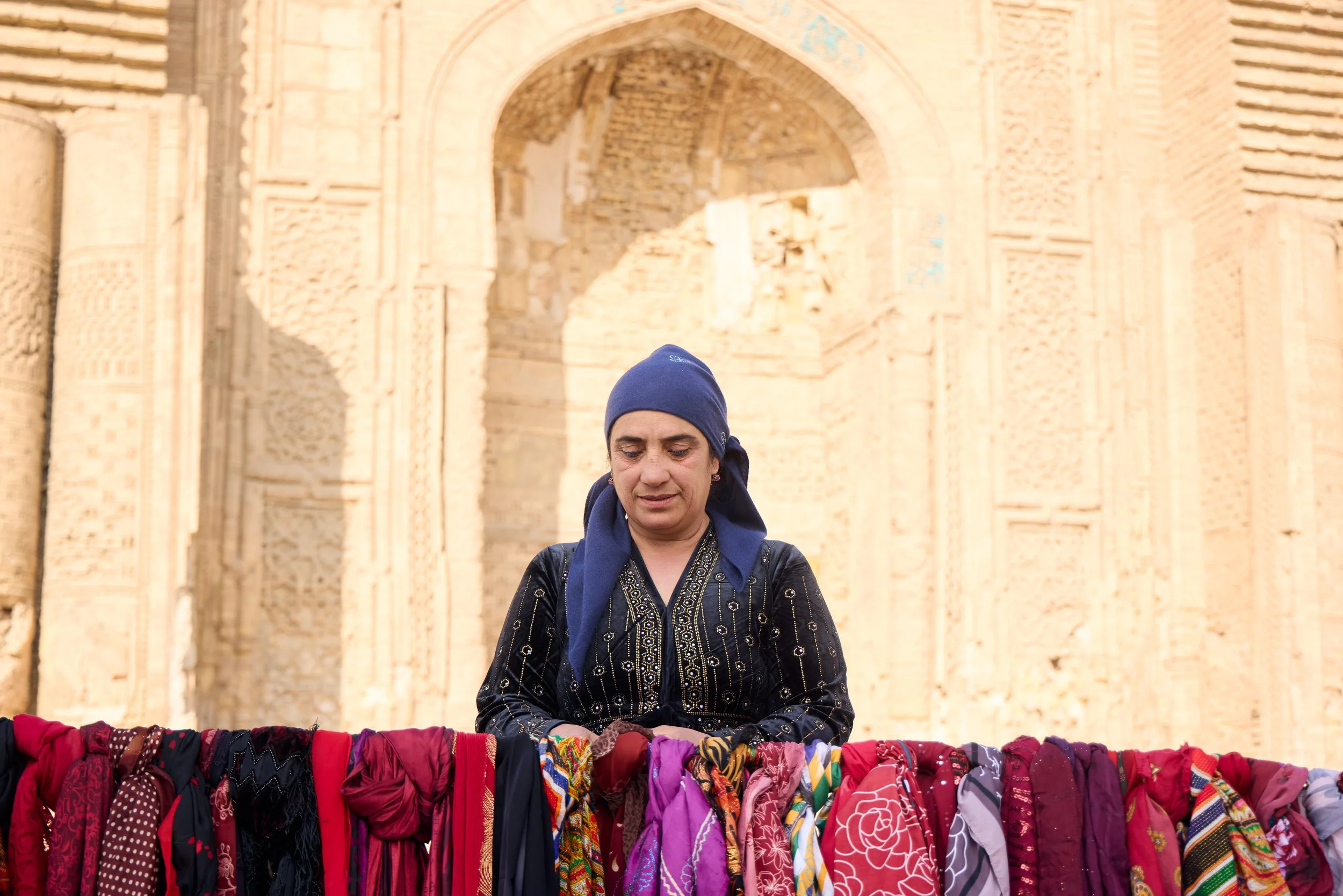
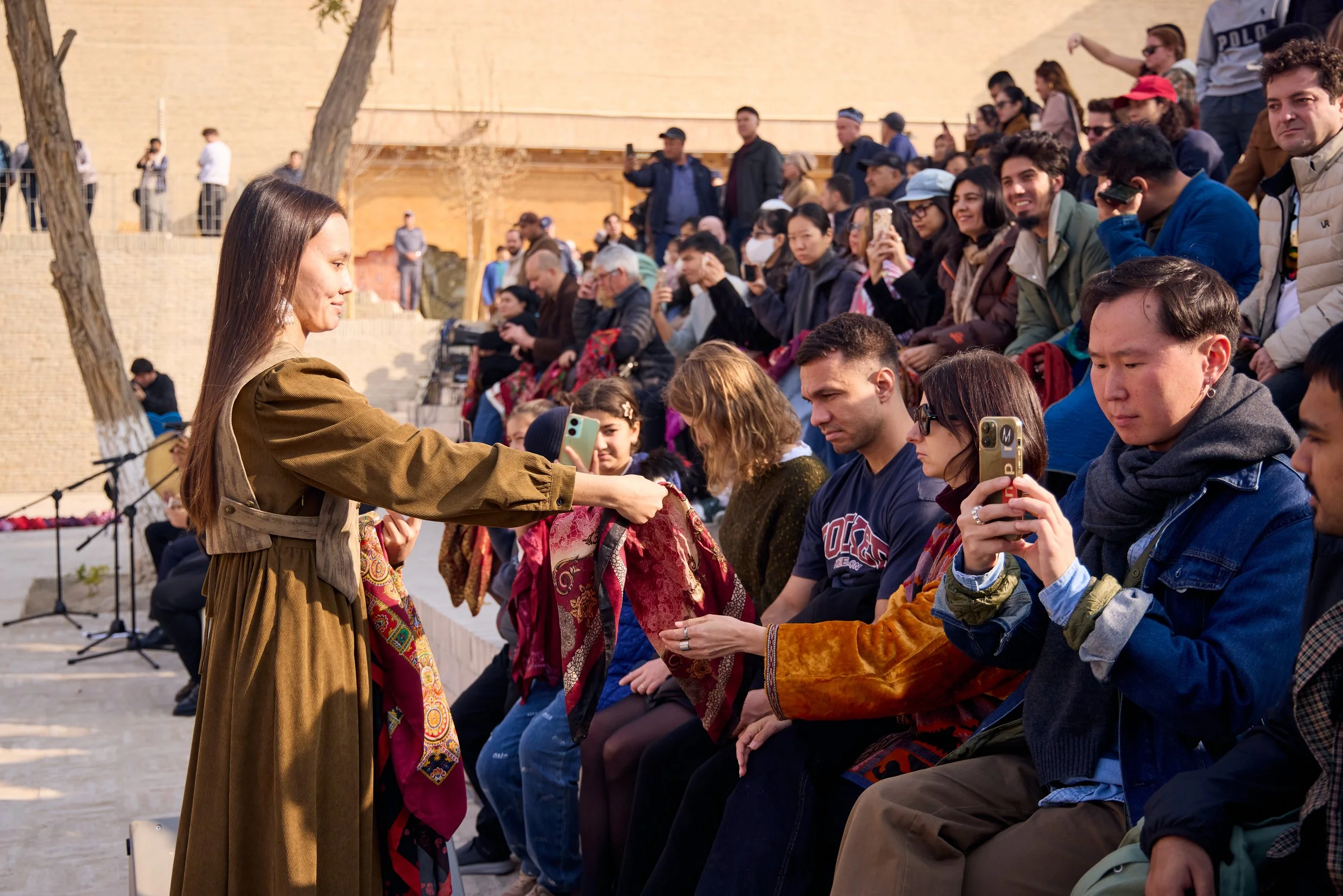
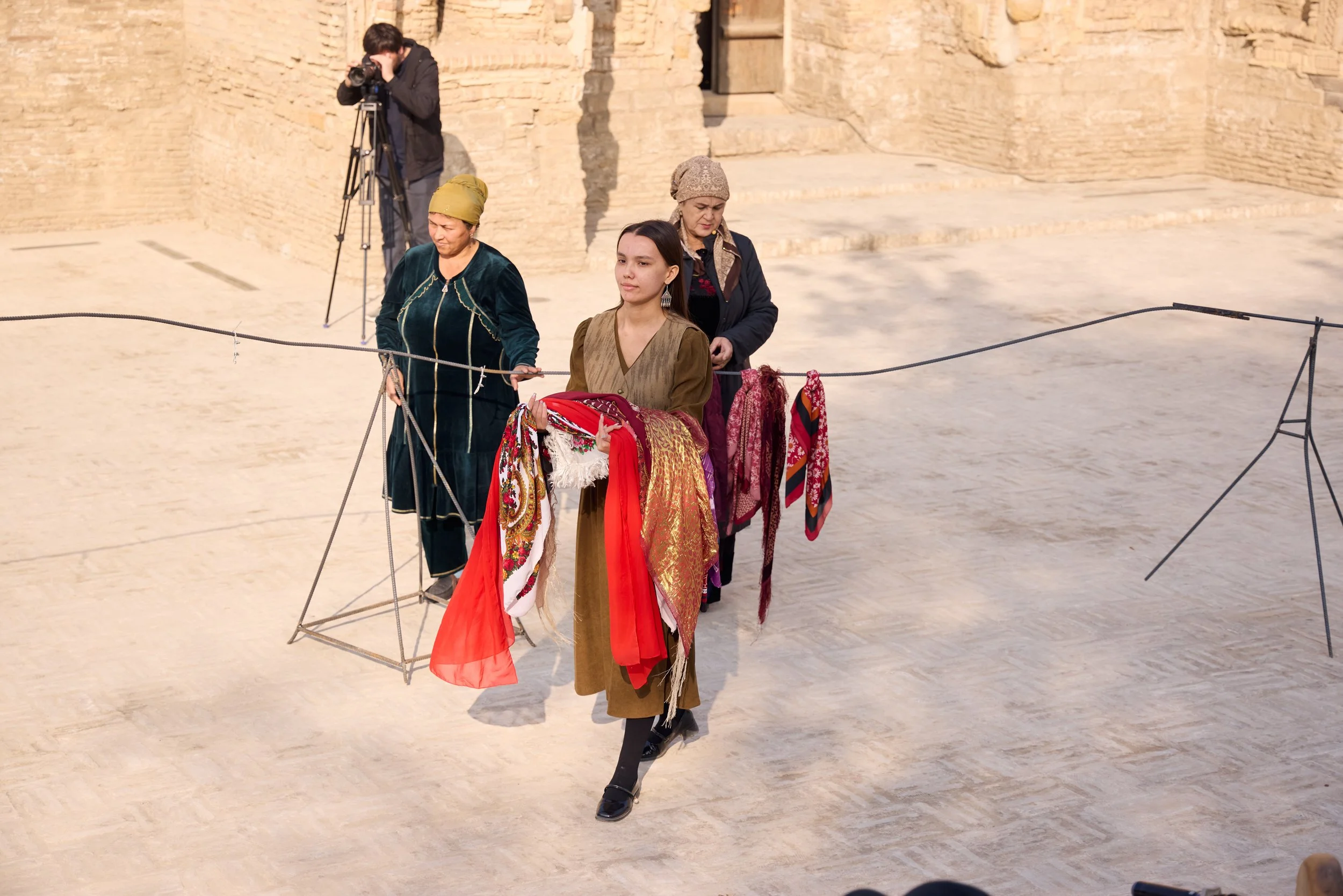
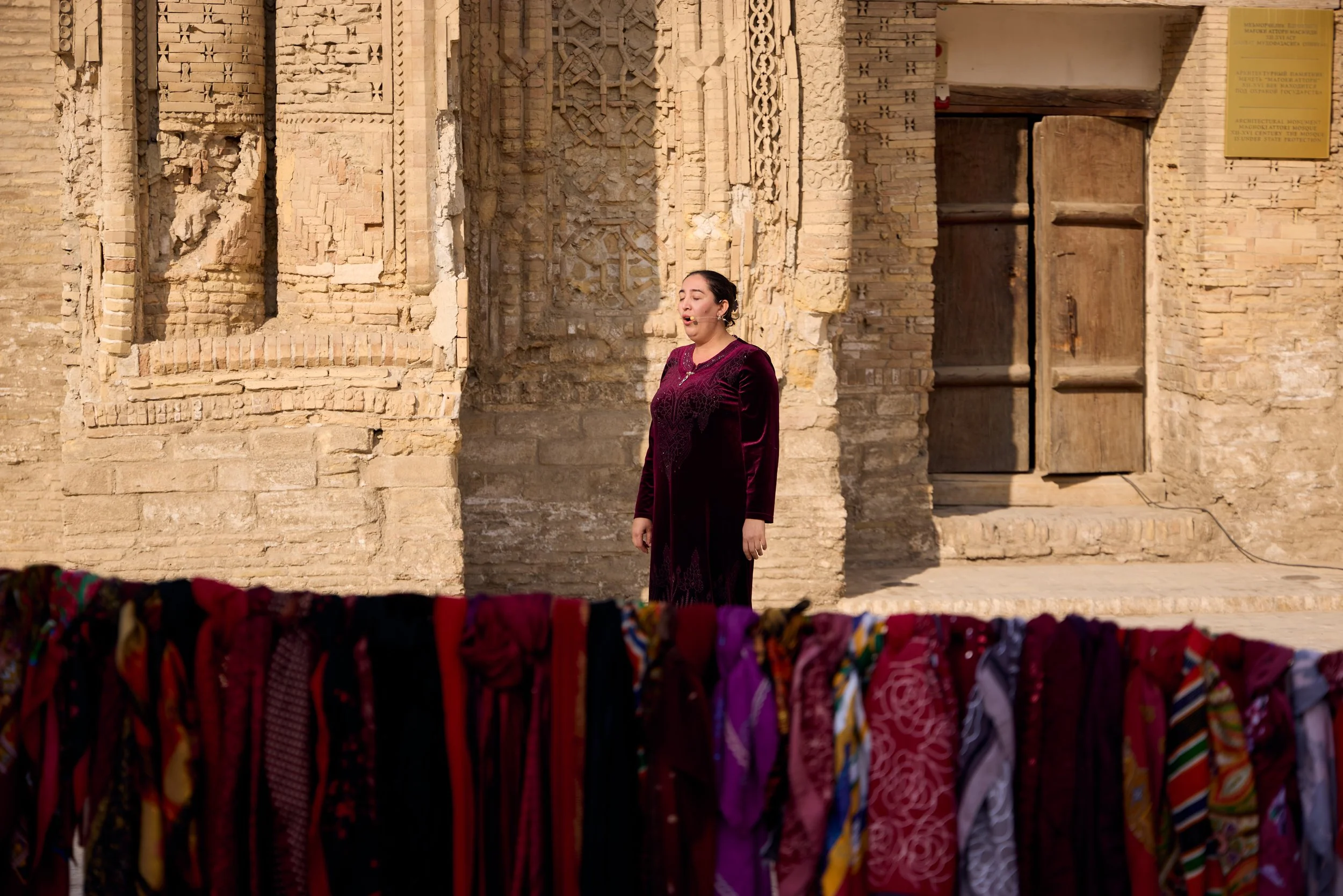
A Thousand Prayers, Bukhara Biennal, 2025, Images courtesy of ACDF ( Art and Culture Development Foundation of Uzbekistan)
PW: The traditionally imposed type of work that women do, their role within the domestic environment, the fact that they create this safe, intimate space, and that so many of the traditional activities related to home happen within gatherings; makes me believe that the practice of collaboration, of achieving goals by doing something together, is more natural for them. I think of it as a practice of nurturing.
Now, I wanted to speak about mourning and grief. We spoke about lullabies and dreams, and about a sense of ritual radiating from vocalisation of something like pain. I wanted us to speak about creating a ritual conducted by withdrawal to this solitary dark place. to talk about this space of in-between that you need in order to deal with emotional challenges. It's a stepping stone in life, in our existence. And you experiment a lot with these type of experiences in your work.
JM: I think of these rituals as attempts at healing — expressions of what's too hard to do in ordinary life. We sing lullabies before sleep, before entering that threshold between life and death, before someone (or we ourselves) crosses into something else.
Humming is part of that. It's something we do naturally, even as children — a soothing, comforting sound, made without much self-awareness. When I started using humming in my work, it wasn't a conscious decision so much as something that felt right — an attempt to create the conditions for rest, for a transformation into something else, I believe, our souls crave that reconciliation, especially when it comes to grief.
My cultural heritage points me toward doing this communally. In Kyrgyzstan, when someone dies, we sing about them — not one voice, but a circle of women, and the more voices lament, the better. Singing is expected; it's how grief is given voice, and how the person is remembered. Sound — humming, singing, lament — isn't just my instinct, it's what I was raised into. It's a necessary rite.
For a long time, the lullaby and lament felt separate to me. That changed after I saw a video on Instagram: a mother in Gaza, holding her dead infant, singing a lullaby to her. Her last embrace and her first moment of grief were the same gesture. She wasn't lamenting — she was helping her child to sleep, a sleep that would last forever. This story collapsed the distance I'd assumed existed between a lullaby and a lament. That wasn't a concept I arrived at — it was something I felt, watching her.
In the end, this all comes from my culture, my mother, and the women around me who grieve by performing what their souls need in order to heal. It's bound up with female identity and motherhood — giving voice to what those states carry.
PW: Personally I feel that death and sleep are really not that distant from one another. Both of them are, in a sense, places of somewhere else, somewhere that you move to, another realm. The difference lies in the fact that sleep is of a shorter temporality, running in a rhythm. Death, well, that depends on what you believe in. But I think deep down, it's the experience of leaving the hard reality behind.
This brings me to two notions, which constitute my third question, and those are: memory and weaving. Just before our talk today, I was sitting at my desk and looking out of the window with a spider web across it. A spider has been living there for some time. I actually checked images online and it looks like it's a female. And she was weaving her web this morning. I was looking at her because it was absolutely beautiful, the intricacy of the design, and the spider at work. Now the web is perfect and finished. She was putting so much work into it. This brings me to the beauty of an act of weaving. You braid hair, you weave things and situations. You work with fabric (a product of weaving itself), you tie knots, you tie things together. Weaving is a metaphor for how stories live. The story is like a thread. And the memory itself is also a thread. It's a line that you follow, it gets tied into knots, or it weaves together, it entangles. Sometimes, it even snaps.
Finally, there is the memory of the body, traces and residues, material and metaphoric. I have been thinking of the way the fabric holds a part of a person, keeping traces of contact, archiving the presence. A headscarf holds the memory of the body like an embrace. Binding things forever. Like in a spell. How do you feel about these instances when work evolves through an act of braiding or knotting things together?
JM: I did not come to art through studying it at a university — I learned it through lived experience. My materials and methods came directly from what surrounded me in life. My first material was offcuts from a garment factory — waste fabric I had access to and started working with. That same process eventually led me to my mother's headscarf.
That pain, tied to whatever materials were around me, is what pushed me to make art — a way to give the feeling a form. I cry a lot while making art. I don't know the rules of composition — I only know what my intuition tells me to express.
So braiding, and seeking a form through braiding, is something my hands already knew how to do. The first artwork I ever did was braiding a textile in the sculpture “Mons Pubis Veneris”. This practice soothes me, as an intimate, nurturing process - my mother used to braid my hair everyday, later I used to braid my sister’s hair everyday. It is a practice women have been doing for centuries - tying, twisting, braiding. It is a creative expression that may have come out of domestic needs, but then turned into a language of beauty. Women used to communicate about their marriage or social status through their braided hair, but also it was their individual expression of beauty.
In ‘Mons Pubis Veneris’ I braided textile and sculpted a form of a female pubic hair. The twisting element felt right in this work, because it is often an object of shame and control.
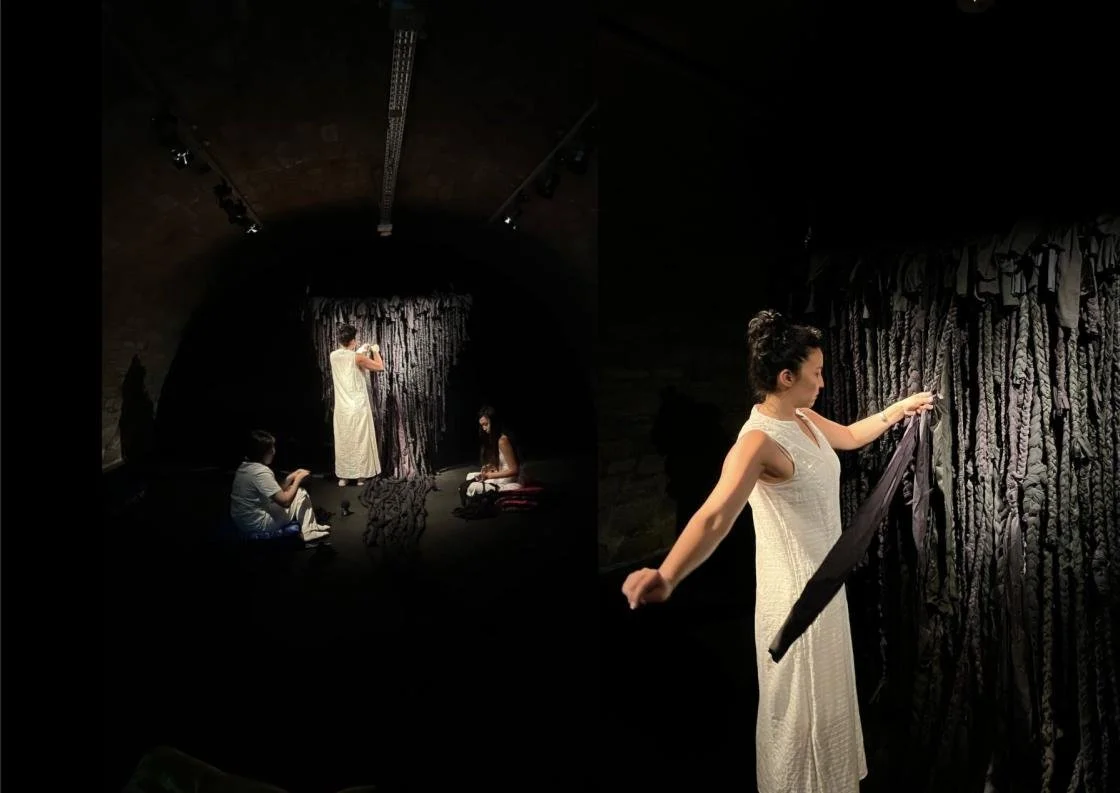
Mons Pubis Veneris, produced with Davra Collective at the invitation by Saodat Ismailova for Documenta 15, 2022. Image courtesy of the artist.
PW: In ancient Greek mythology, there are 3 rivers that surround Hades, the Greek Underworld. One of them is Lethe, the River of Forgetfulness. Once the soul drank from that river, they forget their life on earth. It makes me think that what it really means is that the memory, and the stories themselves, don't belong to the dead. They belong to the living. It's a remnant that we have kept for ourselves. As long as we have the memory of the story, it lives.
I wanted to discuss ‘Mons Pubis Venerus’. The reason I liked it so much, was that before anything else, it was a little bit grotesque, silly. This endlessly long, abundant, serpentine pubic hair that you braided in this cavern-like space. It touches on the idea how the very essence of femininity is always considered just a little bit monstrous, just a little bit grotesque. I thought about how it is a bit silly, and a little bit scary in the way it spreads and weaves, in the way it becomes this gigantic creature, something that is not exactly alive, but neither it is inanimate. You make it your own, and you braid your own monster. It became this physical network that to me was like a manifesto of appreciation for what the female body is, and at the same time it addressed the way the male gaze sees the female body. You help this creature to manifest. Something that is out of norm, that is expected to be tamed, domesticated, but refuses to be so, and it takes place in the spot that is like a lair.
JM: I agree, especially on the darker side of what you said. This is the reason why I was very happy that ‘Mons Pubis Veneris’ was exhibited underground, in the basement of a museum. It was reminiscent, or perhaps it turns it into something of a root, something that is living in the dark, underneath the surface. Like a witch. Something that comes from our true nature.
PW: Some of your work is dark, in some other place, down below where the protagonist fights for the possibility to live and be the way they want.
JM: In my mind it had to do with an archetype of wise women, the stories about witches. Why was this concept created? Why was this persona vilified? And why did society try to get rid of witches with such determination? I think the reason lies in the inner power and knowledge. They were too strong. They were too powerful to be controlled.
PW: The feminine knowledge, right?
JM: Yes, the feminine knowledge. It's very earthy. The Earth is like that too. The reason why it ties us to roots is because it's Nature. Nature is fertile. It's powerful. It's like water. It's also like rock. It's like the ocean. We got a lot of it in us. The feminine energy reminds me a lot of the Earth, how it is rooted in the order of the universe. I feel it's very much related to how we are rooted, naturally, in the earth.
PW: Remember when we spoke before about the sky? This is what drove me to your work to begin with, your work on the Nebula project. When you spoke about Nebula, to me, the idea that you had proposed a practice where a cosmos, an entire universe began and ended within a woman's body, was mesmerising. The claim that, in a sense, we are the universe, that we are the sky. And then you said that before the Islamization of Kyrgyzstan, shamanistic religion dominated the country and the sky was a God.
It makes me think of the divine sky, with Nebula being the last burst, the last explosion of beauty, before the star collapses onto itself and dies, becoming a black hole, a dark space, where time ends in the event horizon.
I also mentioned reading Carlo Rovelli's book about white holes, celestial bodies beyond black holes, places where time bounces back. To me, it relates to this moment where you go to a dark place with the help of your work, but also when you emerge from it. What happens creating that moment when time bounces back, where the memory is recovered, and someone's presence is recovered, but not necessarily the same, maybe in a different way, yet still bounced back. As if the universe was returning to a different, or rather not-exactly-the-same balance.
JM: I think ‘Nebula’ was born out of dreaming, and was worked on as a dream, but also out of being amazed. It's just so amazing how the universe works.
I used to collect traces of menstruation blood left on pieces of textile. The shapes of stains immediately reminded me of stars, Nebulae and cosmic elements. I was in the stage of life, when I was trying to decide on whether I would like to have a child, thinking about all those cycles happening in my body. There's always a period of time, when women think about these matters; “Should I and or should I not?”. I was very much in touch with my female body, and, for me, it is a very beautiful place. It is miraculous that these cycles happen. And we're not the only ones who go through cyclic existence. It's also the universe that works in cycles. When the star grows old, and just like our sun, it eventually dies, one day it explodes and becomes a nebula. And its death creates a new life after a while.
It's an ingrained part of the universe where the cycles that repeat in me, repeat in the immense body of the living. I knew that something that was considered as ugly, often culturally deemed unclean, was one of the most beautiful things that this universe lives by. Because of it, the universe can keep going. It wants to keep existing for an eternity so much that even though you die, death becomes a hope for another life, like nebula.
PW: There is a theory, the majority of the astrophysicists reject it, but still, there is a theory that the universe itself is sentient, that it's an aware being. I find this concept incredibly beautiful, the idea that the entirety of everything that exists has mind and awareness. When I think about you and the ‘Nebula’, it's as if one being that is the Other, reflected another being that was also the Other, and a little bit monstrous, and then, these two different minds somehow meet at the point of expiration, but also at the point of the upcoming new emergence, a new life that's going to rise from it, different, but also the same.
JM: We naturally tend to seek for something hopeful. I was very touched by a young mother losing her child in Gaza. There was nothing she could do. That brought me to wonder what the nature of death was. Why is it so hurtful and why does it happen? What then is the point of giving birth?
We think about these things, when we come across something bigger than us, something that hits us so hard. For me it originates in an experience of grief, painful experiences in my life, or seeing someone's pain. That makes me wonder: What is our relationship with death? What is the nature of the bigger cycle? The death of a celestial body gives birth to a new star. I think a lot of the answers that science cannot provide, can be answered by our own nature.
PW: You work with the body in a metaphorical sense, but also in a very direct way. For example the use of traces of contact, skin, fragrance, sweat and so on. In the same way, when you braid the metaphoric pubic hair, the physical action refers to the female body, to the pudenda. You preserve the menstruation pattern containing blood. It doesn't matter that you present them in the form of scans later. It all started somewhere visceral. In ‘Koshok’ (traditional Kyrgyz lamentation songs), you work with the markers of boundaries that refer to the body both metaphorically and in a very direct way. The fences in your series of drawings “Rabitza” mark boundaries of how far our bodies can safely go. They mark boundaries of our intimate domestic space. Beyond that, it’s wilderness and danger. The fence marks a field of inhabited zone, the zone of someone's presence. In this context, I wanted to ask you about the way you work with the body? How do you see it?
JM: The fence begins with the question of where does home start, and where does it end. Spending time around the fences, wondering about them, relates to the notion of arriving at the point where the departure begins. On one hand, departure feels very sad. But also it feels as the place where new things begin. You depart someplace that is safe. You leave a nest. And then something else starts, a journey, or a war, or a migration. Where does that departure really begin? For me, it starts from where the home ends. Or in a place of boundary marking the safe territory. Thinking of departures led me to the notion of journeys and beginnings.
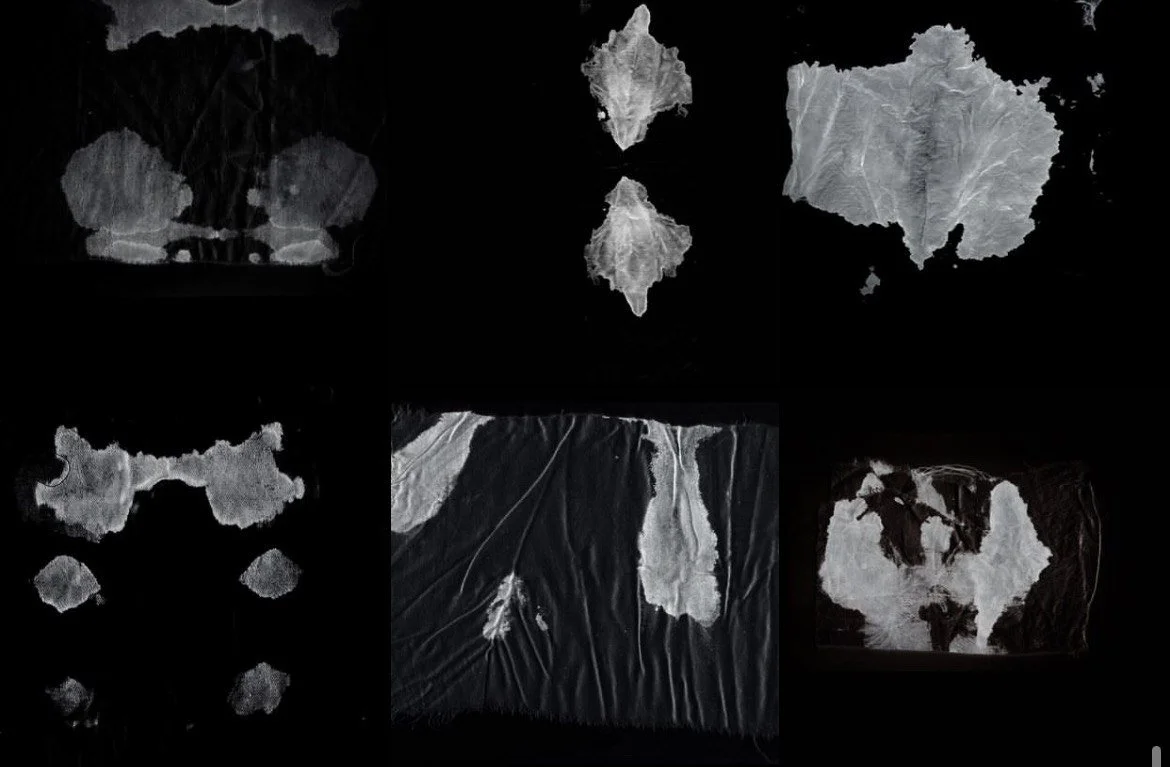
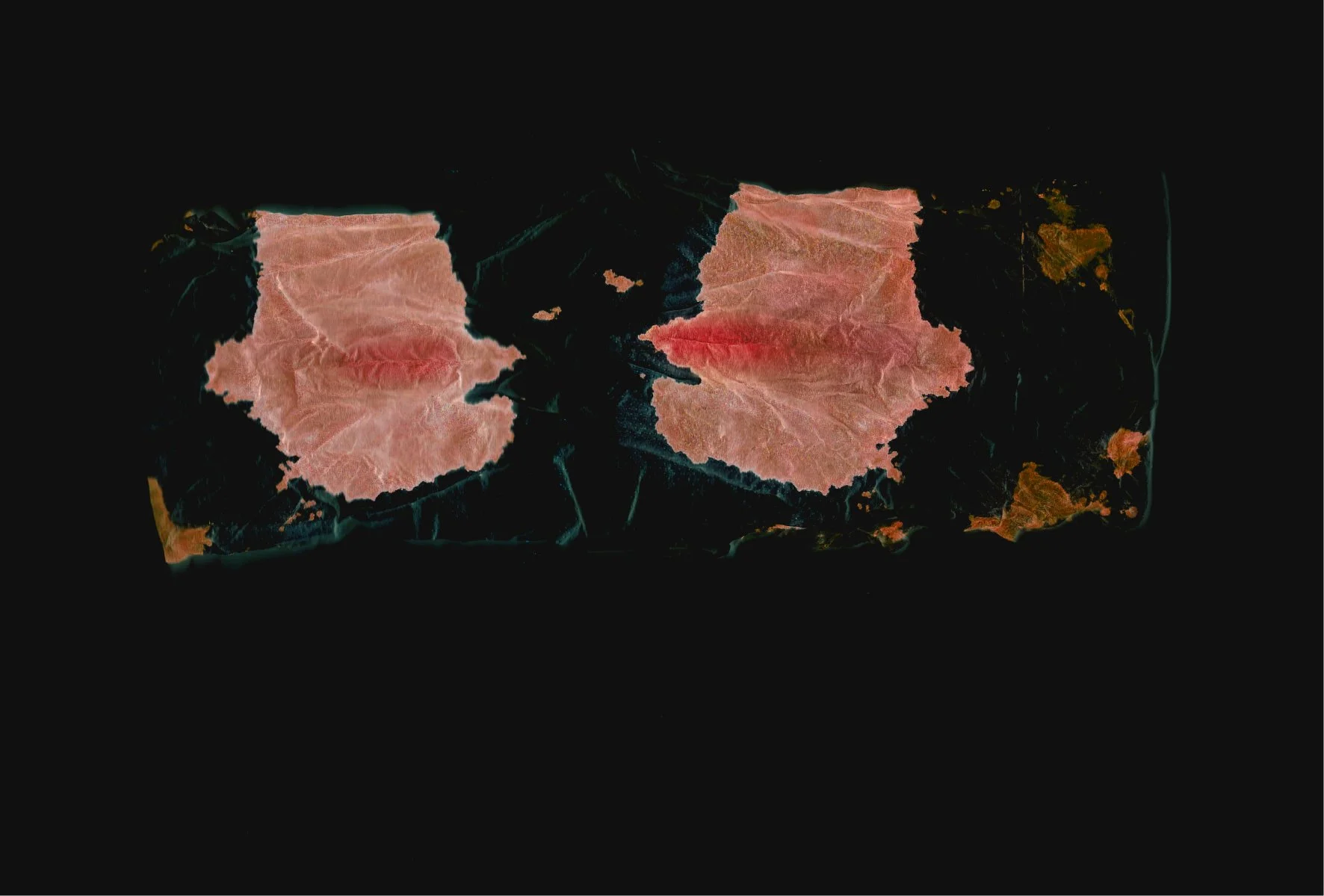
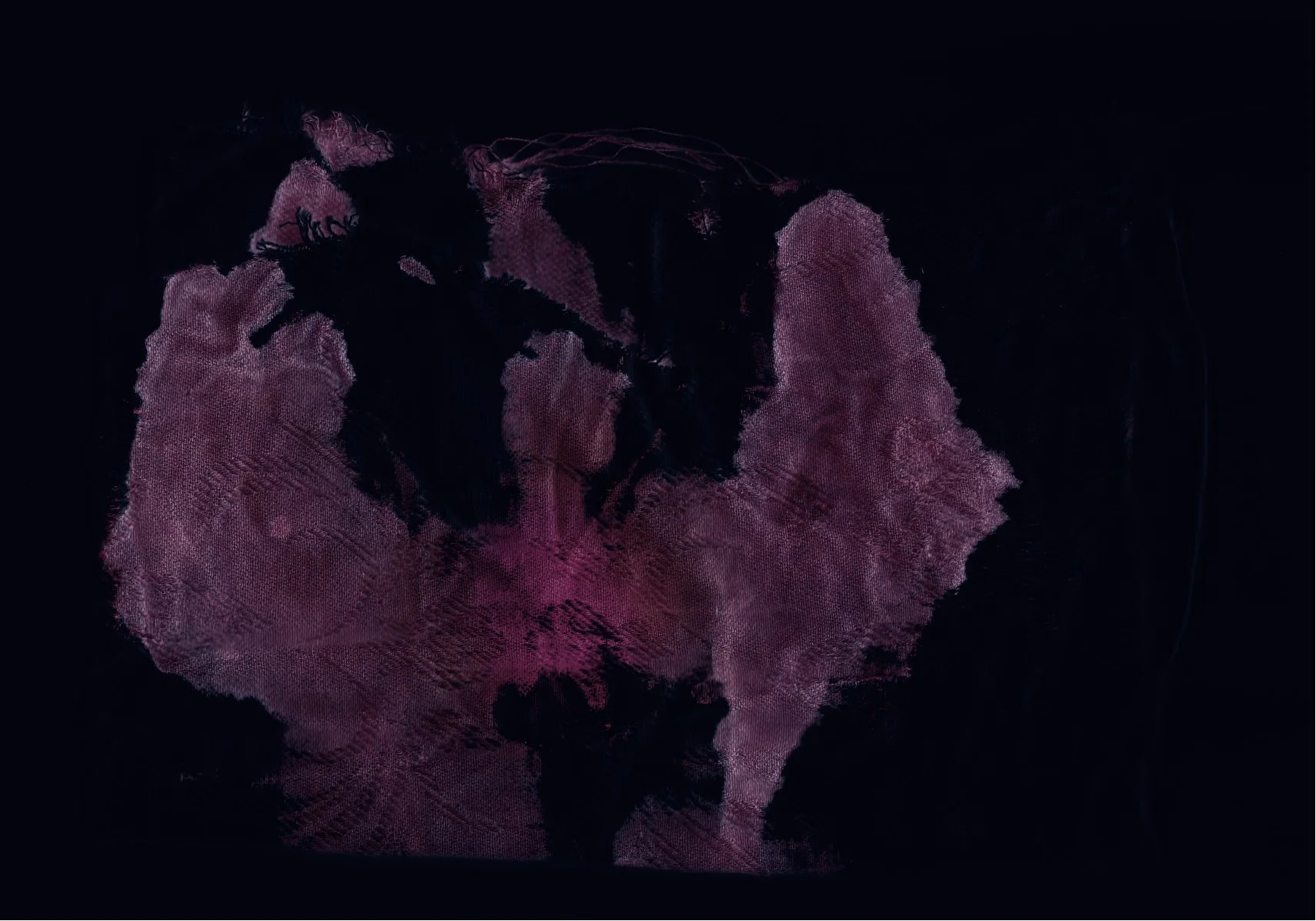
Nebula, ongoing research. Image courtesy of the artist.
Later, I realised that home can be outside of a physical home too. Can a home be a road itself? Or a journey, a process? If we change home to a road, home itself becomes temporality. That impermanence is interesting to me. It means that you never have to truly leave something, or someplace. You can always be on the road, always in the field. You're in transition. Living in a temporary house. And you learn to become comfortable being at home that is a place out of your home. The concept of home changes into something momentary, whether it's a hotel, or a rental, or a spot under a tree, or a field, or a mountain.
PW: When you smell your mother's headscarf, a scent is a reminder of the sense of safety that comes from the reminiscence of her presence. It's sort of the same thing. How the body needs a lair to be safe in the same way as the psyche needs it.
Lastly, I wanted to touch on a few things we previously spoke about and which I thought were really beautiful. For example, during discussing your participation in Bukhara Biennial, you mentioned that the project ‘A Thousand Prayers' was inspired by the Tibetan prayer flags, and you mentioned the relevance of women wearing headscarves during performing domestic work tasks. I think the act of giving back used scarves was like a marker. As if you took them only for a short time, for safekeeping. You were giving them back to other women. You returned them and simultaneously, you passed them on.
JM: The key element of that artwork was circulation of what you took from the local community. It involved trust. Why should they give you their headscarf in the first place? Headscarves are precious to Central Asian women. It's part of their self-image. From the day they get married until they die, they wear them. So why would they give them to me?
When we create art with, in or about a community,trust is important. You talk to people, tell them your story, and they can relate to it, like in the case of ‘A Thousand Prayers’. I think art starts with describing the underlying explaining intention. How you share your story and reasoning why, are important. That conversation itself, approaching the community and listening to what people have to say, and then believing they will trust you with their story and their belongings, is an important part of the work. In Bukhara it felt like it was possible. The women could feel the energy of the work, sense that the work was going to be about them. The story itself was creating trust between us. It was about how we create the prayer, and how we send the prayer further to the bigger world.
In this work, a lot lies in collaboration. Collaboration, which in essence, is trust and communication, a seemingly continuous exchange, back and forth. We took the headscarves, put them all together into one installation, keeping it as one work for a period of time, and later put it apart and gave it back to the community. It came from people and it circled back to the people. That circulation itself created foundations for the work and how it unfolded over time.
It honoured the community itself more than the actual sculpture. The piece disappeared, just like that, within one hour. Despite how big it was, it went back to the people just like the Tibetan prayer flags. They come from a very generous intention - to send people prayers. We wanted to hang the assembled piece and let the wind deliver an incorporeal message to people.
Art should be something we enter with intention. People can sense the soul of a work. The women who performed at the end were the local residents. Untying and tying headscarves is something they do everyday. There was also a song. The women were singing, and they were thrilled. I said, “Please come dressed the way you feel the most comfortable.” They came in beautiful dresses. The closing performance was an event that was about them.
The work itself brought me to the point I had not fully realised at the time. It was the experience of stepping back as an artist and letting things unfold naturally. I did not take part in the performance itself. I designed the process. I created the set of rules. Once I completed the outlines of the process, I took a step back and watched the process as an audience. The circular character of the work was the whole point. By giving someone your headscarf, you were giving your presence and your memory, your experience.
PW: All these elements tied the work together making it a process. Different experiences and memories, collected pieces of fabric creating this animal-like beast floating in the city. The wind carrying memories, dreams and stories further, and further away. It was like a song, sung by many different voices. All these dreams, memories and wishes dispersed in the air. It reminded me not only of the whale we spoke of, but also a dragon, and at the time we were laughing at that. I think it's actually a beautiful image. There is a power in this multiplicity of experiences and voices that is completely different to what the patriarchal world represents. The installation was a gathering. The wild beast, even though it was dismantled, in a way, is still there. It's within the scarves that were given back to the community. And within the memory that now, even if different, is a memory that has someone else's presence layered onto it.
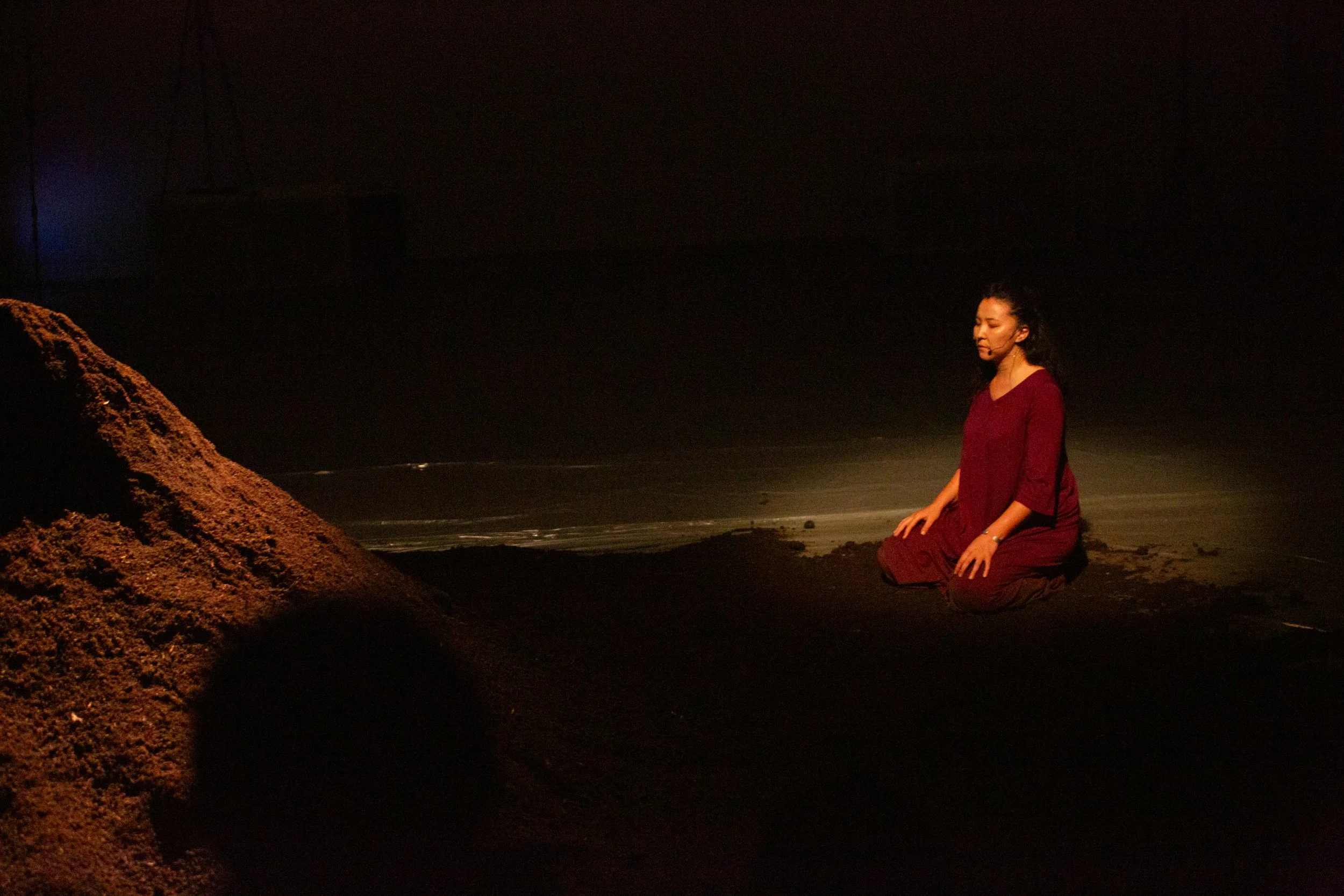
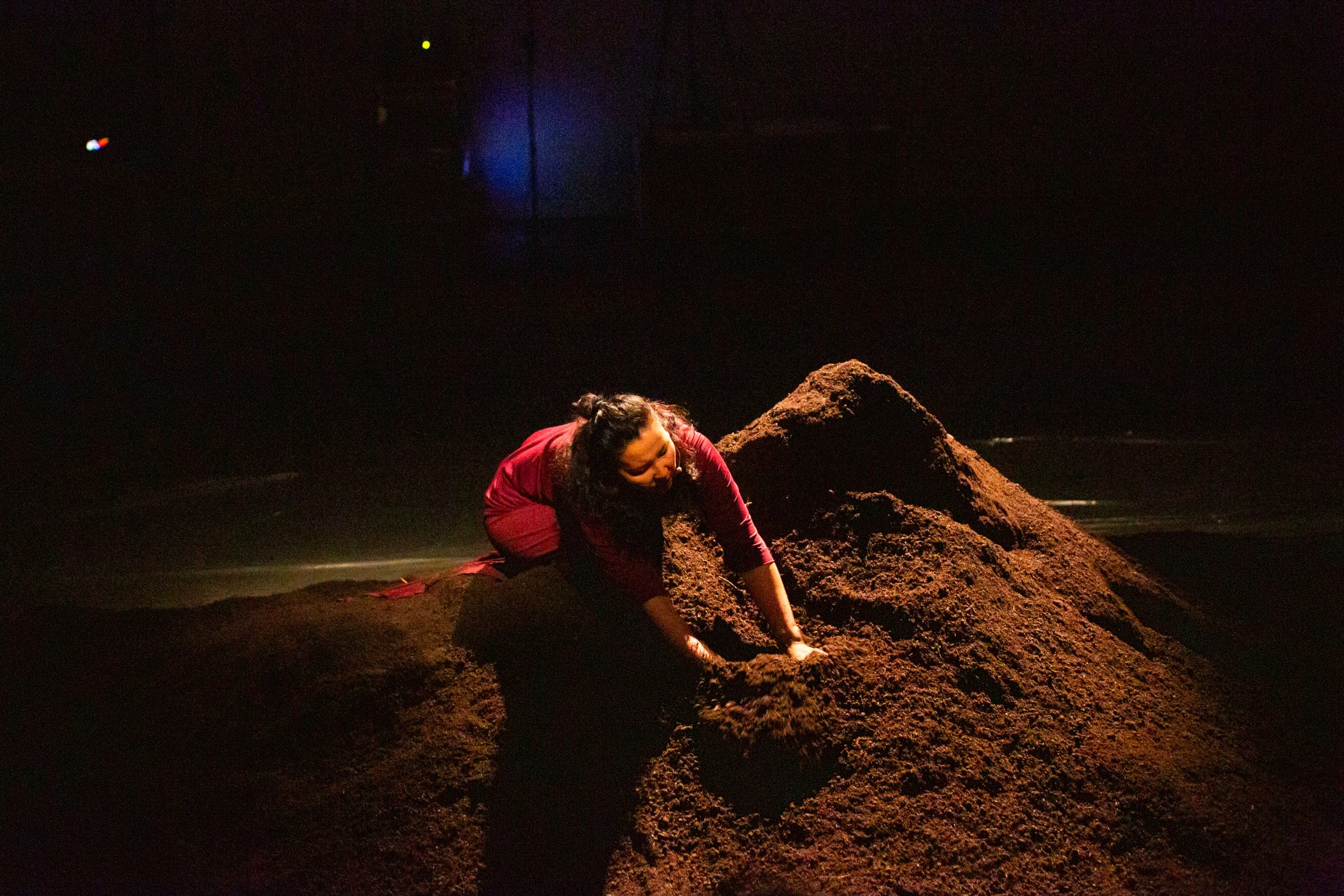
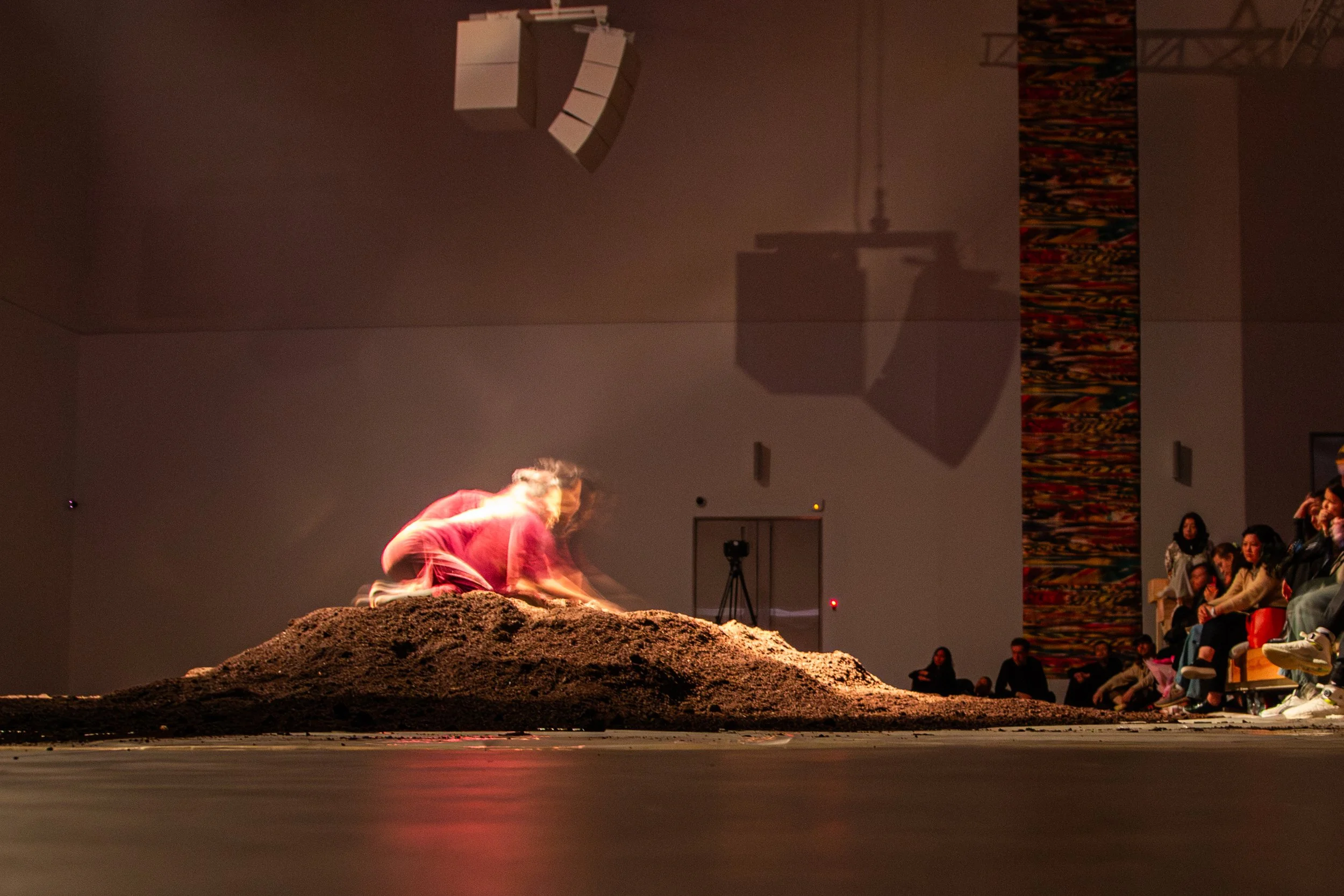
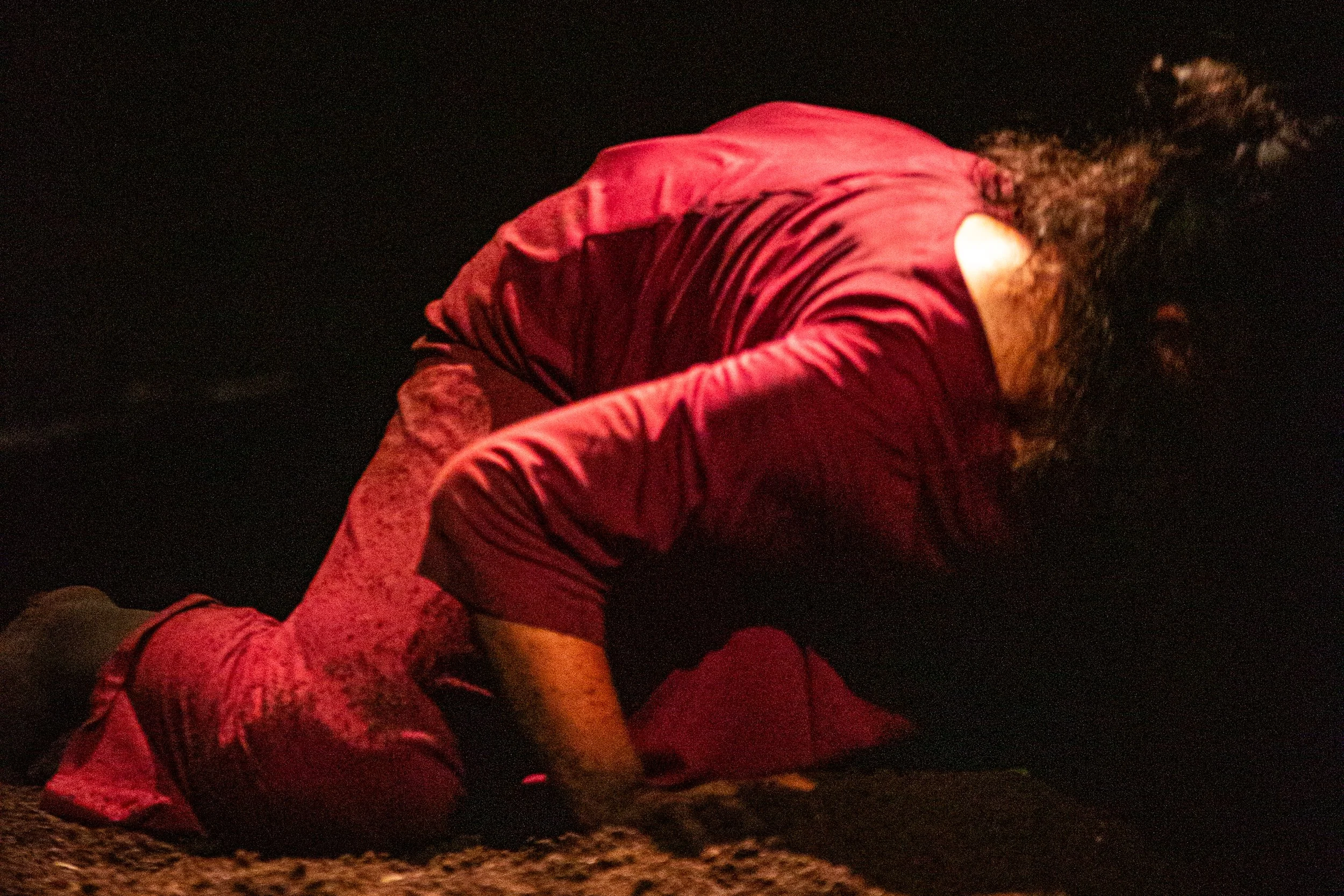
A Rite of Fallen Mountain, perfomance commissioned by the II Korkut Sonic Arts Triennale, Rites of Eternal Wind, Korkut Tselinny, Kazakhstan, 2026, Image courtesy of Korkut Tselinny
JM: Yes, and it was important that there were many headscarves. It became about the people. They were the backbone of the work. The installation that we created had this animalistic aspect and, actually, it had a very heavy back. I think it was something inherent.
When making the installation, I tried to create a relationship with my grandmother whom I never met. I was thinking a lot about her death when my father was still a child. I know she lives somewhere within me, in my spirit. These thoughts somehow got translated into the spine like shape of the Thousand Prayers. I remember I wanted to make the back of that animal very heavy. Because the heaviness of the back felt like what tied me to my grandmother.
It was not my single story, however. It wasn't only about my grandmother, even though the memory of her gave the foundations to the project. These were stories of people who trusted me. It was not exclusively my authorship any longer. These were their bodies, their presences, themselves completing it.
PW: This heavy back looked so very much like a humpback whale. It was giving this animalistic context to stories it weaved, but it also reflected the labour of the people wearing headscarves daily, of the women, of the cleaners, of domestic work. And it reflected your labour as you were tying the headscarves, while assembling the sculpture. That exhausting, back-bending work. But there is another aspect I thought of, more metaphoric, how heavy memories or losses can be sometimes , so heavy that they bend you to the ground. And it was a little bit like the wind, which, in a sense, takes the stories away and it also makes the back a little bit less heavy. It gives relief.
JM: It did feel like a liberation at the end. The animal had a heavy back, but also as we were untying the structure; it was disappearing bit by bit, every time we were untying each headscarf. At the end, we ended up with a naked metal structure that was holding the installation. So in a certain way, it reminded me of a ritual of letting the animal or its spirit go. For me, it has to do with the fact that we were doing it with care. That animal was a representation of something about us.
PW: I think it was liberation rather than the simple process of putting it apart. There is this expression “to have a knot in your stomach” when one is really stressed or anxious, or scared. Like a premonition of pain. So it makes perfect sense that when you untie the knot, something becomes free, and a little bit less burdened. It's an unburdening process that completes the work.
PW: It was a real pleasure to speak with you. Thank you.
JM: How beautifully put! And thank you too!
Jazgul Madazimowa, born and based in Kyrgyzstan, addresses migration, absence and loss. Her rituals engage communities while speaking of intimate grief, reaching to the practical energy of the feminine. She frequently uses female domestic work and the female body as a medium and an anchoring point for her explorations. Jazgul’s practice is collaborative and socially engaged.
Its character is poetic, eluding categorisation and literal meanings. Like lament and song, her works linger in memory and prompt lyrical response.
Madazimowa’s ongoing work with migration, boundaries, rituals of loss and grief is framed by her cultural heritage, deeply personal Kyrgyz roots, and a shared mindset of Central Asia.
Born and based in Bishkek, Jazgul Madazimowa is a member of Davra, an art and research collective initiated by Saodat Ismailova in 2022.
She has exhibited internationally. Her recent exhibitions include: Documenta 15 (2022), Center for Heritage, Arts and Textile, Hong Kong, (2023), HKW Berlin (2023), Fondazione Elpis (2025), Bukhara Biennial (2025), II Korkut Sonic Art Triennale (2026).
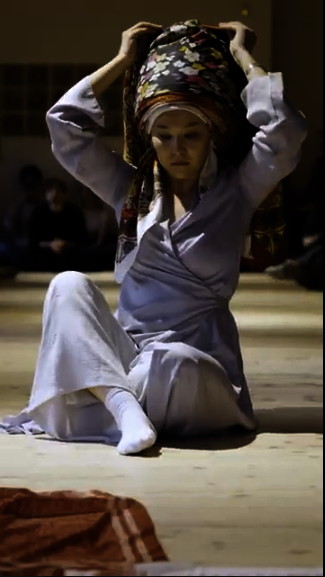
The artist performing The Scent of Your Memory as part of YOU ARE HERE: Central Asia at Fondazione Elpis, Milan, 2024, Image Courtesy of Fondazione Elpis
