Liberation of Hecate.
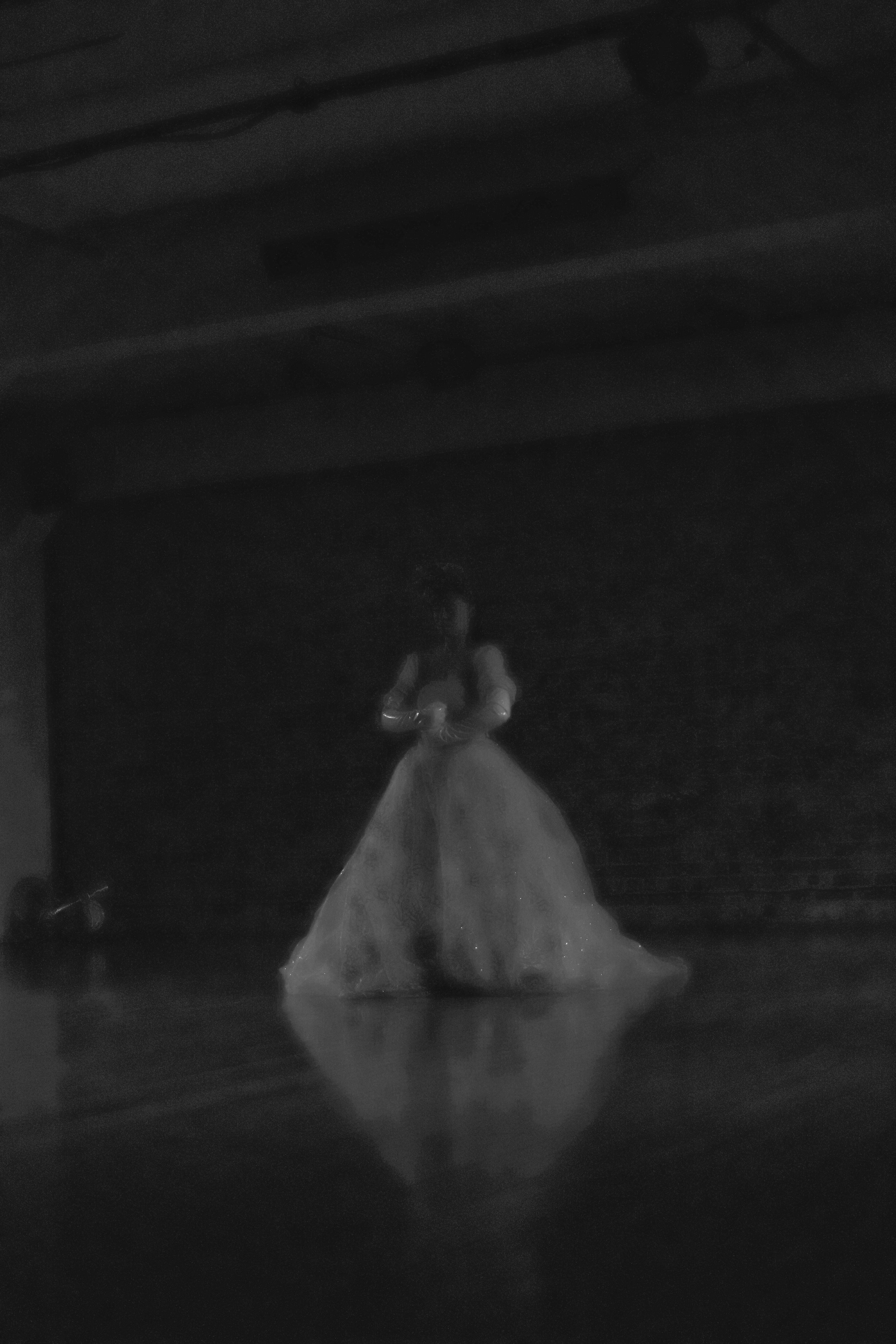
photo: @12inoxford, June 2026
Performance by Iris.
FROZEN SEA
It begins with a lament of the wind.
The dark stage is empty, except for a figure standing in the middle, facing the audience. The performer is perfectly still. An eerie sound fills the space. The sound of wind. The sound of a blizzard, like a snowstorm. The sound of desolation. I think of crashing waves.
The protagonist’s hands are modestly folded in front. Like Jane Seymour,the obedient wife. Prim and modest. Or maybe, they clutch at one another to conceal internal tension. Barely contained. Tendons strung. Nails biting into the flesh. The tension is like an underlying hum. Me and her. Facing one another. There are plenty of people in the audience, but I feel solitary in my experience.
In Robert Eggers’ adaptation of Bram Stoker’s Nosferatu, young, soon to be a bride Wilhelmina Murray, stands at the edge of the sea next to an old forgotten graveyard on the sandy shore. When I look at the performer, I think of this image. I know the protagonist is facing me, facing the audience, but in my mind I see her at the shore, facing the frozen sea. She is looking past me, towards distant tides, towards an open horizon, listening to the wind, watching icebergs and frigid waves. She is facing a decision that will affect her life forever. Something she is being pushed to do. Something she has chosen. A transformation. Like Mina, she will pay a necessary price for her becoming.
The protagonist is between human and beyond, or rather between animate and inanimate. She is a woman on the verge of something, but she is also an archetype, a territory. She does not have a name, but she wants one.
The stage is a landscape. Image, sound, and light function like an orchestra of elements that activate an entire system of agencies, stories, and vibrations. The score translates these internal processes into a sound, holding movement and time in a shared field of pressure. I think of Wilhemina looking at the sea, standing on the lonely dune, waiting for a cursed ship.
The protagonist begins to move. It takes all her strength not to implode, not to become a snowstorm. Slow, measured, highly controlled movement. So slow that the exact moment of change is barely registrable. To catch a difference in performer’s position, I have to concentrate almost as hard as the dancer herself. As if everything else was in-between.Neither this nor that. Neither here nor there. Fluid. In becoming. Hands parting. Slowly, seamlessly. The gap. In between forms. The body prepares to move, to lean forward, but the tension does not subside.
There is a quality in this movement, almost as if it was not real. I am trying to control what I see, guessing each of micro-alterations. The performer makes me a reflection of her experience. I mirror the pressure. Now we are locked in a coming change. She takes me with her to this place. Together we stand at the precipice.
The shore is a porous boundary, between land and sea, solid ground and endless depths, wet and dry, compact and dispersed, concrete and fluid, alive and dead, entity and object. States, beings, and selves come and go, together with approaching and receding waves. Or to be more precise, they used to. Now everything is suspended, wind and no-air, un-breavable particles are the only things that move. Rushing over an abandoned beach. Tag of land and sea.
It is a performance of a transformation, a rite of passage, an example of choreography built on the aesthetic category of stillness at work with 2 types of tension. The movement is like a geological force, planetary time, slowed down to a nearly impossible pace. It is futile to try to break it down into its basic components. The movement is like an inseparable series of stills, a sequence of projections.
Ovid wrote: "Look at Hecate, standing guard at the crossroads, one face looking in each direction."
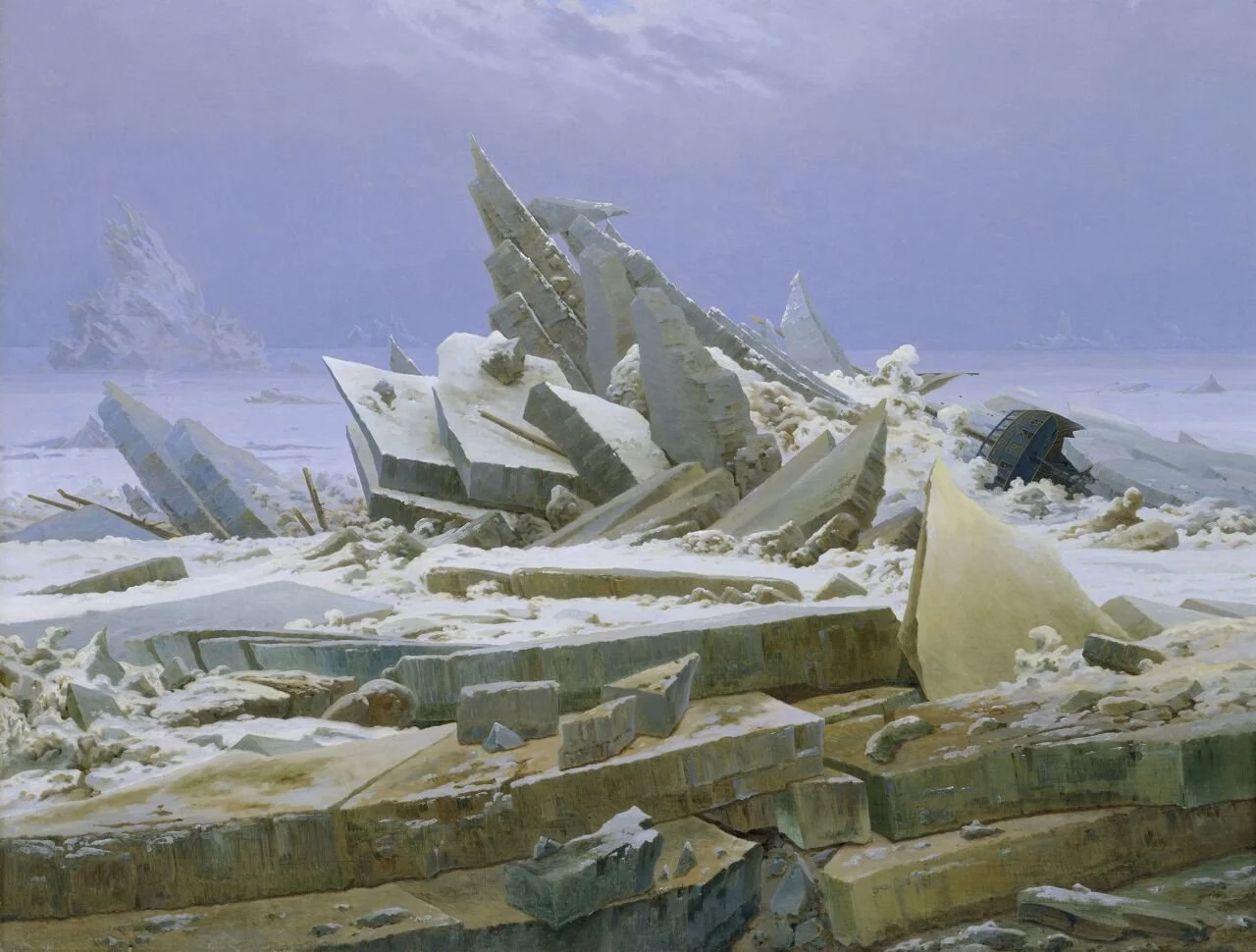
SEA OF ICE
In 1824 Caspar David Friedrich completed ‘Sea of Ice’, the artist’s interpretation of the Arctic landscape. Apart from a half-buried wreck in the background, the pictorial field is dominated by great ice floes, a fantastic landscape of cold grandeur. An essence of Romantic Sublime, the painting amazes and terrifies.
Reportedly inspired by Théodore Géricault's The Raft of the Medusa (1818–19), Friedrich's work shares with it a similar composition and bleak understanding on human relation to the unforgiving sea. 2.
What strikes me the most when I look at this frozen landscape, is how man-made, how artificial it feels, and how desolate, how void of life. Instead of a living environment I feel as if I was watching a collection of not precisely objects, but maybe representations of life. These are images, simulacra of living beings.
The fantastical picture is not fantastic because the ice formations are exaggerated, not because of the way they were painted, or how the artist re-worked the scale. It feels fantastical because it is a perfect illustration of what we mean when we say: Nature.
The natural world in the ‘Great Western Narrative’ and in particular, the notion of Sublime, are in fact constructs. Nature is void of life, change or agency. It is an empty depiction. Nature contains a series of objects, not living beings. It is not dead, but it is also not alive. Perfect to control. Nature is also timeless. Temporality comes with life.
Can we feel sublime awe and terror facing a woman's imagined place in the world ? Her position in the nuclear family and patriarchal universe of Man? I regard the protagonist in a similar manner to Friedrich's figures, seen from the back facing vast landscape. The human soul facing a distant horizon. She too, will move away from Culture and Nature into another realm of being.
When I look at the protagonist at the stage, I picture her on a desolate shore facing the emptiness, the wasteland of Man’s Nature. In frozen waves she is facing her-self as it is prescribed by the Man-made universe. She is facing roles she is supposed to take on, masks she is supposed to hide her face behind, ways in which she is expected to exist.The desolation is the emptiness of all these guises imposed on the protagonist. In order to animate the sea, to bring life into the landscape, she has to become. To find her name. Life arrives with self-determination.
The performance is like a coming tide, slowly submerging everything. The protagonist is standing in front of a frozen future that was made for her.
Dog. Monster. Shore. Figure in the shadows. Inscrutable face. Hecate.
The goddess-witch stands on the frozen beach. Black she-dog accompanies her. She is looking towards the sea. Waves are transformed into ice formations. Suspended mid-way. Just before they crush against the land.
Not-exactly-bride stands in front of us. A woman in the darkness. Black dog next to her, just a shadow, ice cold waves hiding a devouring Deep.
The stage is a landscape. Liminal. Just like a shore she-they stand on. Neither sea nor land. Neither before nor after. Forever of no time. The now is non-existent. Instead it is a place of somewhere, sometime else.
Sea is animal. Animal is sea. Woman is animal.
Within this un-definable place she becomes a process that is seeking to dissolve the boundaries between self, other, human, and beyond.
Hecate holds us a breaking point; the tension is almost unbearable. If not for the ocean. The sound of a snowstorm makes me think of solid waves. I am standing in front of the frozen endlessness. Me and not-quite-bride are standing together. We are looking towards the horizon. Forward. Waves crush one over another, turned to ice. A sense of emptiness filled with presence. A stage. Friedrich’s painting. Sea of ice. Black dog panting.
The protagonist becomes a Maenad. Slightly leans in. She opens her mouth, wide, mute, full of voice that did not vocalise yet. She becomes Medusa. A tragic mask. A soundless scream. Voracious gaping cave. A whirlpool of the void. A chasm. She stands on the shore that is a reflection of her own change. Her-self frozen like the crushing waves. Mouth open, like a dark gap, ready to tear apart the arctic stretch.
Ancient Greeks used to place a Gorgeion over the entrances to the buildings in order to ward off evil. The look that turns to stone. Silent scream. I am waiting for her to let go. Still the bride is looking towards the horizon. This empty shore is a place of haunting.
Icy waves crash against the sand. A deserted, lonely place. Neither land, nor sea. Waves come and go; water flooding it, approaching and leaving it dry, receding.
I scream. There is no sound coming out.
Alterer of the winds dark Hecate was.
3.
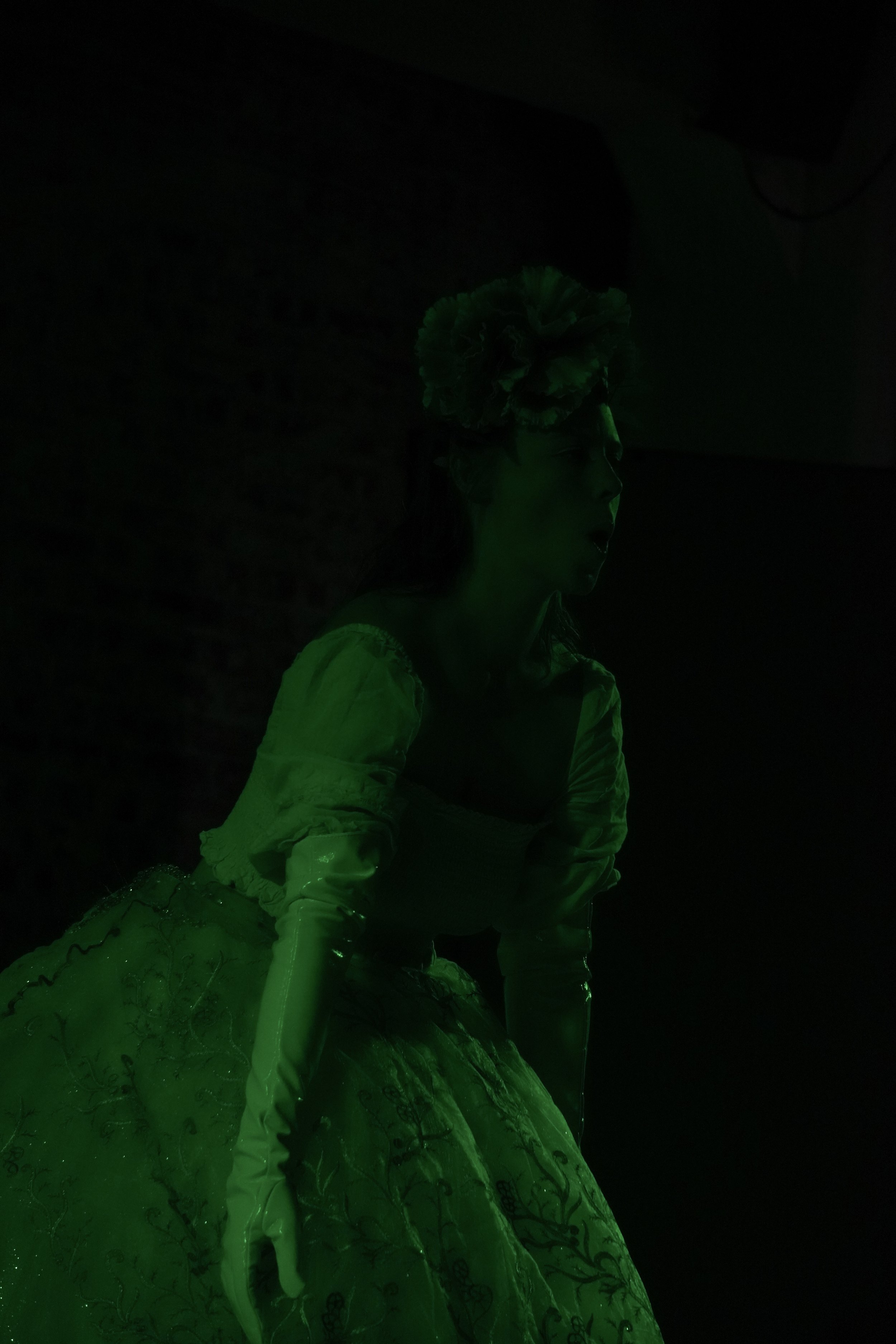
photo: @12inoxford, June 2026, courtesy of Iris
2.
SEA IS GULLET
“What’s in a name? Using the example of a famous monster from Greek myth,” Marianne Gowers Hopman “ challenges the dominant view that a mythical symbol denotes a single, clear-cut “figure” and proposes instead to define the name “Scylla” as a combination of three concepts – sea, dog, and woman – whose articulation changes over time.” She explores” how the same name can variously express anxieties about the sea, dogs, aggressive women, and shy maidens” 1.
“Dogs are one of the earliest animals to be domesticated by humans, though the exact timing of this first domestication remains uncertain. They started living in close quarters with humans, began guarding camps and fields, hunting and tracking animals for them, scavenging waste and preying on rodents. Dogs didn’t just enter human settlements but also stories, rituals and beliefs. Dogs are gatekeepers, often associated with transitional spaces, such as gates of the underworld, crossroads, and the transition from life to death. (...) Dogs crossed the threshold of the wild and entered the domestic realms. “2.“Since their domestication and introduction into human environments, dogs have become liminal creatures—able to move fluidly between the human and non-human worlds (Crockford, 2002).” 3.
The protagonist, a woman on the precipice, a potentially castrating figure, is associated with the familiar in the shape of black she-dog, to which she is often compared.
Ancient Greeks were apprehensive about dogs. A tamed animal that has a potential to reverse the domestication process and to turn on its masters, always suspected to ravage those who control them. The only animal “fully integrated into human society, dog is also known to be capable of deceit and unfaithfulness. An ambiguous member of the household-human-like but not human, trusted but feared- the dog is a liminal being that stands between the spheres of nature and culture. “ 4.
It can turn feral.
“Due to its chthonic nature, the dog was believed to belong simultaneously to the underworld, the magical realm of dreams (Drexl, 1925, p. 358, 360), to omens (Burriss, 1935, p. 35–37), and the upper world. “5.” The Ancient Greeks often thought of women the same way. Dog, potentially dangerous, greedy, and voracious animal, who is connected to the underworld, and who can speak to the dead. Woman-human-like but not truly human suspected of potential for deceit and betrayal.
Hecate is a primeval darkness of the feminine. Dog and her mistress. A presence. And they both are facing the frozen sea that cannot be seen, but can be potentially a devouring space.
Like the identity of Hecate, the protagonist’s, her daughter, Scylla’s is bound by 3 fundamental concepts: sea, dog, and woman. “The concept of a woman is tied to the concept of sea and dog through the motif of engulfment.”6. “It resides in the dialectic between the sea and its paths; the sea, or a rock and a wave.“7. “The Greek concept of woman is thought of in terms of the Greek concept of dog. Similarly, (...) the Greek concept of sea is considered in terms of the Greek concept of woman, and (...) the Greek concept of sea considered in terms of the Greek concept of animal. In (...) the conceptual metaphor woman is dog;(...) and sea is woman; and the metaphor of sea is animal.” 8.
For ancient Greeks women, dogs and sea were all connected to liminal realms, and all were creatures of uncertainty. “Double metaphor; WOMAN IS DOG and WOMAN IS SEA is a continuum.” 9. A perfect loop.
These 3 concepts are bound by deeply seeded fears and anxieties. All marked by potential danger that comes from their changeable nature, identity that melts, morphs and fluctuates. Identity that is female. Dogs are guardians driving intruders away. “Sea is a forbidden or untrodden space” 10.
“The deployment of Scylla’s name across time and genres thus documents ideas, images, and especially anxieties associated with three fundamental areas of Greek experience: the sea as a vital route of exchange allowing the inhabitants of a rocky and barren land to develop an elaborate commercial network; the dog as man’s closest animal companion, hunting partner, and guardian of houses and flocks; and woman as the other half of humanity.”11.
The woman with the dog is looking at the horizon beyond the frozen ocean. The dog, the woman and the sea enter a strange relationship, creating a threshold, becoming a self, in a way, devouring something that is accepted and recognised by the society, while the woman, Hecate, wants to become someone, something, she wants to regard as her reflection. In order to do this, she needs to tear apart the mask.
It begins with the crisis of presence, with too many faces to wear, with the memory of the other self. It directs the search for one’s own being in place of ‘somewhere else’.
SEA IS ANIMAL
Like a respiratory rhythm, punctuation of life regulated by intake and release, shared by woman and sea, a tremor and a tide, female monsters of Scylla, and her mother, Hecate, reside in the gullet of the sea. And like endless oceans of female fluidity they can be manifested as a boundless dangerous vortex.
SEA IS WOMAN
Teeth tear apart, hard rock that fights back. Mouth that sucks in, respiration that consumes the world. Scylla vomits her own otherness, outpour marking the rejection. Wind, desert and waves. Hecate crouching, in waiting.The protagonist slowly unfolds her hands, leans in, her mouth like a gaping hole, and she rests on her front paws like mute, quiet sphinx. She is getting ready for her transformation. For her becoming.
Associated with Scylla, the female monster,“voraciousness is closely connected with perceptions of the sea as a “devouring gullet”” 12. Stories of monsters have always co-existed in their duality, the woman and the witch, the self and the other, the mother and the daughter. Now, through the process of this incredibly tense slowness, they become one, a hybrid being that is reborn to live in recognised freedom. Monsters and dangerous gulfs between them, the protagonist and the witch, tripite beings and sole hybrid of selves are distinctly separate forces that meet in the middle. The change results in the emergence of the new power. One hungry and ready to devour the hostile man-made world. Between desolate wind-beaten shore and storm-torn frozen sea.
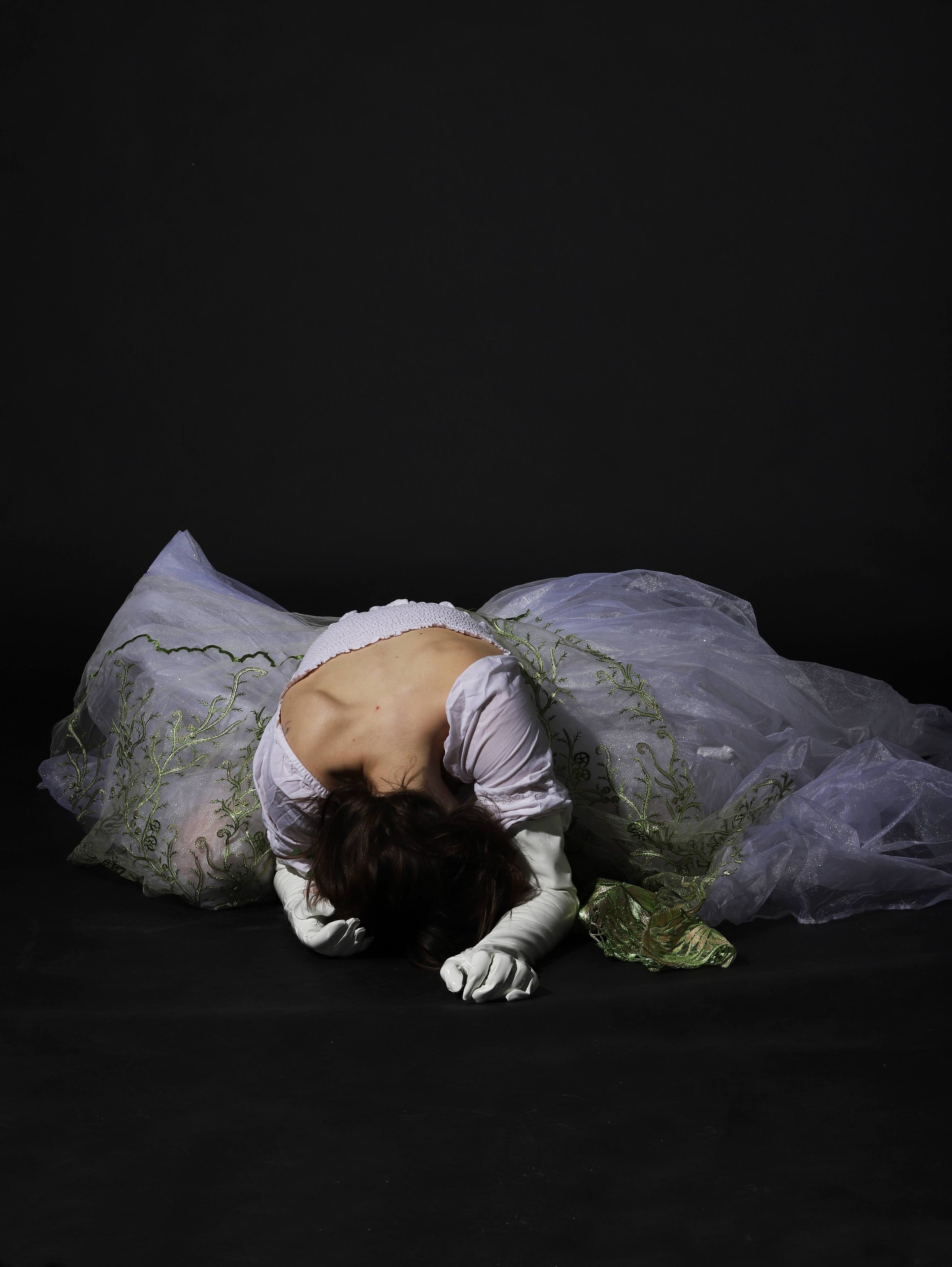
photo: Courteney Grafton, June 2026, courtesy of Iris
FERAL
A feral (/ˈfɛrəl/; from Latin fera 'a wild beast') animal or plant that have changed from being domesticated to being wild, natural, or untamed.“Ferality is what was once hidden in the gap between “wild” and “domestic”.” 13.
The ritual of change,which is the performance, is feral. Femininity is here recognised as marked by, animality and otherness. Poetics of slow spasm are ways of a return to nature in altered ways with the world. Or to be more precise, to the state of ferality. Being in the wild, leaving domestication behind.“Ferality is acknowledging the (un)belonging; it is something anterior, translational, and including the beyond.” 14.
The inherent connection of a woman to the natural world, the monstrous otherness outside man-made confinement called safety, directs feminine expressions of resistance on plural realms of being. What if we consider ferality both an individual and collective experience of a woman? To recognize its potential is to extend beyond, to become signifying change. Can a monster grieve for its many selves leaving them behind? 15. The monster is both a space and a living being. Like a dog, woman hides inside of her domesticated self, dreaming of the potential to break out, to leave it all behind. No longer tamed. Turning on her masters.
WOMAN SEA AND DOG
Tides going in and out. The monstrous breath of the female sea as a devouring deep. The stage is desolate elsewhere beyond linear passage of time. Female monsters that scream; but also consume; like Scylla’s roar, tearing apart self-space. Monstrosity of every woman ready to devour.
As I navigate through performance and my internal connotations, I “encounter an array of images, concepts, and ideas associated with the sea, ranging from its perception as an uncharted, mysterious, and riddle-like space to its representation as a gullet infested with ravenous creatures.” 16.
This is at the heart of the performance: Scylla- or more to the point, her mother Hecate, document male anxieties about women, who remain un-tamed. “She thus powerfully exemplifies the widespread psychological phenomenon of horror feminae, or gynophobia” 16.
Whirlwind of Charybdis = the one who sucks in Scylla vortex = the one who tears apart
The stage-landscape-body is a site of memory, potential, and transformation. The work frames the body and sea as entangled sites. Since ancient times, seas have served as metaphors for the subconscious—for memory, for an archive of hidden fears and desires. Like winds, waves shape the seas and oceans; they also shape mind and imagination. They give form to dreams. The protagonist and her familiar on the empty shore.
SEA IS ANIMAL. ANIMAL IS SEA. WOMAN IS ANIMAL.
The sea roars, the waves crash, the sky thunders.The sea itself is a score, a stratified field of movement, signals, and accumulated traces. As sound emerges through processes of listening, echoing, and breathing in relation to the rhythms and pressures of seawater—the sonic register extends beyond the sea itself. Otherness of voice. A performance is a poem of radical loneliness.Sea is a contact zone. Sea is a ghost, yet it remains present.
In early Lars von Trier's film, “Medea”, Medea meets Jason on the seashore marshes: foggy, liminal, dangerous landscape. The entire play-film happens within this threshold. Marshland. Place of change. At the very end, the sorceress escapes on the boat, and she takes off her headscarf she has been wearing the whole time. With her flame red hair loose she looks towards the horizon. Liberated. Like the bride on the windy shore.
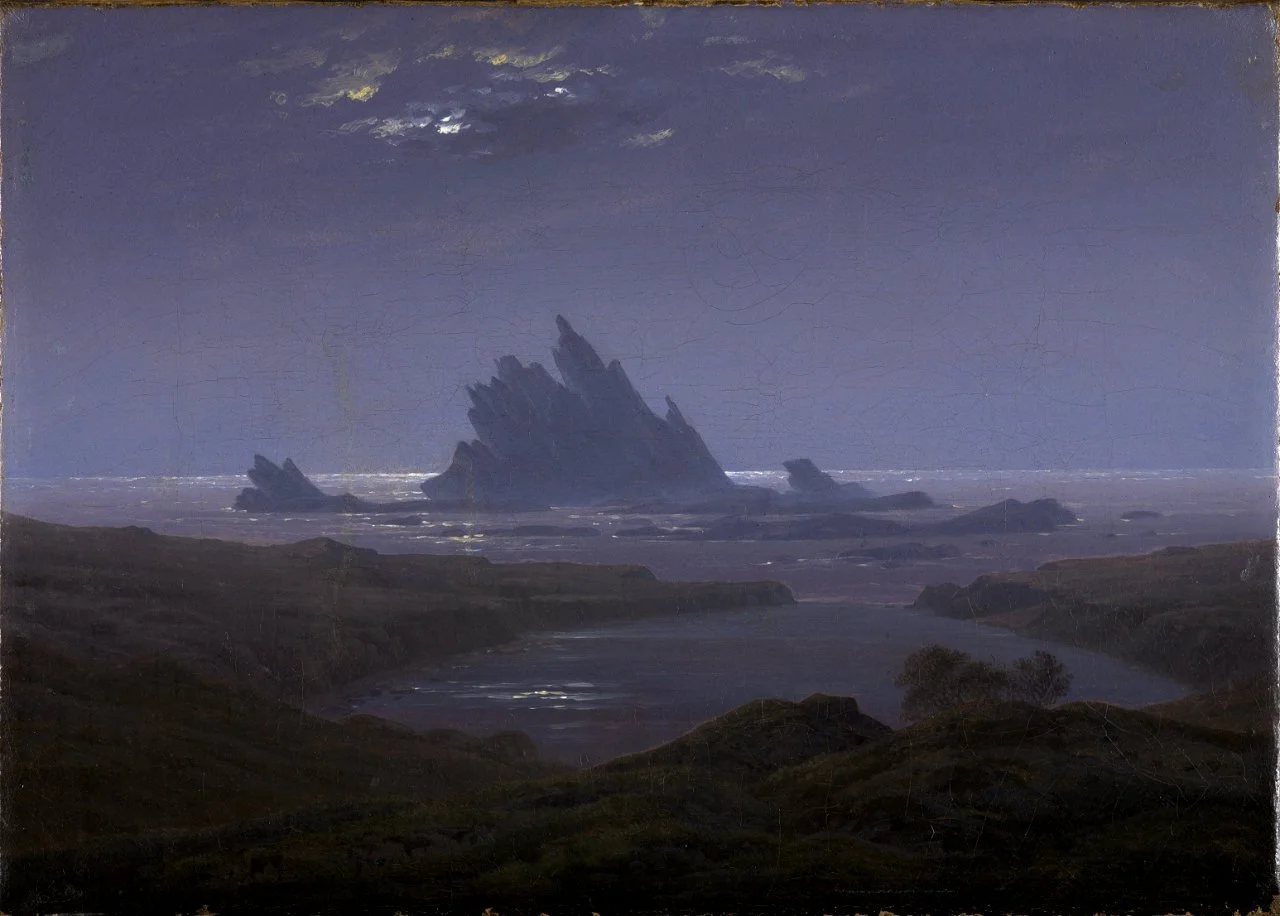
Caspar David Friedrich Rocky Reef on the Sea Shore, c.1824, Staatiche Kunsthalle Karsruhe,22X32 cm
3.
SEA IS ANIMAL AND SEA IS WOMAN
As Henrichs has shrewdly observed, Vernant strongly emphasizes the radical otherness of the mask and its enigmatic and elusive power to disorient those who encounter it. 1.
“Mask”, from Medieval Latin masca "mask, specter, nightmare," is a word of uncertain origin. It may be originally: a Provençal word. Compare Occitan mascara "to blacken, darken," derived from mask- "black," which is to be originating from a pre-Indo-European language, and Old Occitan masco "witch," surviving in dialects. In Beziers it means "dark cloud before the rain comes.” Masks were widely used in ancient drama, evolving to take different forms: female, male, comical, even tragic.They were also placed in the sanctuaries of temples as tributes and offerings, while the most gruesome hang in homes and shops and served as amulets and talismans warding off the evil eye.” 2. The traditional triple image of Hecate consisting of three bodies joined in one around the pole is, according to some researchers, derived from the ancient custom of 3 masks hung on wooden poles, possibly placed at crossroads and gateways. Triple-faced figure-being: past, present and future; maiden, mother and crone.
The performance is a space between the soundless scream and desolate windy shore. The protagonist voices out silently the terror of her world on the crossroads. She is facing the iceberg sea, facing us, her adoring audience, fellow travellers in a journey of internal change. There is a radical otherness to the female in front of me, in front of us. We both share it.
She opens her mouth. Her face becomes a mask. Otherworldly shriek trapped in a gaping pit. The masks are many: Virgin, Pleasure Model, Lolita, Spring, Wife, Mother, Maiden, Crone. But the screaming mask is the mask of becoming.Woman’s howl. Feral. A female that refused to be moderated, restrained and controlled by men’s order. Many faces pretending to have an answer of how to live. Of how to be. Women having to appear as something, someone else, to hide their power and self-knowledge.
There is an ages-long tradition of closing women’s mouths. Of taking away their speech. Maybe that’s why so many female monsters manifest their otherness through their voice. Maybe it is simply that they try to breathe freely, while the silencing they are subjected to, leaves them breathless.A silent scream is an expression of dissent. A protest, an initial step to change, to liberation. Nature and Culture are constructs of Western modernity. The protagonist in her becoming, leaves both of them behind for the sake of ferality.
A late film by legendary director, Akira Kurosawa, “Dreams” consists of 8 stories, of 8 dreams. In one of them, “The Blizzard”, lost in the snowstorm men encounter a female ghost-demon, yuki-onna, woman-death, personified danger of desire in a snowstorm. She appears like a mirage, like a woman-witch, a spirit, a frozen world, on a frozen shore. Dreamed out fear of the terrifying power of the female. She is from another realm. A mask is also something that you put on, when you want to hide, when you don’t want to be recognised, when you don’t play the part you are expected to. Each role of the woman on the shore is another mask to wear. There are two types of masks used in the performance. The mask imposed on us, all women, and the mask that is a manifestation of tension and change, the mask that lets us remain an unsolvable riddle.
Mask reaches down across time to archetypes of what people are, of what human is. And it concerns the question of pretence and reality. Like someone else’s skin. Identity to take on. There is monstrosity embedded in the mask, shaman becoming an animal, woman becoming a bride, bride becoming Hecate, woman on crossroads. It reaches to the Other. To the way women are still being perceived in terms of animalistic modes of existence. And how they are represented and incorporated into strategies of capitalism; production, labour, and reproduction.
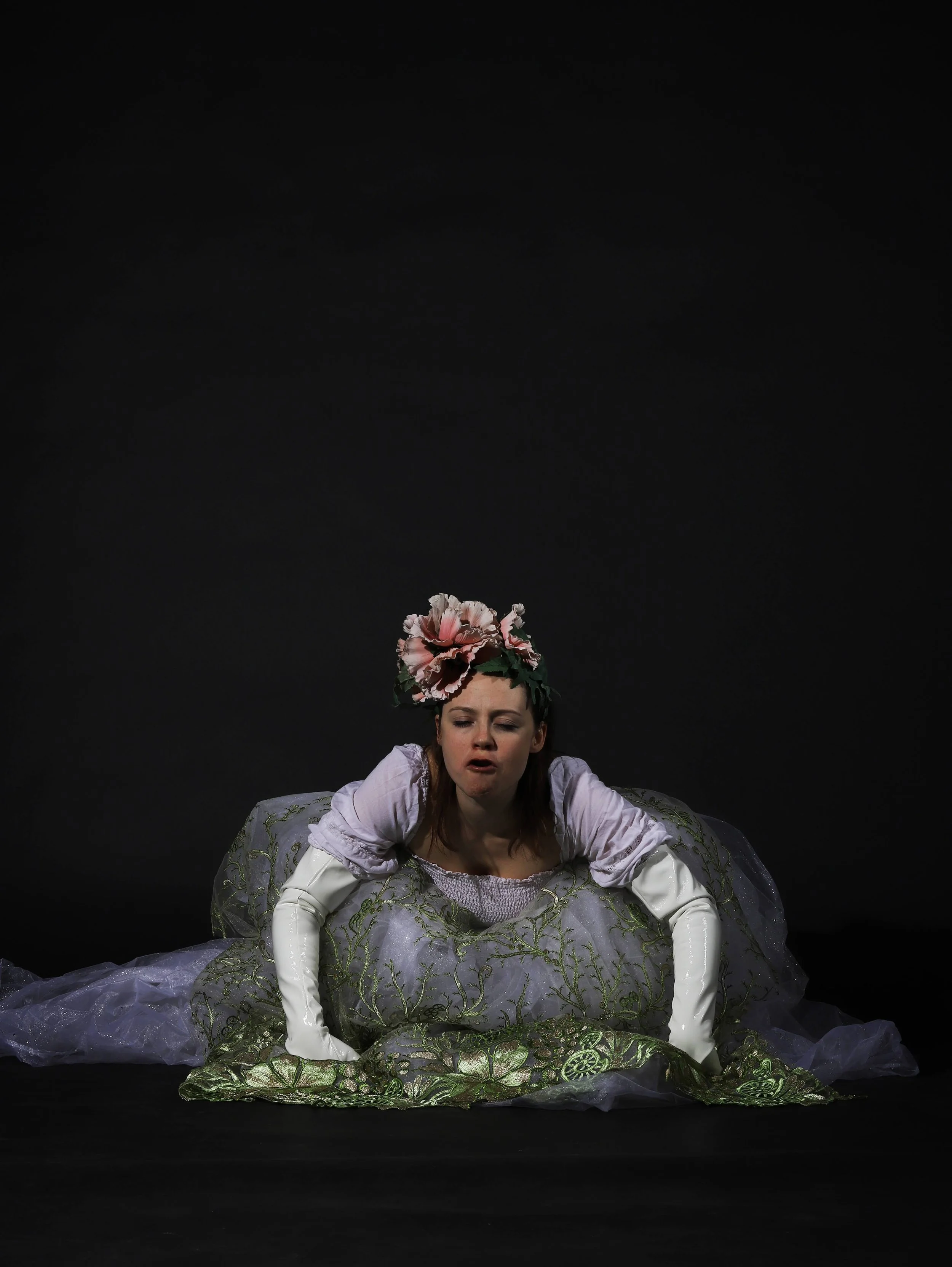
photo: Courteney Grafton, June 2026, courtesy of Iris
Dionysus mask. The primal scream from space with no time and no air. Can we speak of possession in this context? Is the triple goddess inhabiting the mask? The protagonist's hands are possessed by a feral witch, who tries to break through the surface.
In a way, it is a fight over the ownership of the female body and psyche. Hecate claims hers. The need of capital to control everything and everyone, is prevailing in the contemporary world. Once a woman removes herself from the established order, to the position on the fringes of that market-place that our lives have become, she is someone of non-value. There is no point in investing in her. A woman who does not play by the rules, and does not bring any profit, needs to be erased.
The protagonist is different, non-normative, not completely human. A monster. A witch. And so Hecate metamorphoses in order to claim her internal self-worth. I think of how women are still being perceived now. Part animal, part monster and always in part, a mask. To play her role. To entertain.
The protagonist considers her prescribed future showing in the iced-over sea, all expectations submerged in the distant line where water meets the sky. Each one of her garments symbolises the mask she is expected to take on. But she wants other face, another role, a different future.
All the faces are competing with one another. A slow controlled movement with almost infinite intensity. Deliberate, not entirely human. Fluid, yet jarring. As if she was an automaton. She purposely keeps us, keeps herself on the edge. Her body is full of energy that persists to be released.
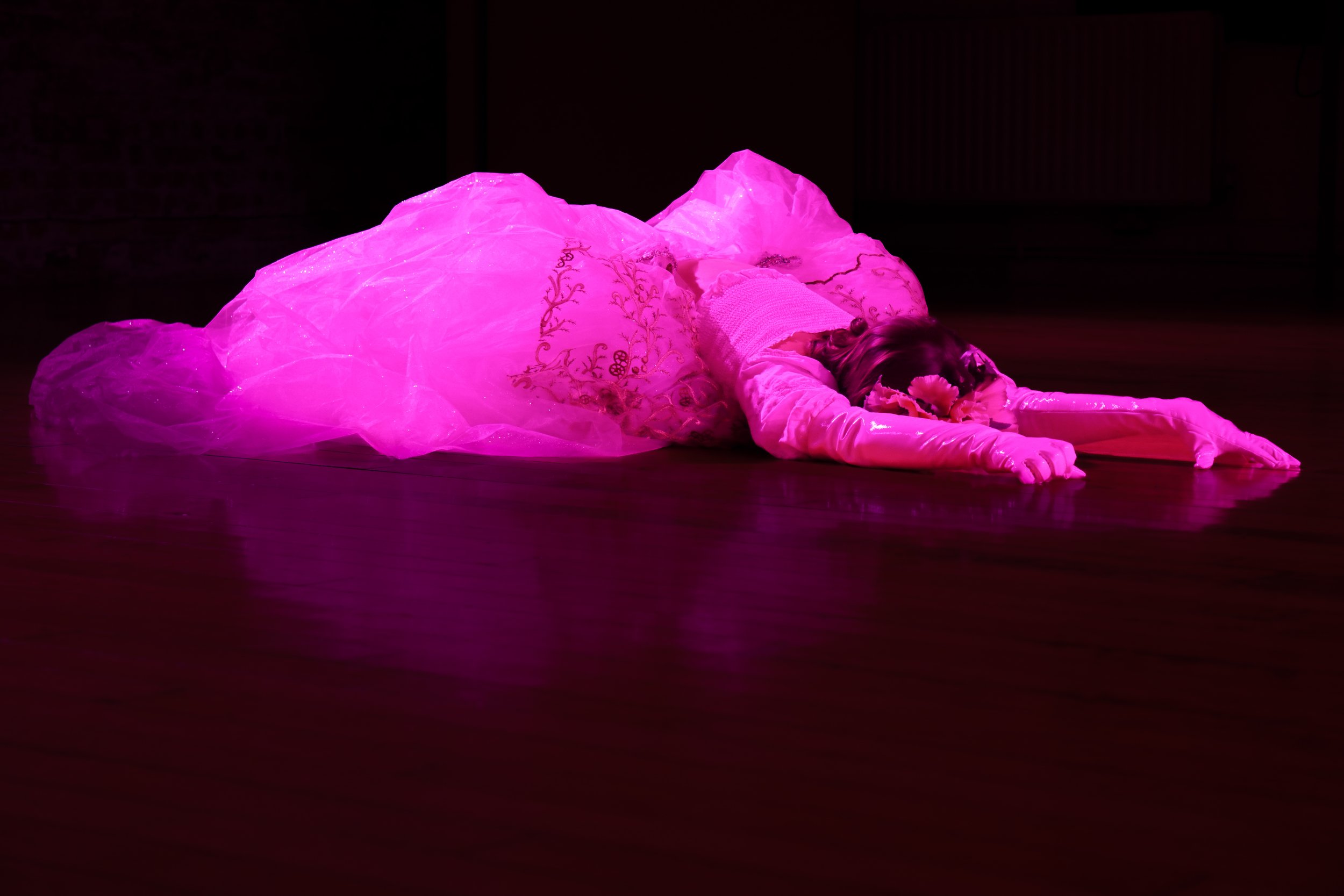
photo: @12inoxford, June 2026, courtesy of Iris
Liminal space. Liminal being. Liminal state.
Just like the shore itself, the protagonist eludes definition. Without assigned identity, but toying with many figures, cliches, archetypes. Neither flesh nor spirit. Neither human nor beyond. Someone, something different. A series of faces. A series of masks.
“Now the Sirens have a still more fatal weapon than their song, namely their silence. And though admittedly such a thing has never happened, still it is conceivable that someone might possibly have escaped from their singing; but from their silence certainly never.”
Franz Kafka, The Silence of Sirens (Translated by Willa and Edwin Muir) 3.
4.
THE SPHINX AND THE RIDDLE
“(...) the historian Susan Wise Bauer suggests that the word "sphinx" was instead a Greek corruption of the Egyptian name "shesepankh", which meant "living image", and referred rather to the statue of the sphinx, which was carved out of "living rock" (rock that was a contiguous part of the stony body of the Earth, shaped, but not cut away from its original source), than to the beast itself” 1.
Butoh (舞踏, Butō) is a form of dance theatre that arose in post WW2 Japan emerging from collaborations between a number of key founders, most significantly Akiko Motofuji, Nakajima Natsu, Tatsumi Hijikata and Kazuo Ohno.” Butoh dancers consciously tried to distort the aesthetics of other dance forms, creating movements that disturbed, rather than pleased, audiences. (Harada 2004, 1).” 2. Buto is a form which shares the employment of playful and grotesque imagery, explores taboo topics, and uses extreme or absurd environments. It is traditionally performed in white body makeup with slow hyper-controlled motion. “Notably, Nakajima Natsu introduced slowness and sublimity to genre aesthetics.” 3.
Butoh explores the transmutation of the human body into other beings, for example animals, or marginalised bodies, but also looks into the nature and manifestations of possession, monstrosity and otherness. Butoh works with a poetic and surreal choreographic language, butoh-fu (舞踏譜; fu means "notation" in Japanese), to help the dancer transform into these other states of being.” 4. Moreover, Motofuji’s ideas of nature came to underpin the ideas of butoh. “ 5.
“While traditional, Western dance forms tend to prioritize intentionality: Butoh,“is equally interested in what appears before conscious decision. A tremor, a collapse, a recoil, a hesitation, a change in breath, a reflexive contraction (...) become material for the dance. This distinction radically transforms the relationship between performer and body. The body is no longer treated as a disciplined object to dominate or perfect. Instead, it becomes a field of perception, and a never-ending source of material. For this reason, sensitivity occupies a central role in Butoh training. Sensitivity is not understood as emotional fragility, but as heightened perceptual capacity —a capacity that must be trained”. Many of the central aesthetic qualities associated with Butoh—slowness, fluidity, states of suspension; or conversely, metamorphosis, instability, and dissolution of identity—emerge directly from this altered relationship to tension and nervous-system regulation. .(...) The dancer learns to move fluidly between activation and surrender, intensity and neutrality, sympathetic charge and parasympathetic grounding.(...)… In Butoh, the body is a threshold toward more deeply integrated forms of consciousness” 6.
As such, butoh is a perfect form to explore movement as a transformative process. It is believed to serve as a tool for both personal and collective transformation. The performer reflects on female experience and ways women search for their agency with Iris’ very personal, intimate take on it.
Iris trained under Vangeline, renown butoh dancer and activist. Born in France, Vangeline lives in the US, and while pursuing butoh tradition, she developed her characteristic style of extreme slowness. Iris learned this way of moving from her tutor, and applied it to her artistic pursuit.
“How to move in a way that people cannot really tell that you are moving? How to make a still moment a movement?” 7.This dance has a strange quality. As something between film and photograph, choreography and series of paintings, cultured and wild, human and beyond. It is neither staged nor spontaneous, but there is some sense of moving beyond reality in it. It affects the audience's perception of time, and their understanding of what is stage. The stage becomes a place and a process. And in the case of “Liberation of Hecate” it is Friedrich’s landscape, animated and yet, not real.
The performance explores the endless identities that a male-dominated world presses on women. The entire process of transformation is a search for a particular type of weightlessness, to emerge from transformation, as Iris describes it,” lighter”. Iris brings forward the legacy of butoh in her performances, and “Liberation of Hecate” is certainly an instance of her finding her own butoh. There is no distinction between emotion and representation. Slow, precise, powerful movement, the dark stage, the haunting soundtrack, transforms a performance into a rite. We recognise and share barely contained tension. And in a strange way the dancer is our reflection. We look at the sphinx as she is holding the riddle, the secret we all share. The sphinx leaves the mask behind, instead waiting for the ghosts of what is yet to come.
Can I think of sphinx as a complete being? Crossing thresholds between living and existing, monster and hybrid, gendered and beyond?
*
Sphinx. A woman who is a creature who is a wild animal who is a monster who is danger. Her riddle is her opaque integrity. She refuses to wear a mask given to her. Instead, she is a secret.
Patriarchy does not only want to control women. It wants to explain them away, break them apart. Keep them exposed . Like a vivisected rabbit. And then provides them with a set of faces to wear as their own selves.
I want to remain a mystery. To keep my secrets nicely tucked away like a riddle refusing to be solved. The protagonist slowly withdraws, vanishing in a protective lair of the fabric.
“The infantile body is lost in space. It experiences a terrifying absence of situational apperception and self-in-the-world. Prior to attaining motor control, the infant moves through its environment without sight of its form as a unified, seamless whole; the body is lived in fragments, in the unfathomable, incoherent depths of its own interiors. This primordial anxiety foregrounds the child’s fascination with spatial identification and attachment to its unified Gestalt image. Jacques Lacan characterizes the “mirror stage” as the point at which the child recognizes itself in the mirror and experiences the “joyous affirmation” of a visual identity.
The “I” coheres at the sight of this imaginary, visual body. According to Lacan, subjectivity is, in this sense, illusory—ultimately removed from sentient experience and projected onto an exterior surface; “I” is an other. This subject visualizes the body as a coherent whole and lives in material fragments, predicating its relations to others upon the fantasy of a contained form and fixed gaze.”8.
Slow movement and visible containment is a reaction to boxing strategies of Culture. It is a piece about liberation, but it is also a piece about the tension of being boxed up and restricted. The performance possesses a different quality of stillnesses depending on which part of the performance it is. The first stillness is of being restrained to the point that you don’t know how to move anymore. The tension emerges with a multiplicity of forms demanded by cultural concepts, all parts competing with one another. It rises, but also alters its character, during the metamorphosis process.It is about containment, containment that is imposed by external conditions, and containment that is broken by the process of transformation.
In Greek tradition, the sphinx is a treacherous and merciless being, a female monster, with the head of a woman, the haunches of a lion, and the wings of a bird. She challenges those who encounter her to answer a riddle, killing them when they fail to solve it.
Iris calls the performance her first full length butoh piece. I believe she does so because her performance requires venturing into movement understood as an expression of the Other, but also of hybrid way of being. A creation of a monstrous creature is the way to express the story in movement. The movement and mask-like face brings in aesthetics of grotesque, often used in butoh, into the show. The protagonist is a female figure who turns her back on all expectations imposed onto a woman by patriarchal society. Dog turning on its masters.
In patriarchal society women are not really human, not truly. The archetype for the perfect human being is always a man. If women are to accept their monstrosity, they may also embrace and redefine this dehumanisation enforced by men onto them. It is not an easy thing to do, but Hecate is a perfect creature to represent the tension originating in the image women are forced into having, and the identity they want for themselves. This is the reason she/Hecate accepts her non-humanity, and eventually leaves the controlled layer of her life behind.
Reclining sphinx is a personification of unspoken secrets and unsolvable power. Is she waiting for the riddle? Or is she the one protecting it? The performance is a rite of passage. Not a representation of rite, but the rite itself. The audience witnesses the first 2 stages; withdrawal from society on a desolate frozen shore, and metamorphosis in the safe lair of the drag queen skirt. The third stage, the stage of return to the world, to the community, extends onto real life when the transformed protagonist re-enters the world as Hecate. There is no ending. Instead the rite is left open, becoming a journey shaped in real time, in real world, by the performer who consciously regarded her imago, and rejoined life on her own terms. She remains on crossroads, liminal, barely visible, and she is content with it.
Iris works with a particular quality of stillness that is not really a stillness, but rather a micromovement, another technique learned from her tutor, Vangeline. The move is immensely slow and controlled. It is difficult for me to decide whether I don't notice the movement at all, and see the change in position as if just appearing out of nowhere, as if I was watching a perfectly arranged series of projections, or is it that I can think of it as a series of stills, where change in dancer’s body happens from the corner of an eye, where a shift in performer’s position marks her as not-exactly-human? Like something un-cultured, something becoming feral.
There are 2 parts of the performance in terms of quality of movement. In the first, the protagonist faces an internal conflict. She struggles with what is expected from her, and what she wants for herself. There is a certain tension to the protagonist's body. That part is lacking harmony. It ends with a change of the protagonist's face into a (Dionysus?) mask, mask emitting the silent scream. The second part happens, when she slowly reclains to go into the cocoon of the dress itself as a newly emerged sphinx, and finally the ritual-process unfolds. As the bride moves from being a sphinx into her gown as if it was a cocoon, she becomes a silkworm needing a shelter to become her new self. This seemingly endless moment contains the protagonist-chrysalis, when she becomes someone, something else, a being who is slightly liberated from the previous tension.
“In Ancient Greek culture the monster was conceptualized as the incarnation of a menace against civilized order, often misogynistically constructed on the basis of sexual difference.” 9. “Fluidity and hybridity were associated with the female body, whose reproductive capacities posed both a mystery and a threat to the male social order. This fear was, in turn, reflected in the proliferation of female hybrid monsters in mythology.” 10.
Female monsters are terrifying, marked by their bodily hybridity, but more to the point, they refuse to be controlled. The sphinx screaming silently, wearing her mask so we could reflect on silencing women, taking away our voice, of silent rage.
It is a performance of a transformation. She moves to a reclining position, the position of a female monster. Of a hybrid. The position of expectation and power.The bridal headdress is becoming a crown. She reclines slowly, tense, and alert. Finally she rests, like a seemingly bored sphinx looking for prey. And to remain a riddle, she retreats into her cocoon-dress, beginning her transformation, a process of transition into her new self. Something she can regard in a surface of iced over sea. She moves softly, slowly. Control of the movement is different. Still tense, but finally easing up.
Performance is a rite and rite is a performance.
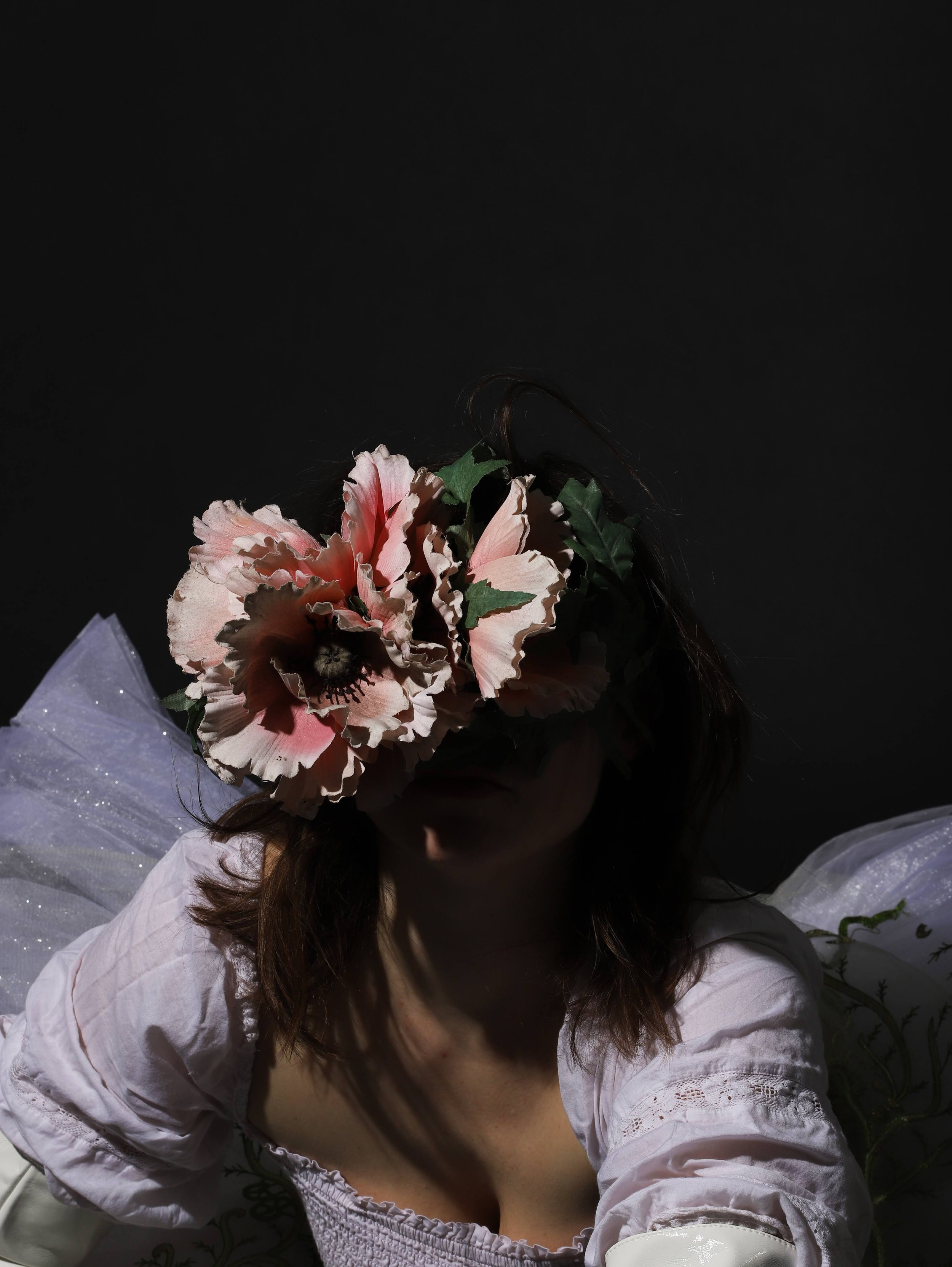
photo: Courteney Grafton, June 2026, courtesy of Iris
5.
SEA IS WOMAN
It begins with the crisis of presence of the memory of the self. Feeling co-habitation of the other or perhaps a search for one’s own being while being in place of ‘somewhere else’.
From: Greek “moinos “ = raving or mad. Maenades=raving ones. Maenad is a priestess of a frenzied ecstatic worship, uninhibited freedom. She leaves societal norms behind, embracing her primal instincts. She is an ecstatic woman with an otherworldly appearance, wearing her hair loose to symbolise her untamed nature. Her presence,showcases power and ferocity, serves as a reminder of the thin line between others and chaos, divinity and mortality. Maenad breaks all social and sexual boundaries. “They were said to have sought the "wild delirium" of possession by the god so they could "get out of themselves", which was called "ekstasis". 1. Maenad is a female liberty and living outside of form through abandonment of the self. The oreibasia ("mountain dancing") was a midwinter Dionysian rite practised by women, and said to be originally an "unrestrained, ecstatic dance where the 'human' personality was temporarily replaced by another"2. The term ‘ecstasy’ originates in the Ancient Greek ἔκστασις ekstasis, "to be or stand outside oneself, a removal to elsewhere" from ek- "out," and stasis "a stand, or a standoff of forces”.3.
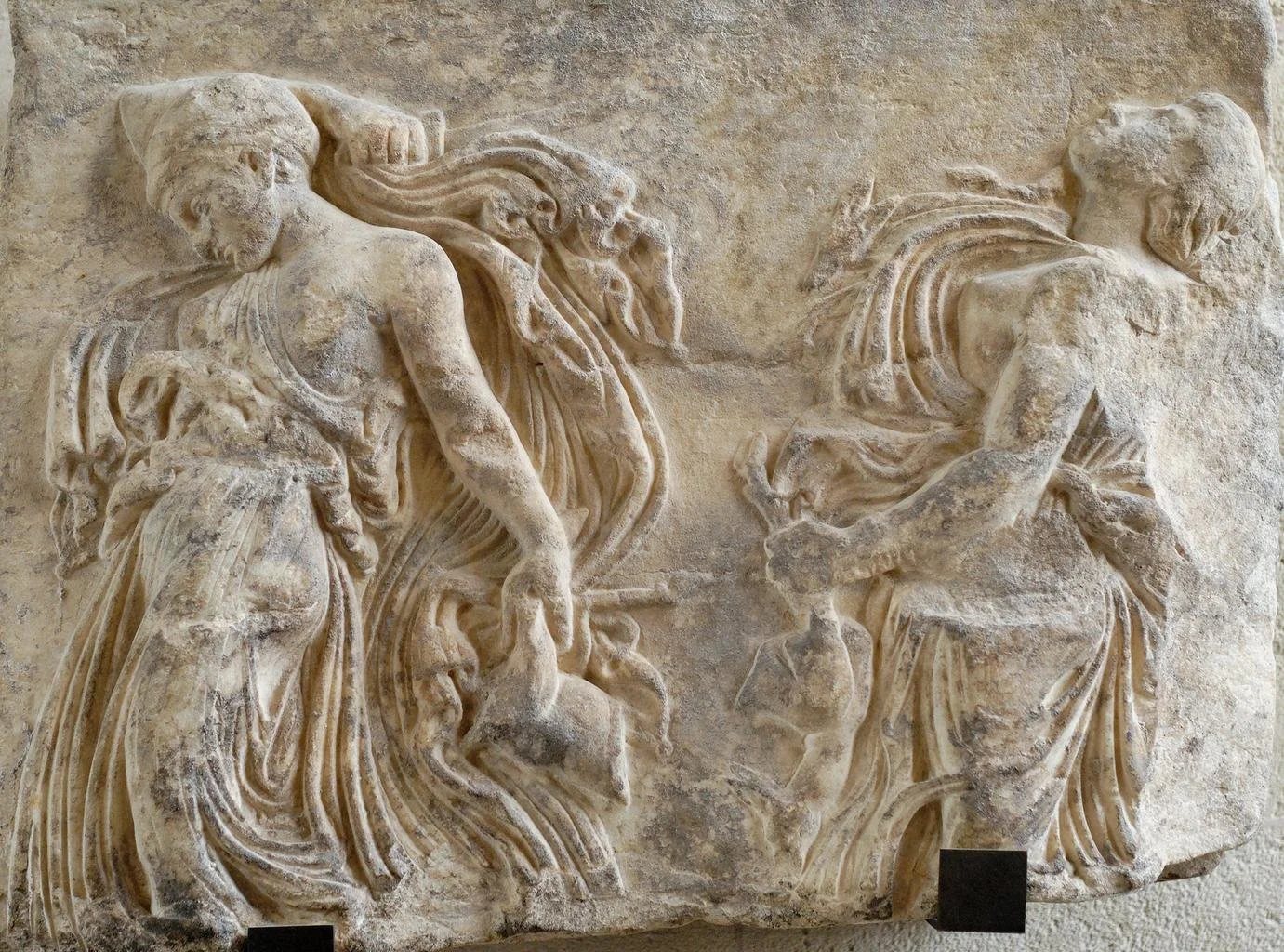
Dancing Maenads, 1st century AD, Louvre
“Liberation of Hecate” introduces ecstasy, as a state achieved by highly controlled stillness. The method of rigour, control and held tension underline aesthetics employed by Iris. Can we consider aesthetics of slowness, ecstatic? Can micromovement holding the tension serve as a point of rupture? Ecstasy is often associated with manic, spasmodic movement, but what if you can achieve ecstasy through near-stillness, with the use of extremely controlled, full of tension, slowing down? Like a star collapsing onto itself in massive gravity. Iris uses her body as a site of potential, transmitter of knowledge, a space of blurred boundaries, a temporal hybridity.
The dancer moves beyond linear order of past, present and future, and re-emerges in anywhen. She is a fleeting moment brought to form, a place of totality. She is going through an ecstatic change and experiencing the power of stillness. Reaching an impossibly slow climax. Silently screaming out windy desolation, dancing out her many masks and selves, her body is exhaling. She resides in a world where there is no outside, no otherness, and no time. Place of dark matter, a void of a space.
During Dionysia women worshippers were moving into nature, or more to the point, into the wilderness, stripping away cultural thropes and expectations, abandoning everything that was boxing them in, becoming wild themselves, leaving social restraints behind. They were Feral.
“Perception and organisation of reality is rooted in the experience of the body. A woman, a female monster, superimposed on the earth, proposes another way of being in the world, interacting with it and flowing with it.” 4. Dance and spasm are ways to regain repressed agency in the context of slowness and the way it contains internal tension. The tension of tearing apart and the tension of coming together. The stillness of standing at the edge.
As she dances, she becomes the other she is defined herself as. A despised and feared monster constitutes as a new hybrid and frees herself. Constrained ecstatic dance is an emotion transformed in flesh and surrender to wilderness. The protagonist leaves Culture with its restraining, boxing strategies, behind. It is a move to the beyond, into the territory of feral.
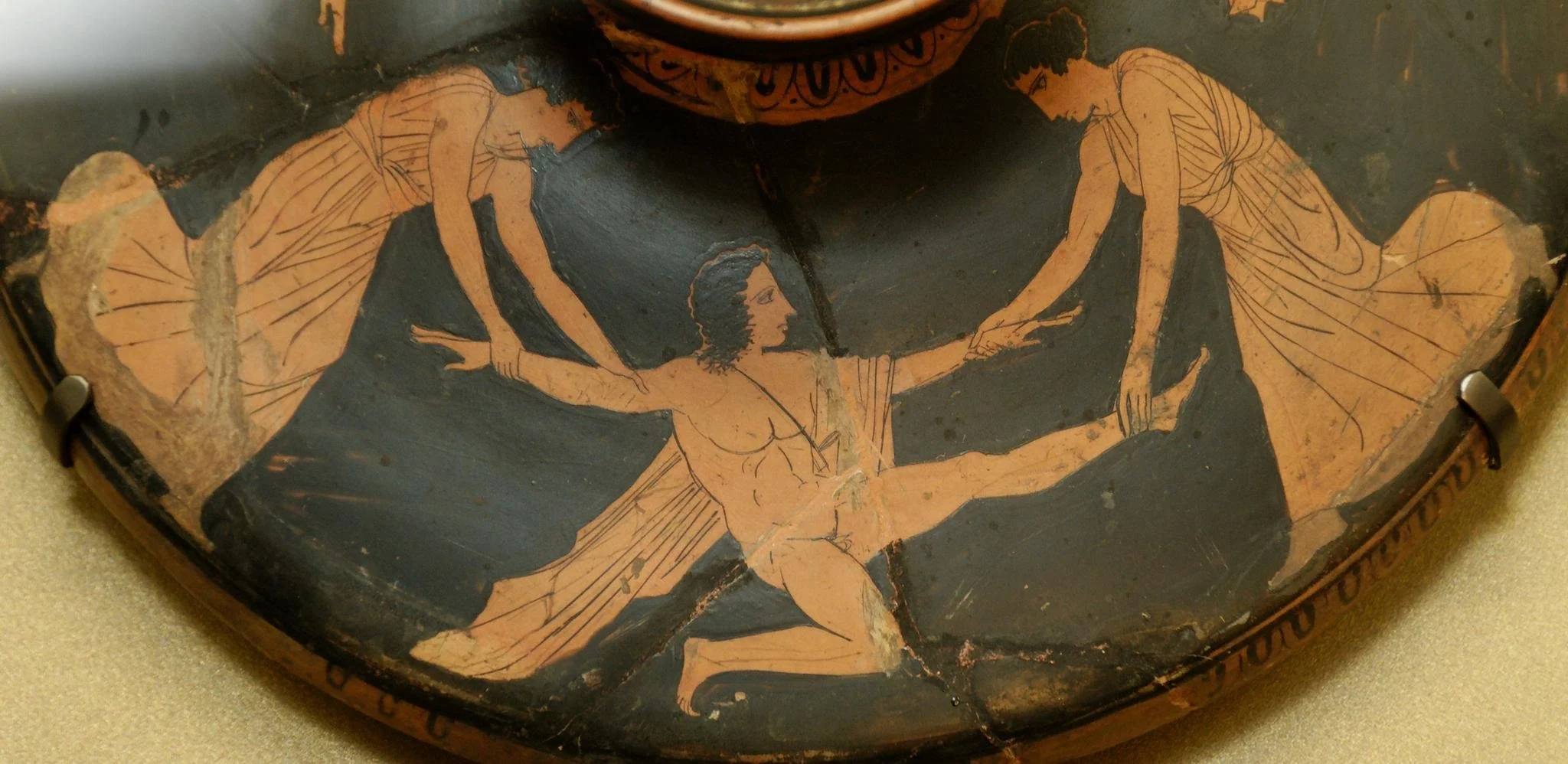
Pentheus torn apart by Agave and Ino. Attic red-figure lekanis (cosmetics bowl) lid, ca. 450-425 BC, Louvre
SPARAGMOS
Maenads’ dance begins from an action originating in Culture. It becomes a vehicle of transformation through transfer into a natural environment. Land-stage-frozen shore, all become places of change. Masks get stripped away, the sea becomes a devouring, consuming void, beings belonging to Nature torn apart in order for a monster to be reborn anew.
Constrained energy of Maenad-Hecate is translated into existence of in-between, within blurred boundary set on the territory where normative, constructed world meets a self-established other. More than skin-deep. What is inside, emerges outside of socially controlled artificial self.
The term “feral” forces attention to what was once hidden in the gap between what we consider wild and what we believe as domesticated.” ferality is (...) a quest towards the breathability of chaos’ 5. a response to the future that was made for me. The protagonist is seeking to dissolve the boundaries between self, other, human, and beyond.
“What will it take to undomesticate the world? What would a more feral world look like, and what would it entail for woman? What is the prospect of animals and nonhuman others, and women breaking free of confinement and subordination, interrupting the man-dominated world with explosions of feral freedom“ 6.
SEA IS WOMAN
“Domestication tends to be considered an entirely one-way process, a program that humans impose onto animals to transform them, over time, from wild beasts to helpful servants.”7.Perhaps here lies the endless association of women with dogs. So they know their masters and they know their place. “Ferality stems not from any particularly wild behaviour—the woman is silent, almost still, nonaggressive—but from its total resistance to being understood humanly.” 8.
The performance is a myth-place. Based on a cross over between butoh and ancient Greek tradition, both in terms of archetypes and symbolism, and in terms of dance itself. “The beginning and the ending are both stillness. They are both very still and very slow, but they possess different kinds of stillness. The first part is really about holding and keeping tension. The final part is about almost letting go. Aesthetically, it is tied around finding harmony within the stillness. explains Iris.The aesthetics of slowness was applied here to applify representation of the character, a figure that holds so much tension, that it finally begins to break down, starting to deteriorate. “Liberation” is manifested as slowing down, and stepping out of all social expectations. Breaking the restraint.
The shadowy figure is being forced to be still and to create out of that stillness. Culture acts by boxing the movement.“Dance, like other cultural products,expresses power relationships, and places them in the frame of social drama.The body becomes a vehicle for the management of a tangible cosmic movement,and factual implementation of mythology, which is relieved and re-enacted by participant in the rite. The dancer becomes a place.“ 9.
The inherent connection of a woman to the natural world, the monstrous otherness outside man-made confinement called safety, directs feminine expressions of protest against these restrictions, and it is an act of moving into plural realms of being. The protagonist calls us to consider liberation as both an individual and collective experience and to expand this inquiry onto the boundaries of what we define as freedom. 10.
The mythologies melt into this image-stage of empty shores and desolate horizons. Being in a charged, mythical place. Listening to the desolate wind. And yet, I still think of frozen sea, where all waves are icicles, impossible to transform.
The soundtrack is a landscape, it penetrates everything and everyone and makes it a place. The wind and crushing waves merge with the dancer’s body making her land, sea, place, and finally, herself. It is a landscape out of time, airless, even if subjected to endless storms. Like the sea, the shore is frozen. A place of becoming. The soundtrack invokes a sense of endlessness, as if she was standing at the edge of the sea of ice. A timeless space, a myth of a liminal shore.
HANDS OF THE OTHER
Hands of the performer become beings of their own agency. A lot of butoh dancers deal with possession or ghosts as an imagery, and hands can be very expressive in terms of possession. The way the protagonist's hands move gives the impression of being possessed by something. They have a certain uncanny quality. Introduced partly to escape the figure filled with all the pain, manifesting silent scream, gloved hands are at the beginning frozen, inanimate, and when they begin to move, they are instruments of finding the way to liberation.
Latex gloves, playful hands as if they wanted to explore the world outside of the body. They are trying things out. Non-human in movement, playful and creepy at the same time. They reach out, move, and dance, fingers tapping like strange independent beings. Alive and inanimate, born and artificial. Like something not exactly belonging to her. Like something not really alive. As if they had a mind of their own. As if they were being possessed. Sexualised. Pris, the Pleasure Model.
The protagonist’s whole body is very tense and her hands try to depart from that state, and do something different. A playful element added to something that otherwise would be almost unbearable to watch.
Drag queen skirt that became cocoon. Not exactly like a wedding dress, added gloves break a little bit this virginal image. The hands keep on escaping the controlled compact creature. Going on short trips out. While their owner goes through the change.
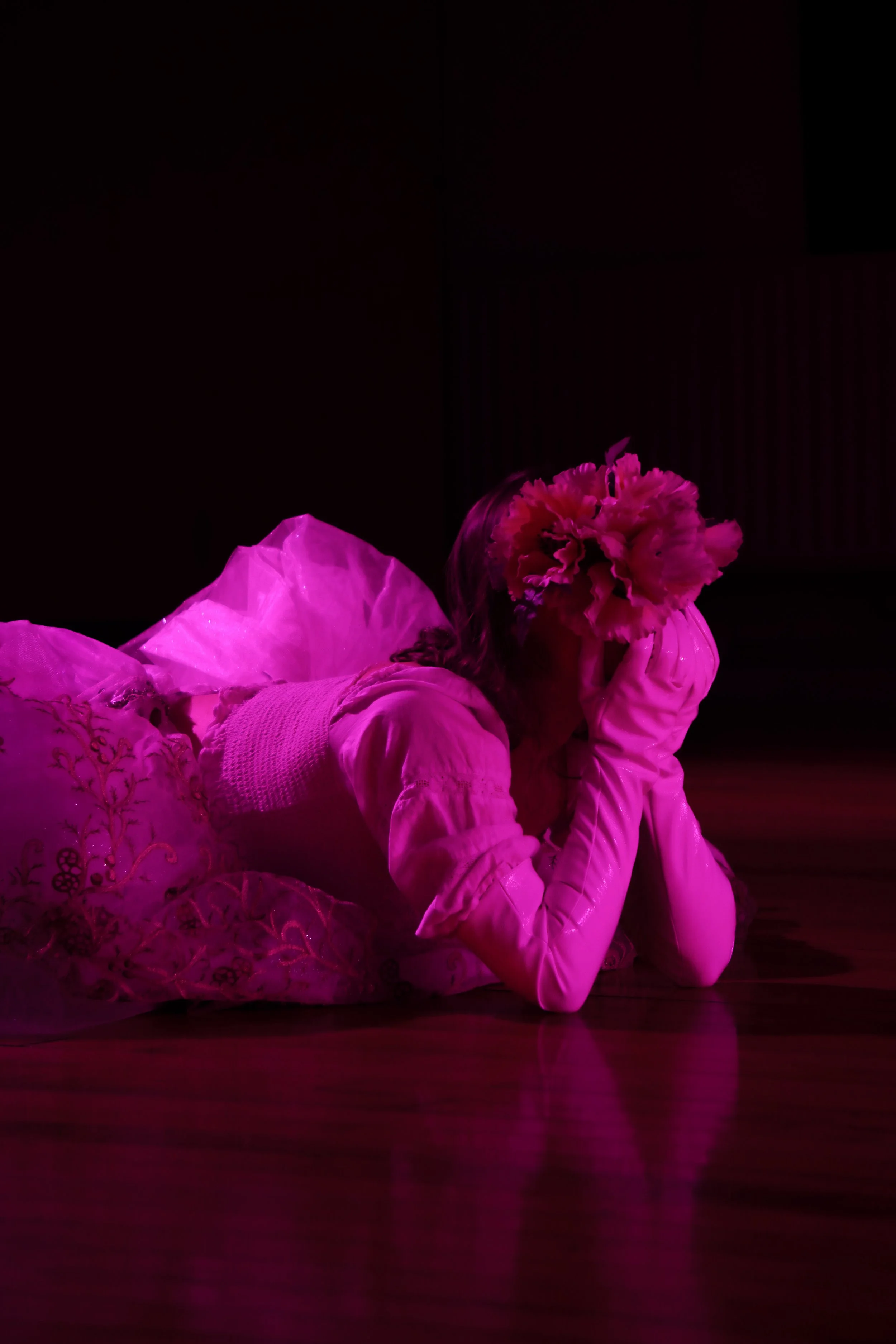
photo: @12inoxford, June 2026, courtesy of Iris
Ecstasy in “Liberation of Hecate” is a series of temporalities. Building up at an incredibly slow pace, reaching its soft seismic conclusion. Like ephemera residing at the core of the world. Impossible gravitation of new being. Bride that is a witch that is a monster.
6.
KATABASIS
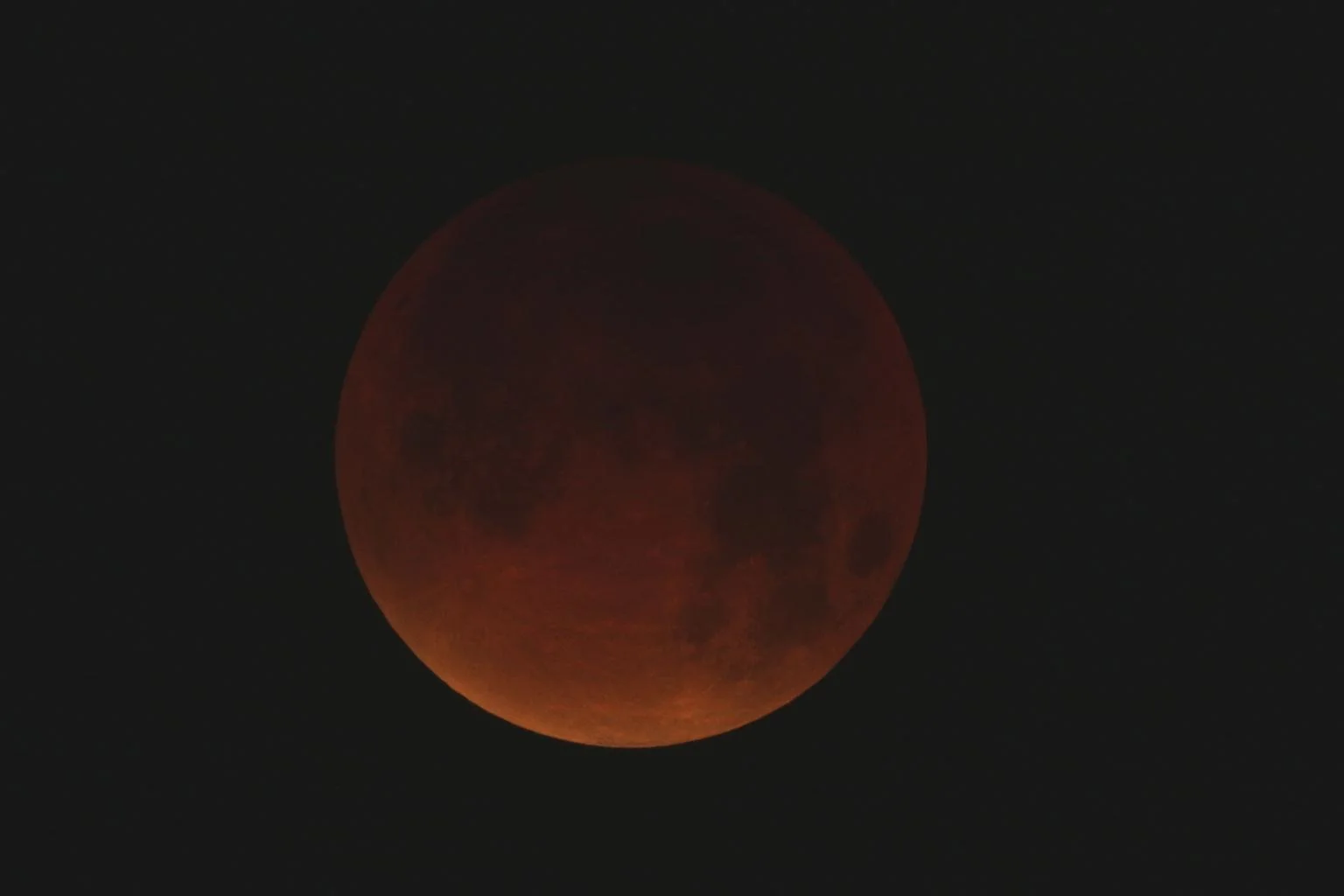
Blood Moon also known as Huntress Moon, Total lunar eclipse seen in Poland in September 2015, September 29th 2015, photo:Jaroslaw Jasinki
A katabasis or catabasis (Ancient Greek: κατάβασις, romanized: katábasis, lit. 'descent'; from κατὰ (katà) 'down' and βαίνω (baínō) 'go') A descent into the underworld, or a literary account of such a journey to the land of the dead, constituting a temporary visit followed by an anabasis (ascent). 1.
The dark, empty stage is the world. The world as a subject and as an image. The change happens through an extremely slow movement, which takes the form of a series of figures, identities, and masks. They all give birth to a singular entity. The protagonist gains a name,becomes Hecate, deity of the margins. She is accompanied by a familiar, black she-dog, which she is told is her equal . Dog and woman, both a danger of going feral and turning on their masters. The protagonist goes into hiding. She enters a dark place. Place of dark matter, a void of a space. She is in-between, as she becomes more and other,than herself. The beach is the underworld.This is a descent.
Even if still tense, the protagonist to a certain degree softens. The slowness becomes dream-like, delicate. Instead of means of holding it together, to keep the status quo, to keep appearances, it is used as a means of a transformation. The rhythm of movement and internal choreography alter.The tide morphs into waves. We move away from a desolate shore, ice formations melting. And the sea, although it remains inscrutable, becomes calmer, more alive. It gives shelter.
From being a landscape, the protagonist becomes a process, geological cadence, claiming territory. Movement in the cocoon is soft, as if she was not exactly sleeping, but resided somewhere in the shadowland, dreaming out her change. Soft mesh textile is transformed from “bride-like” dress into silk worm’s, soft, semi transparent refuge. She is elsewhere. Transforming. Chrysalis. Becoming a difference. Still & Still.
Precipice,a beyond, a boundary, a threshold, a limen.How to walk the line which is undefined?
Space between epic and elegy. The real and the symbolic, the material and of no flesh.Tidal rhythm in the performance, not only the waves. Woman,the protagonist,moves from the seabank into land (emerging).
“A cocoon is not an instrument for the projection of the self outside the limits of the anatomical body. On the contrary, it involves the construction of a threshold where all borders and identities - of self and world - are temporarily suspended. It is the chiasmus that makes the world into a laboratory of the genesis of the self, and makes the self into the most precious matter in the world, that which continually transforms it.” 2.The dancer becomes an instar 3.throughout this entire part of the performance. The remedy for the conflict lying at the base of internal split in the nameless protagonist,is to become whole,to gain the name,and identity she can regard.
The not-exactly-bride moves from being sphinx into her gown as if it was a sanctuary, needing a shelter to become her new self. Soft, determined life. A being on a threshold. She becomes a riddle. A puzzle to reflect upon, if not ready to solve.
Bridal headdress worn in such a way that is becoming a crown. Flowers mark a return to the wild. Slow controlled movement, with almost exaggerated intensity.But there is something cameral about it.Lyrical.Soft. Cocoon of a not-exactly-bridal dress. Chrysalis dreaming.
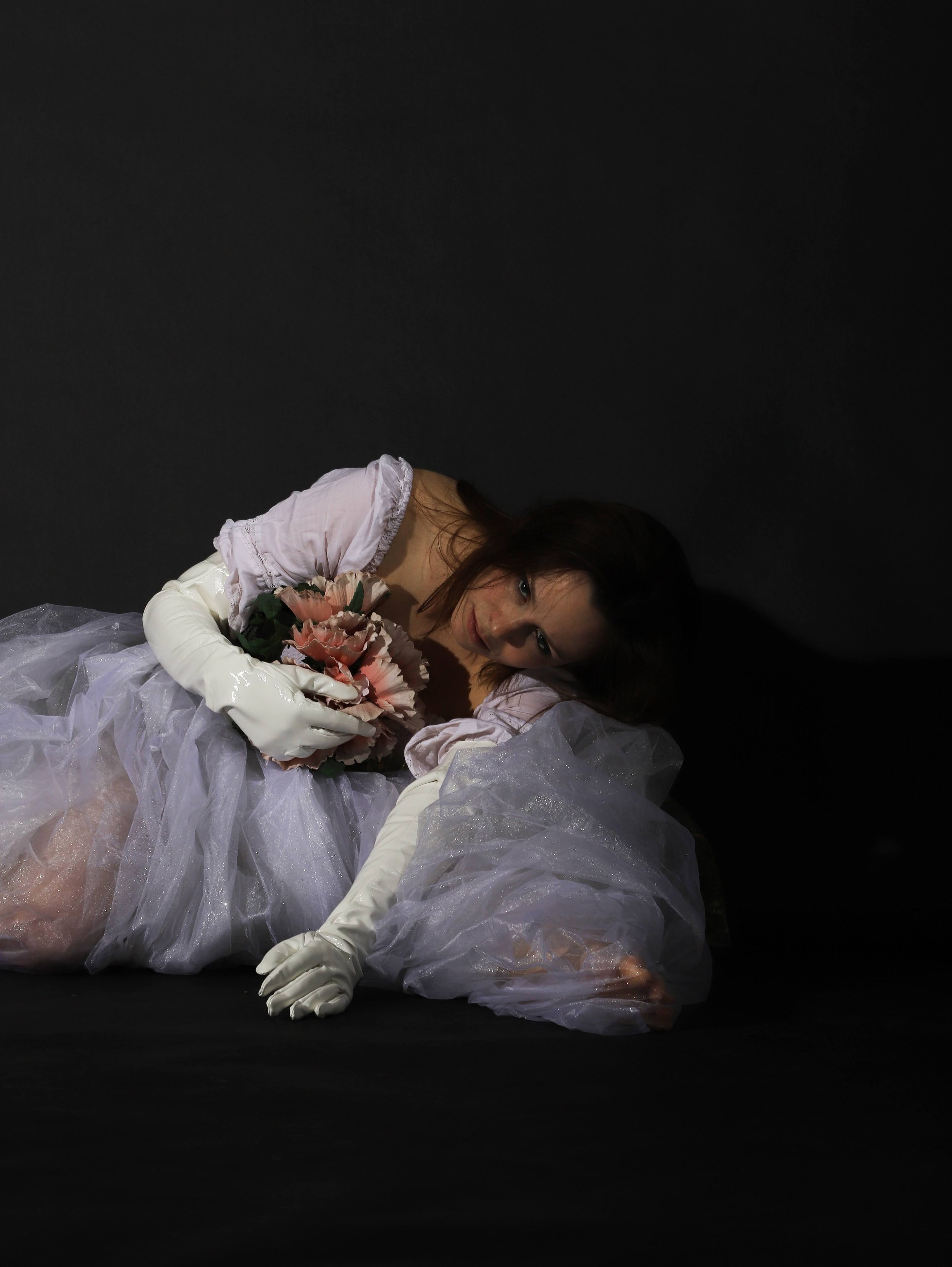
photo: Courteney Grafton, June 2026, courtesy of Iris
“The intention behind the performance was to explore the tension of holding it all together; this is what the first part is about. What happens when you let go of it all.” says Iris. 4.
The shedding of your skin. Gaining a new shape. Our form is something we continue to construct and dismantle at every moment of our existence. It begins with Hecate, the triple body, tripartite being, the three and one, separate and unified. At the same time it is as if they are fighting each other to separate. Maiden, mother and crone; singular and collective. Fragmented and whole. How can a person actually contain all of those things?
The last part of the performance-rite is placed in the future, extended into real life. 5. It belongs to Hecate, a re-born being, who at the end of dance enters the world. That entrance is the final part, the part that goes beyond the stage and merges with life. It unfolds within its own time as the newborn being. There isn’t a real end, no real closure, but a life to be lived, and self to recognise. Over and over and anew.
“Liberation of Hecate” plays with the notion of female monstrosity in a dual sense. The monstrosity imposed by patriarchal society, and the monstrosity claimed as a way of liberation. It explores how a woman is a monster, and who decided that she is, and especially how a woman who doesn’t follow the rules becomes a monster. She is something that is called unnatural, while non-normativity is in fact a deeply cultural phenomenon. Performance is the process of learning to accept the monstrosity of her own self.
Time gravitational density is part of dance, of possession, and of being elsewhere. Who is the other? Dance brings forth the effect of self-understanding. An amorphous shape within the fabric manifests the soft density of midnight star. Ongoing process of revolt. Slow turns where the cosmos begins and ends in the female body.
STILLNESS
What if we think of it from a physical point of view? The chemical changes in repeatedly contracted muscles. Their tightly controlled movement is a mirror to change of the self. Like real chrysalis, the protagonist-puppa goes through metamorphosis to emerge anew. Can we speak of molecular change that happens in the muscle as a mirror to the internal, psychological transformation happening during the performance? The way body chemical structure breaks down, and morphs during strenuous movement, this slow ecstatic tension. Like micromovement, this (al)chemical processes are to be a mirror to transformation building a new body ? Transmutation that happens within the flesh itself, where movement is a way to achieve equally conceptual and visceral shift.
In this case the place of performance is not a stage, but a laboratory., a place where myth, memory, and transformation intertwine. The protagonist descends to the underworld to find their real self. It is no longer dance, but a new cosmology, spreading into the world together with newly ascended Hecate.
“ The flower is the proof and manifestation of a principle of absolute anatomical and somatic plasticity: to have a body no longer means to exist in one form, but to have the power to translate any one form into another.” 6.
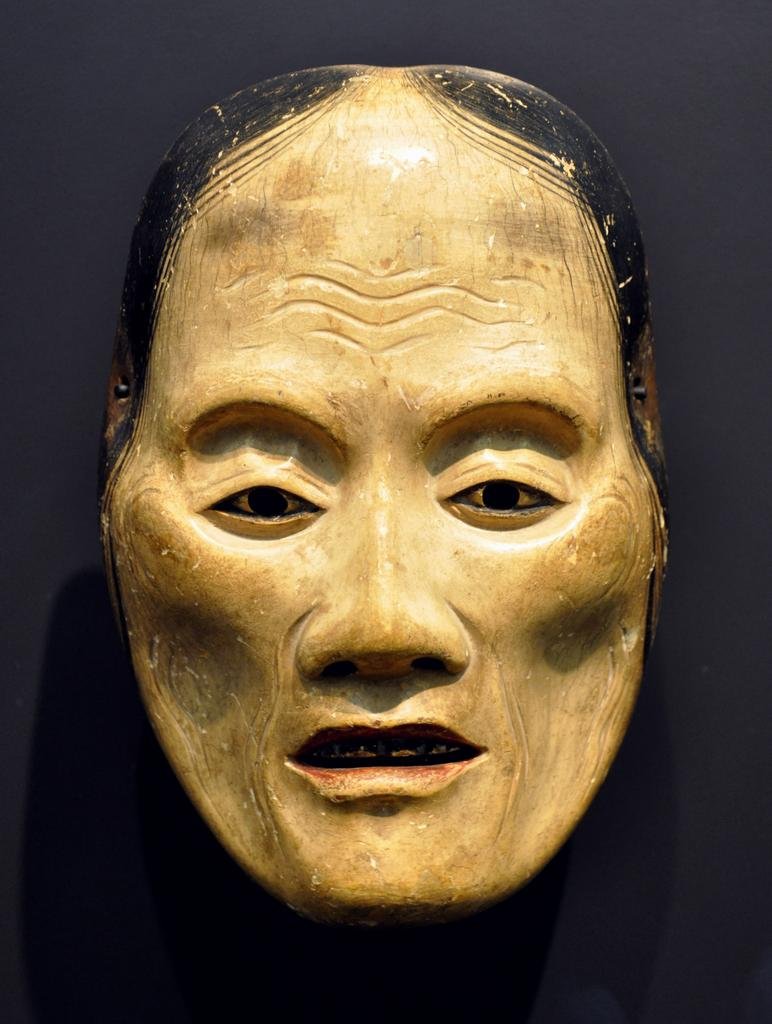
No Theatre Mask, Rojo, Museum Rietberg, photo: Andreas Praefcke
7.
MONSTER IN THE SHADOWS
Goddess of the underworld, the chthonic being, Hecate, the old wise woman, the oracle; the dark, destructive and thereby, life-giving fate. She surpassed dualities of life and death, male and female, and is able to create everything from her own source. She is a primordial divine, or more abstractly, the void.
Thanks to her association with boundaries and the liminal spaces between worlds, Hecate is recognized as a chthonic goddess. As the holder of the keys that can unlock the gates between realms, she can unlock the gates of death, as described in a 3rd-century BCE poem by Theocritus . (...) Like Hecate, "the dog is a creature of the threshold, the guardian of doors and portals, and so it is appropriately associated with the frontier between life and death. (...) Hecate was seen as a triple deity, identified with the goddesses Luna (Moon) in the sky and Diana (hunting) on the earth, while she represents the Underworld. Dogs were sacred to Hecate and associated with roads, domestic spaces, purification, and spirits of the dead.(…) Netherworld goddess Chthonia (Χθωνία), of the earth/ underworld.“ 1.
What are the reasons for naming female monsters? What is in her name? Who is the monster in the shadows? When I look at the protagonist in the centre of the empty stage, I think of her image, of her reflection, the reflection she is to become,-the witch. The audience vanishes, and I see Hecate with her companion, black she-dog at her side. She is facing the sleeping terror of a frozen sea. Woman, dog and sea. All animals, all dangerous, all monstrous. Poetry is like a swell of the ocean. My feet are firmly anchored in the ground reaching out to the layers of soil. I bark. My paws feel soft sand. Cold from the snow on the beach. I look up to my mistress. She is looking towards the sea. Towards the horizon. She is getting ready for the change. My body is exhaling and inhaling, reconnecting with the world, seeking out the other, sharing an ecstatic experience of language of self-definition. I look at the dancer. She is ready for her riddle.
A woman's self and body are mysteries, and their inexplicability remains marked as monstrous. Becoming Hecate is a process of learning to accept the protagonist's own freakishness. It is her un-normative quest for agency. Unmarried, means standing outside of accepted norms, unstable and uncontrollable in the female liminality. Standing on the fringes. Or to be accurate, it is an acceptance of being feral. Hecate is a monster since she left domestication behind.
The performer is dressed in a selection of clothes that seem to represent a series of different types of women. A simple white cotton, short-sleeved top. A top young woman would wear. Even a girl. White full mesh skirt. Not quite a ballerina. Bride’s skirt. Finished with another layer of embroidered fabric. It’s leaf green. Floral headdress completes the look. Botticelli’s Spring. She is also wearing long white wet look gloves. Latex gloves. Blow up doll gloves.The entire outfit is a combination of cliches and narratives weaved around women. An assemblage of female archetypes seen through the eyes of men.The virginal bride, blossoming at the start of her adult life. A young girl. Not yet a woman. Lolita. The not-quite-bridal skirt. The dominatrix. The dominated? Latex gloves. Pris, Pleasure Model. The not-exactly-bride. Hecate. The witch. The woman in the shadows.
It is not necessarily the dominant position they fight for, but a space to exist. So many faces, so many bodies, so many figures, so many myths. So many expectations. Each face becomes the next, one morphing into another, like projections, as if in a dream. They are more like a disturbed mirror, the surface of a lake.
How to remain many, but also to become one? Is this really possible? The woman in the shadows is a MONSTER. Impossible to read. Prostitute hunts. Deceitful woman fawns. Unmarried girl is wild. Female genitals are mouth.
Maybe Hecate’s liberation is the right to stay in the shadows? Her face unreadable, fused with the surrounding darkness. Maybe that is what it is? To allow herself to be a cypher, a figure seen in the dusk, residing on the periphery. Like something out of focus, visible only for a blink of a moment, from the corner of an eye. A glimpse. A reflection in rapids, a blurred photograph, a half-forgotten dream. If you call her, she comes with her unreadable face.
The protagonist embraces her own becoming. A female deity who learns to become her own self, a woman who stands in her own right. Wearing a triple-faced mask, she is associated with the darker side of human experience. All these Greek monsters that are female. Medea killing her children because there is a liberation in that act.
Moving from Culture to Nature the protagonist becomes still. It is stillness of rock, stillness of a mountain. In fact I believe that this action is to leave behind Nature and Culture as both are modernist, Man-made constructs, and move into wild, animalistic territory of the feral.
As monster changes, the Culture is being stripped away. Performance space becomes a planetary process. Of time belonging to a different realm.
Hecate accepts all of these characteristics, because she is not human. She is a female other in the shadows. This figure doesn’t give birth to anything, but herself, and in the end becomes very still and very unproductive. Very inert. This inertia is important. It is a refusal to take part. Nonconfirmist to the bone. To leave patriarchal framework of existence is to come to terms with femininity in the larger framework of Western modernity. To embrace being a monster. To be an animal, dog and sea. To be a devouring mouth. A castrating figure. A silhouette in the shadows. Barely visible. To stand on the empty desolate shore. To be a terrifying Deep. To know yourself.
Dog. Monster. Shore. Figure in the shadows.
Onthophagus, M, Side, MD, Charles, Indian Creek
"Troy fell and Priam too. His ill-starred wife [Hekabe (Hecuba)] lost, after all besides her human shape; her weird new barking terrified the breeze on foreign shores where the long Hellespont contracts in narrows (…)
Hecuba, rage linked with grief, oblivious of her years (…) made her way to Polymestor, author of that foul murder, and sought an audience (…).She attacked the king and dug her fingers in his eyes, his treacherous eyes, and gouged his eyeballs out (…) Incensed to see their king's calamity, the Thracians started to attack the queen with sticks and stones, but she snapped at the stones, snarling, and when her lips were set to grame words and she tried to speak, she barked. Then still remembering her ancient ills, she howled in sorrow through the land of Thrace."
Ovid, Metamorphoses
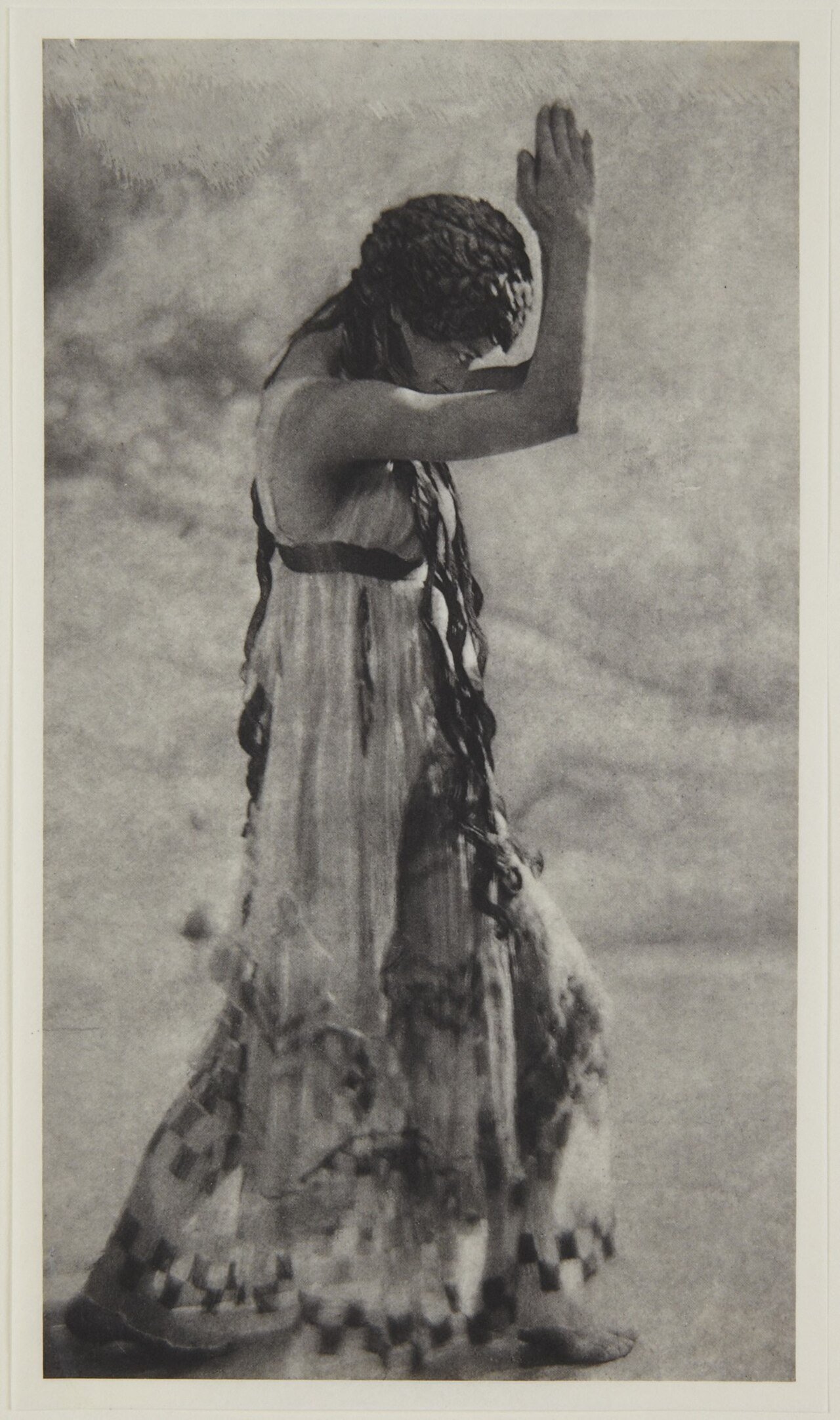
Danseuse de profil, Adolf de Meyer, 1912
8.
THE 9TH WAVE
Sometimes I think of Pulsars as a transmission of recurring thought. The triple creature who stood at the frozen shore slowly transformed. Her near stillness only a pretence.
In 1985. Kate Bush released as side 2 of the album ‘Hounds Of Love’‘The Ninth Wave’, a suite of seven songs, written as a concept piece.
The suite consists of the following tracks:
And Dream Of Sheep
Under Ice
Waking The Witch
Watching You Without Me
Jig Of Life
Hello Earth
The Morning Fog
Bush described her “The Ninth Wave” as a story of a person being in the water, washed over the side of a ship. “The person has a life jacket with a little light. (...) They are completely alone at the mercy of their imagination, (..) absolutely terrified,” 1
I think of The Ninth Wave often. Like ” The Ninth Wave", "Liberation of Hecate” is a story of going elsewhere and re-emerging transformed. The suite makes me think of katabasis, travelling to the underworld, abandoning it behind in order to change. When I hear the soundtrack of “Liberation” improvised and performed by “In Field Lines” I think of being in the water with my own imagination. Small being in the great swell. And I think of the frozen shore. Frozen shore that i s not really the end, but is a beginning, showing distant horizon and endless possibilities that transformation in your true self offers.
The nameless protagonist stands on the shore leaving behind all masks and faces assigned to her. Instead she decides to find a face that is her own. She enters the frozen sea, responding to the crush of icicle waves. Going under.In one of his books Carlo Rovelli described the phenomenon of White Holes. They are what is awaiting at the other side of Black Hole, past Event Horizon, and the places where time bounces back.
It does not come back identical, nothing repeats in the universe, but it bounces back anyway, returning to its starting point, transformed, different, changed. Dance is a seismic activity, a gravitational wave, the bottom of Black Hole where it turns white and it bounces back like time.
‘Liberation’ is a search for a different kind of unity with reality achieved through the state of ecstasy. Movement is a way of making contact,a transitional state, being somewhere else. It is a gift. It is an embrace. It is instability embedded in life. Hecate feels cosmic vibration through the soles of her feet.
Dance is a sculptural process of re-forming of the self. Movement that ruptures into a code of presence. A pulsation of being. Hecate forgets herself just to remember again. The time is not split, but co-existent through many overlapping and intertwined paths. Engaged in a story of disappearance, you need to vanish to re-emerge in this perpetually apocalyptic moment.
Women dance to show their ideas. In deconstructing the matter, I let myself fall, words and images merge, differences fuse, in flickering darkness. A shape-shifting experience. A practice of utterance. An idea of disorder. Spasm is a chaos of the world breaking through an Impossibly slow ecstasy. Expanded present. Almost-stillness.
Ecstatic chaos is an order of the world coming together. An inquiry into the nature and limits of female empowerment.
The intimate texture of air I am breathing. Hiding behind the mask. The sea roars, the waves crash, the surf thunders. Wind blows over silent space. Performance space becomes a landscape.The monstrous breath of the female sea. It is an emptiness of the primeval world. A shore. Circulation of grinding, polishing rhythm of the relentlessness of waves. Dog, woman and sea consume the world as it was. And the woman in the shadows establishes it anew. HECATE. THE POETESS.
The heroine stays in a space suspended between Culture and Nature, between land and sea, a connective tissue between two worlds, an auspicious environment in which one can seek intercession with their identity. The shore is a threshold. She translates herself onto it.
I move to the realm of the undomesticated. This is how I want to be. This is how I want to remain. I regard myself in Hecate’s eyes. Berries sprouting from my mouth.
Feral.
The idea of endless falling…
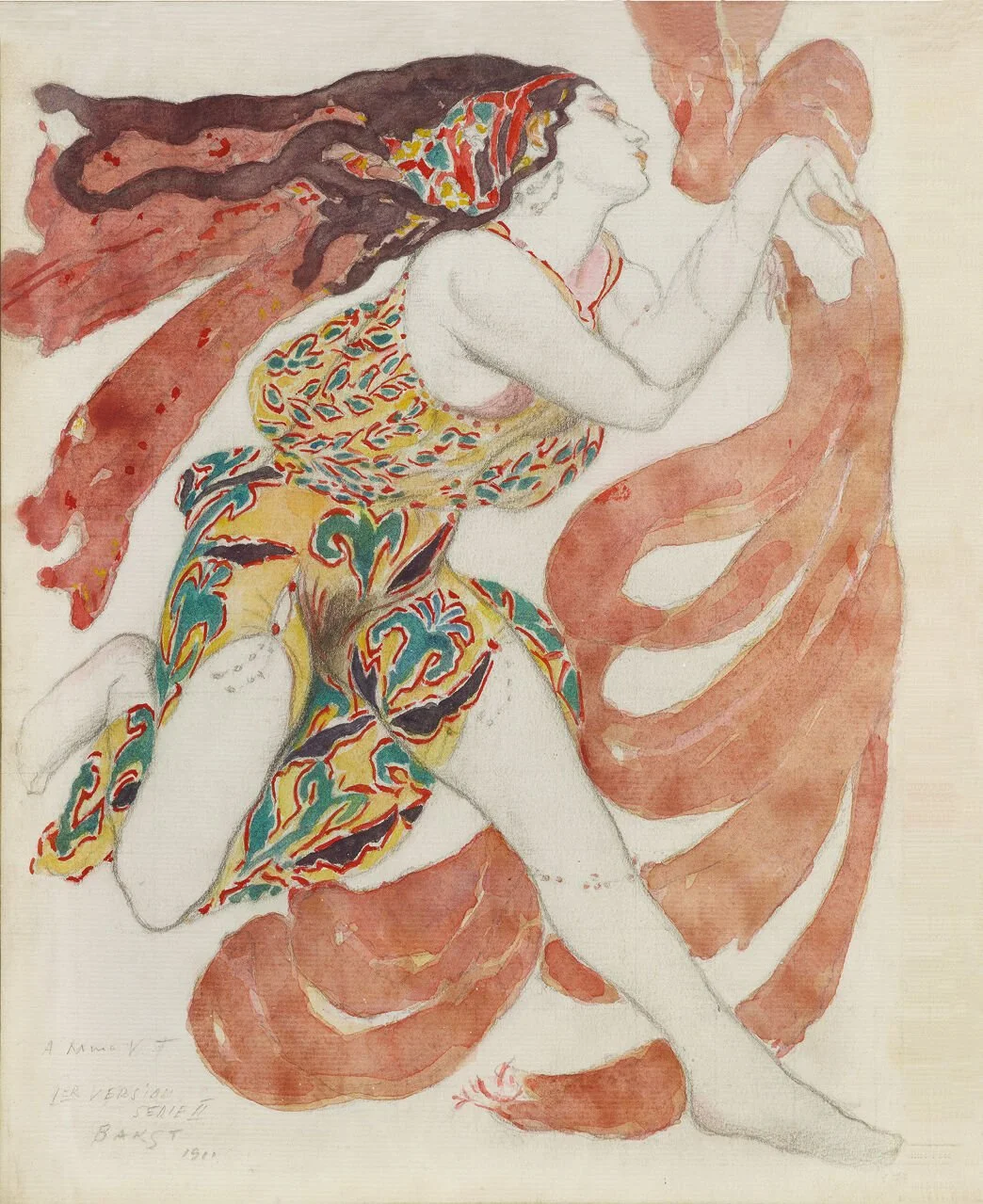
Bacchante for Narcisse, Leo Bakst, 1922
* This text is written from two vantage points of “i” and “her”, 1st and 3rd person, performer and woman in an audience, writer and dancer, woman and she-dog, because one is the other. They reflect one another. She is me and I am her.
1.FROZEN SEA
1. Rabinowitz, Jacob. The Rotting Goddess: The origin of the witch in classical antiquity's demonization of fertility religion.Autonomedia, 1998.
2. Some point to similarities with “Raft of Medusa” by Theodor Gericault. For initial summaries of Friedrich’ works please look up david. (2023b, September 29). The sea of ice. 250 Jahre Caspar David Friedrich. https://cdfriedrich.de/en/chronicle/das-eismeer/
3. In Titane Hecate was worshipped in the Temple of Athena: "In Titane there is also a sanctuary of Athena, into which they bring up the image of Koronis [mother of Asklepios] ... The sanctuary is built upon a hill, at the bottom of which is an Altar of the Winds, and on it the priest sacrifices to the winds one night in every year. He also performs other secret rites [of Hecate] at four pits, taming the fierceness of the blasts [of the winds], and he is said to chant as well the charms of Medea." Pausanias, Description of Greece 2.12.1
2.SEA IS GULLET
1.Hopman, Marianne Govers. 2012. Scylla., p.I
2. Nuriye Külahlı, and Hüseyin Üreten. 2025. “Dog In Ancient Hellenic Culture.” Sinop Üniversitesi Sosyal Bilimler Dergisi 9 (2): 1268–96. https://doi.org/10.30561/sinopusd.1773349.
3. Nuriye Külahlı, and Hüseyin Üreten. 2025. “Dog In Ancient Hellenic Culture.” Sinop Üniversitesi Sosyal Bilimler Dergisi 9 (2): 1268–96. https://doi.org/10.30561/sinopusd.1773349.
4. Hopman, Marianne Govers. 2012. Scylla., p.55
5. Nuriye Külahlı, and Hüseyin Üreten. 2025. “Dog In Ancient Hellenic Culture.” Sinop Üniversitesi Sosyal Bilimler Dergisi 9 (2): 1268–96. https://doi.org/10.30561/sinopusd.1773349.
6.Hopman, Marianne Govers. 2012. Scylla., p.19
7.Hopman, Marianne Govers. 2012. Scylla., p.81
8.Hopman, Marianne Govers. 2012. Scylla., p.16
9. Hopman, Marianne Govers. 2012. Scylla., p.19
10.Hopman, Marianne Govers. 2012. Scylla., p.19
11.Hopman, Marianne Govers. 2012. Scylla., p.9
12.Hopman, Marianne Govers. 2012. Scylla., p.53
13.unpublished Radical Breathing collective (Patrycja Wojciechowska and Giulia Ottavia Frattini) research on commons, female grief and embodied ways of working Radicalbreathing__
(n.d.). Https://Www.Instagram.Com/Radicalbreathing__/.
14.unpublished Radical Breathing collective (Patrycja Wojciechowska and Giulia Ottavia Frattini) research on commons, female grief and embodied ways of working Radicalbreathing__
(n.d.). Https://Www.Instagram.Com/Radicalbreathing__/.
15.unpublished Radical Breathing collective (Patrycja Wojciechowska and Giulia Ottavia Frattini) research on commons, female grief and embodied ways of working Radicalbreathing__
(n.d.). Https://Www.Instagram.Com/Radicalbreathing__/.
16. Hopman, Marianne Govers. 2012. Scylla, p.10
3.SEA IS ANIMAL AND SEA IS WOMAN
1.Su, T. (2003) ‘The mask of Dionysus: Epiphany and confrontation at the limits’, NTU Studies in Language and Literature, 12, pp. 1–22, p.3
2.“Definition of MASK.” 2019. Merriam-Webster.Com. 2019. https://www.merriam-webster.com/dictionary/mask.
3.Kafka, F. (1993). Collected stories of Franz Kafka. Everyman’s Library.
4. THE SPHINX AND THE RIDDLE
1.Wise Bauer, S. (2007). The history of the ancient world. W. W. Norton & Company.
2.Baldock, A. B. S. (2022). Body (of) Knowledge: Women, the Body, and Dance in Postwar Japan. The Journal of Asian Studies, 81(2), 365–379, p.366 https://doi.org/10.1017/s0021911821002266
3.unpublished interview with Iris
4.Sanders, Vicky. “Dancing and the Dark Soul of Japan: An Aesthetic Analysis of ‘Butō.’” Asian Theatre Journal. 5(2), no. Autumn (1988): 148–63.
5.Baldock, A. B. S. (2022). Body (of) Knowledge: Women, the Body, and Dance in Postwar Japan. The Journal of Asian Studies, 81(2), 365–379, p.372 https://doi.org/10.1017/s0021911821002266
6.Vangeline Theater. (2026, May 29). Vangeline Theater/New York Butoh Institute. Vangeline Theater/New York Butoh Institute. https://www.vangeline.com/writings
7.Unpublished interview with Iris
8.Cuter, R. M., Lacan, J., Miller, J.-A., & Sheridan, A. (1980). Concepts of psychoanalysis. Political Psychology, 2(1), 83. https://doi.org/10.2307/3790977
9.Nina Triaridou. (2022, March 31). Lamia, sirens, and female monsters: Feminist reframings of classical myth in 19th-Century literature. Antigone. https://antigonejournal.com/2022/03/lamia-sirens-keats-andersen/
10.Nina Triaridou. (2022, March 31). Lamia, sirens, and female monsters: Feminist reframings of classical myth in 19th-Century literature. Antigone. https://antigonejournal.com/2022/03/lamia-sirens-keats-andersen/
11.Nina Triaridou. (2022, March 31). Lamia, sirens, and female monsters: Feminist reframings of classical myth in 19th-Century literature. Antigone. https://antigonejournal.com/2022/03/lamia-sirens-keats-andersen/
5.SEA IS WOMAN
1. Daniélou, Alain (1992). Gods of Love and Ecstasy: The Traditions of Shiva and Dionysus. Simon & Schuster. pp. 81–82. ISBN 978-1-62055-023-6.
2.Oesterley, W. O. E. (2022). The sacred dance a study in comparative folklore. Creative Media Partners, LLC.
3. Driesen, J. Glenn (2011). "Enstasy, Ecstasy and Religious Self-reflection: A history of Dooyeweerd's Ideas of pre-theoretical experience" (PDF). Archived from the original (PDF) on 2016-03-04
4.(n.d.). Https://Www.Instagram.Com/Radicalbreathing__/.
5. (n.d.). Https://Www.Instagram.Com/Radicalbreathing__/.
6.Sophia Booth Magnone,“Feral Feminisms » FINDING FERALITY IN THE ANTHROPOCENE: MARIE DARRIEUSSECQ’S ‘MY MOTHER TOLD ME MONSTERS DO NOT EXIST.’” 2026. Feralfeminisms.Com. 2026. https://feralfeminisms.com/ferality-in-the-anthropocene/.
7.Sophia Booth Magnone, “Feral Feminisms » FINDING FERALITY IN THE ANTHROPOCENE: MARIE DARRIEUSSECQ’S ‘MY MOTHER TOLD ME MONSTERS DO NOT EXIST.’” 2026. Feralfeminisms.Com. 2026. https://feralfeminisms.com/ferality-in-the-anthropocene/.
8.Sophia Booth Magnone,“Feral Feminisms » FINDING FERALITY IN THE ANTHROPOCENE: MARIE DARRIEUSSECQ’S ‘MY MOTHER TOLD ME MONSTERS DO NOT EXIST.’” 2026. Feralfeminisms.Com. 2026. https://feralfeminisms.com/ferality-in-the-anthropocene/.
9.de Nardis, A. (2023, February 19). Dancing bodies: Dance as an expression of the sacred. Preistoria in Italia. https://www.preistoriainitalia.it/en/2023/02/19/corpi-danzanti-la-danza-espressione-del-sacro/
10.(n.d.). Https://Www.Instagram.Com/Radicalbreathing__/.
6. KATABASIS
1.Wikipedia Contributors. 2019. “Katabasis.” Wikipedia. Wikimedia Foundation. October 18, 2019. https://en.wikipedia.org/wiki/Katabasis.
2. Coccia, E. (2021). Metamorphoses. John Wiley & Sons., p.49
3..*instar ˈɪnstɑː noun
a phase between two periods of moulting in the development of an insect larva or other invertebrate animal
4. Unpublished interview with Iris
5. Giovanna Parmigiani who writes on contemporary tarantism proposes the time mode of ‘expanded present’, an analytical category that challenges past,present and future lives emerging through the process of recognising synchronicities of associations and connection to what is to come. Challenging ontologies of time and rationality both in human and more-than-human worlds.Can we consider the last part of the performance,that moves beyond the stage, into reality? An example of an expanded present.
6.Coccia, E. (2021). Metamorphoses. John Wiley & Sons., p.76
7. MONSTER IN THE SHADOWS
1. Wikipedia Contributors. 2019. “Hecate.” Wikipedia. Wikimedia Foundation. November 7, 2019. https://en.wikipedia.org/wiki/Hecate.
2. Ovid. 1998. Metamorphoses. Oxford Paperbacks.
8. THE 9TH WAVE
1.Richard Skinner, “Classic Albums Interview: Hounds of Love”. BBC Radio 1, 26 January 1992
Fall Web Worm and Spiny Elm Caterpillar: FAll Web Worm (Hyphantria cunea Drury), Commissioners of Fisheries, Game and Forests (1900) Fifth Annual Report of the Commissioners of Fisheries, Game and Forests of the State of New York, 1899
‘The Liberation of Hecate’ is a feminist butoh performance which explores the roles imposed upon contemporary womxn. The work begins with the idea of the triplet that accompanies the image of Hecate, an image of wholeness represented in three unified parts. These parts begin to break down and unravel as the work moves through completeness, multiplicity, fracturing, and stillness. Audiences encounter statues, creatures, and wild gardens growing up from amongst rubble in a piece that fluctuates between extreme slowness and sudden, eerie movement. Resistance and liberation come from defiant stillness, that the way to escape expectation is to reduce as much as possible.
This project is a collaboration with In Field Lines. In Field Lines is a moniker of London based Artist Ethan Garrett. This project aims to lie on the boundary between dance and art, warping vocal, instrumental and field recordings into strange, beat driven soundscapes.
The piece premiered at Chisenhale Dance Space, London, UK, on 15th May 2026, and will be performed at Summertown Arts, Oxford, in November 2026.
*
Iris (Alice Baldock) trained in ballet and contemporary dance since the age of three, and in 2021 started to practice butoh in Tokyo with that late Nakajima Natsu, and now studies under internationally-acclaimed dancer Vangeline. Since 2021, her practice has shifted to incorporate butoh. She is also a scholar with a focus on gender and history.
In Japan, she appeared in Nakajima Natsu’s Yume no yume, oku no oku, nokori no hi (April 2022), and performed a solo piece, ‘Mizu/ Water’ in butoh company Mutekisha’s Kokkyounaki Karada (July 2022). She is part of the performance art collective BEIMA in Oxford, who perform durational and site-specific work, and has been a member of the London Butoh Dance Company, whose most recent performance ‘iFlash: Anatomy Not Found’, interrogates human relationships to technology. Iris performed ‘Fruit of My Woman’ in Oxford, New York (Queer Butoh Festival 2025), and Belgium in 2025. Her current work ‘The Liberation of Hecate’, is currently touring.
