‘My purpose is to tell of bodies which have been transformed into shapes of a different kind’
Metamorpohses, Ovid
‘Power is today based upon abstract relations between numerical entities. While the sphere of finance is ruled by algorithms that connect fractals of precarious labor, the sphere of life is invaded by flows of chaos that paralyze the social body and stifle breathing into suffocation. There is no political escape from this trap: only poetry, as the excess of semiotic exchange, can reactivate breathing. Only poetry will help us through the apocalypse that is already raging as an effect of decades of financial absolutism. Only poetry will soothe the suffering of the engineer’s mind and the poet’s mind, and will act to reverse the financial sphere’s grip upon language.’
F.B. Berardi
“Breathing. Chaos and Poetry.”
My research at Domus emerged from the preoccupation with poetry as expression of ineffiable in language standing against algorithmic realities of cognitive commodification of the world.
Originated in long-term project An(Other) Breath, which focuses on exploration of poetry and respiration as forms of resistance, my proposal is of poetic gesture free of evaluations, prescriptive reductionsm and accelerating breathlessness.
I think of my time in Galatina as a breathing sequence, weeks of temporalities and rythms, a structure evolving around intake and release of air, happening at different speeds like a vibrational atlas.
My initial inspiration emerged from the reading of “Breathing. Chaos and Poetry.” by Italian philosopher Franco ‘Bifo’ Berardi whose practice has been always closely associated with poetry, and analysis of collective unconscious. The book was an investigation of how our shared psyche in the contemporary world involves looking into zones of digital communication and prescriptive language of numerically driven market.
In his book Bifo poses a question: What if we look at language of poetry as one escaping definition, rules, evaluations and measurements imposed by the digital market, and run by the algorithmic infosphere of today? A place where language is in service of the global market, ruled by commodification of everything and everyone.
Poetry, on the other hand, does not have immediate value, cannot be clearly defined, it does not allow prescription. Nor does it bend to rules of cold logic of 0s and 1s.
My initial connection with the figure of tarantata originated in a deep seeded feeling that her actions are a reaction to a state of breathlessness. The tarantata fights suffocation. Poetry is, in her case, manifested in spasmodic movement. Frenetic dance is a means to regain rhythm, cosmic attunement and breath. Her irrational identity very much aligns with protest against the ‘project of reason’ that Berardi describes. And her irrational identity is like herself, Other.
For Berardi‘Rhythm is the inmost vibration of the cosmos. And poetry is an attempt to tune into this cosmic vibration, this temporal vibration that is coming and coming and coming.(...) Reality, in other words, is the sphere of human interaction and communication secreted by language and refined by poetry. (...) There is no earthly measure, so our sense of measure (rhythm) is only a projection of our breathing: poetry.’*‘Breathing and Chaos’ is an essay on therapeutic power of resistance, in the same manner as tarantism is a process of healing. Berardi’s book is dedicated to the contemporary condition of breathlessness. He presents poetry as the metaphor of the only line of escape from technocratic suffocation. And his argument is rooted in the postulate that the intimate texture of being is breathing; and breath is a poetic rhythm.
How can we emancipate through undefiable, unlimited language of poetry? In this project the understanding of poetry is beyond words (written or recited), it’s an application of undefiable language to describe the unspoken, it’s a communication that is considered free and in-valuable. I wanted my research to take place within a conceptual crack, as in a way, this work is about difference, about different ways of being.
Tarantism means an encounter with the otherness. Being attuned with the vibration of the world. Letting oneself to feel it through continuous comebacks and returns to the body, and change embedded in the mechanism, the nature of breath. It is about stepping outside of oneself, and openly regarding what emerged. Being a spider and writing sonic poetry in movement, through cosmic quake.
*Franco ‘Bifo’ Berardi,
“Breathing. Chaos and Poetry.”
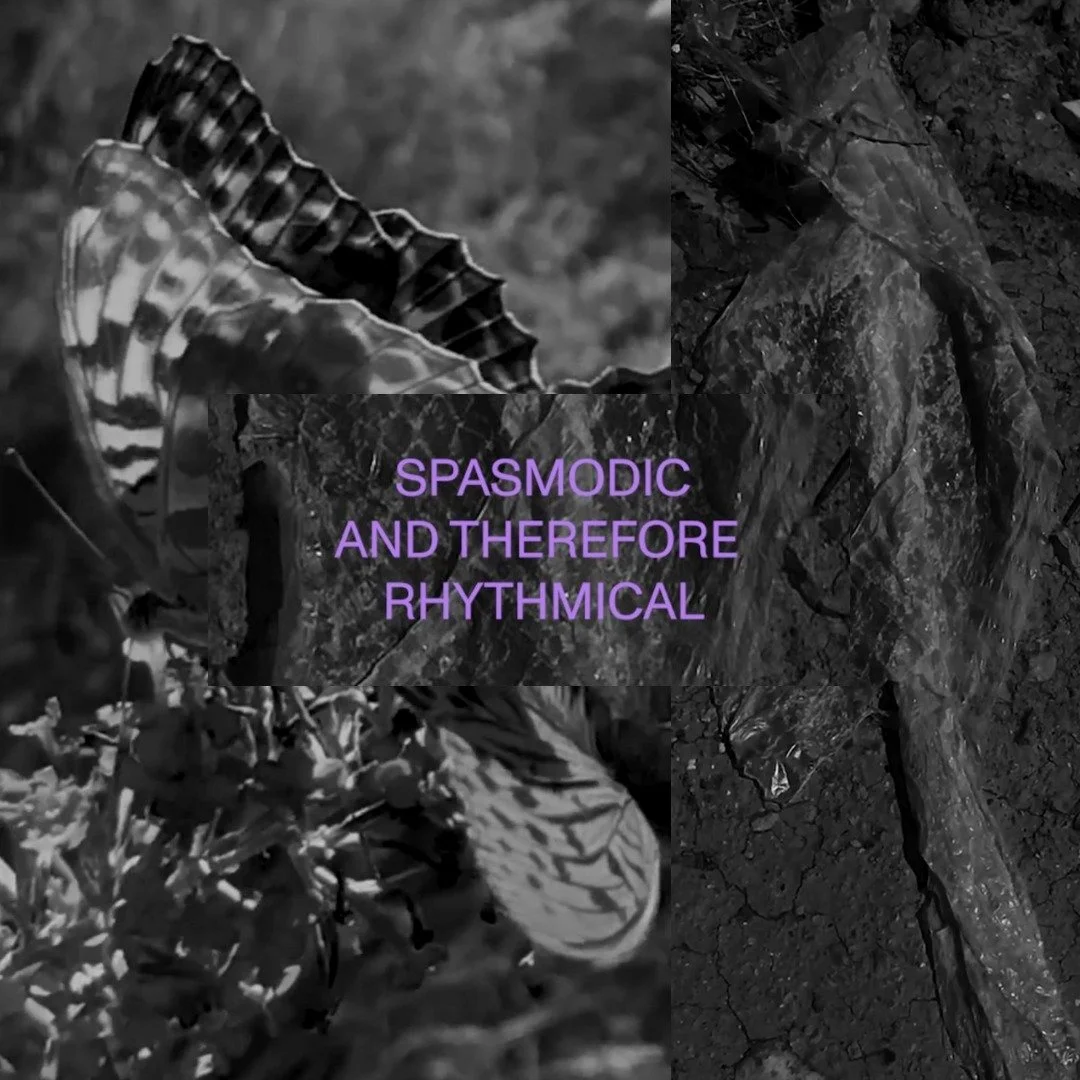
Giulia Ottavia Frattini, Spasmodic and therefore Rhytmical
1.
“Cette obscure clarté qui tombe des étoiles”
(that dark light which falls from the stars)
Pierre Corneille, ‘Le Cid’
(1)
There are few proposals in the realm of contemporary astrophysics for how the end of the universe will unfold. All of them have been aligned, in a strangely symmetrical manner, to the terrible beauty of the Big Bang.
The Big Crunch is thought to be the Big Bang’s eventual conclusion. After an undetermined amount of time, if the average density of the universe is enough to stop the expansion, the universe will begin the process of collapsing onto itself. Eventually, all of the matter and particles in existence would be pulled together into a super-dense state. Perhaps even into a black hole-like singularity. An event like this would be like a cycle of single breath: the universe would "breathe out" the Big Bang, and "breathe in" the Big Crunch.
The structural existence of the universe itself seems to have a circular nature that is responsible for endless departures and returns, like a series of deaths and rebirths, implosions, and explosions. All similar. All are never the same. All respiratory.
Like a strange reflection.
I find this concept of the expiration of the immensity of the world, resulting from the unsupportable weight of everything, especially relevant when seen in parallel with already collapsing onto itself immense amounts of data in an increasingly accelerating contemporary world. This collapse due to the gravitational saturation of the future now, is being repetitively redeemed, by the circular comebacks of new expansions. The Big Bang and Big Crunch are distortedly reflected in current algorithmically regulated reality. Reality characterised by a state of permanent breathlessness.
The universe goes through tensions, collapses, and spasms, all governed by the all-encompassing poetry of breath. Auto-destructions and triumphant re-emergences of inhalations and exhalations. Breath and breathlessness. In and out. Implosion into nothingness and explosion into re-being. Ephemera lying at the beginning of the world. The fleeting moment of glitches in existence.
It’s not that I work with circles, but rather with disparate ways of returning. I start with a subject, then associations spread, reaching out, developing tributaries, finally, a web. Network that returns to the starting point, like a first idea reclaimed anew.
Ri- Morso. Spasmodic Breath of the world exhaled out of the female body. The beginning and the end of the universe. Breath of land.
It’s not a possession, but a form of haunting.
The cosmos begins and ends.
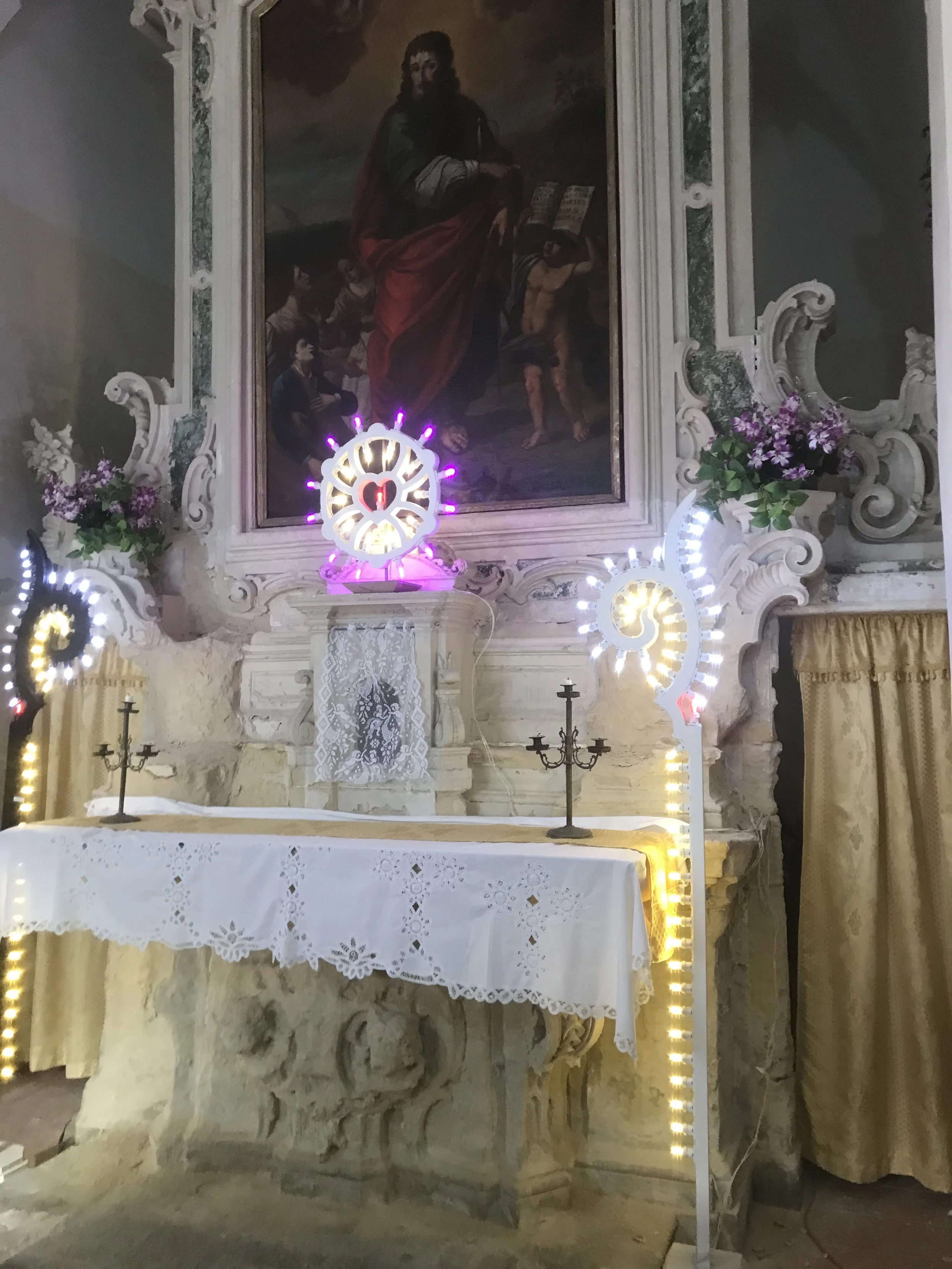
Capella di san Paolo, Galatina, June 2024
2.
In the course of my research I have met a number of musicians and dancers who embraced the tradition of tarantata. Erica and Luigi, a dancer and a tamburello player agreed to speak with me on the matter. Building on their reflections I invited my friend, Giulia Ottavia Frattini, a poetess, to contribute to the project.
THE POEM
My intention was to initiate a poetic performative gesture interacting with the heritage of tarantata at the site connected to it. I invited Giulia to compose a poem inspired by the presence of women going through tarantic possession in one of the most important spaces for the phenomenon, Cappella di San Paolo. In a way, the starting point for both of us were notions of spasm and chaos.
The recorded poem was played continously in the chapel, filling the space with invoked spasmodic whispers of those past presences. Giulia’s proposal of the spasmodic was for me a way to create an instance of irrational movement within the living space of the chapel, the chapel haunted by ghosts of the past, other lives and traces of monstrous spidery bodies. This sonic presence was an invocation.
In the interview with Giulia conducted a few months prior to our collaboration, she mentioned the importance of the bodily element of the language, organs of speech and consciously self destructive act of starvation out of oxygen, as integral parts of the poetic process. This type of partial suicide of tarantata-the poetess, self-abandonment, so to speak, is an act necessary for the poem to emerge. Just like tarantata who cascades down the dark void out of time, so the poetess has to ' kill a part of herself’ to make space for the other and return. She becomes a vibrating image screaming her way into the world.Together with Giulia, we created an instance where the body sensations are felt and explored with means of literary genre.
While Berardi follows Deleuze and Guuattari’s understanding of spasmodic, and this definition is included in my research, I also wanted to use the term’s original meaning associated with the body, lack of control over one’s muscles and irrationality, monstrosity associated with this type of movement. Monstrosity which emerges from being outside of a norm. In a way, spasmodic movement is equal to simultaneous abandonment and extreme presence within oneself. During the experience woman becomes a void and a white dwarf in the compression of temporalities. This rhythm is dark, the rhythm of the body that is not only tarantata’s anymore, but also the body that is a being, and that is being, a universe of more than one. And as such, poetry in spasmodic cadence.
PIZZICA
During my conversation with Luigi and Enrica, I asked about some aspects of their process and how they work together. I very much would like to stress that what I include here is my interpretation alone.
How do we let out our dark gnosis through spasmodic dance? Is self-annihilation of tarantata a sacrifice, an act of killing necessary to re-tune the world?
Dance is an initiation to understanding of the presence of the body, and therefore the condition of the world that the dancer carries within. This is freedom to express our anguish. To manifest our anxieties and disagreements through creative use of language*.
“As she dances she becomes the spider that bit her.”
Ernesto de Martino
*Language understood as all different means of communication
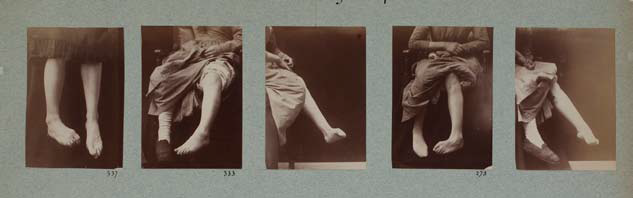
Albert Londe, Salpetiere Hospital
Epistemic ruptures are responses to a crisis that must be resolved in order to achieve new, social, political, and aesthetic life. The spider is the place, place in constant transformation from the fractured woman into an out-time-landscape. It is a moment of becoming something.
In movement. Shifting.
The climax of performance is the moment of ‘complete giving up’ - Is it possible to align it with a call to renewed attunement, to alter the way of understanding the world, and its perception by moving from the word to the punctuated tremors. A vibration.
Tarantata in her dance moves into a temporary time-space dimension, a momentary non-space out of time, a transformation from one state into another, her trance not only happens internally, it affects surrounding time-space, making its boundaries fuzzy, porous and blurred.
I think of our sonic presences, to draw a connecting line between sonic and the body, a movement.
Darkly reflected dancing; eternal stillness, cosmic pessimism, melancholia, new sublime, pre-humanism, ouroboric, shadow bodies.
Within the rhythmic patterns of the music, she does not speak the language, but dances, making a sonic response of the body necessary to re-emerge. The body and acoustic relationship is a manifestation of identity, and in the same way means to communicate.
From the point of view of the concept of inclusive perspective recognising interdependence between humus and every other entity on Earth, tarantata is like a meteor shooting through the space of vibration. Murmuring debris. Tamburello is built out of tremors, emerging from what is contained in the axis of circular shell; the same as the vibrational universe of the Spider is circumspect by rays of her name. The woman prostrates her monstrous body, the rhythm of Earth with her back against the soil like a snake; wild and in vibration (unison of friction) with the element.
CHAOOSMOSIS
The established order; social, political, economic, and sexual; aims to enforce a concatenation that stiffens and stifles the vibrational oscillation of singularities. This stiffening of vibrant bodies results in what Guattari calls “spasms.”
Music is the pulsating search for a possible conscription beyond the limits of the noise of the environment, and the recomposition of fragments of noise in a sound that embodies a conscious vibrational intention. In the spasm, sound collapses into noise, a tangle of inaudible voices.
“Chaos” is defined here in terms of speed, of acceleration of the info-sphere relative to the slow rhythms of reason and of the emotional mind. When things start to flow so fast that the human brain grows unable to elaborate the meaning of information, we enter into the condition of chaos.
What has to be done in such a situation? My suggestion is that you should not focus on the flow, but on your breath. Don’t follow the external rhythm, but breathe normally. CHECK QUOTE
Franco ‘Bifo’ Berardi
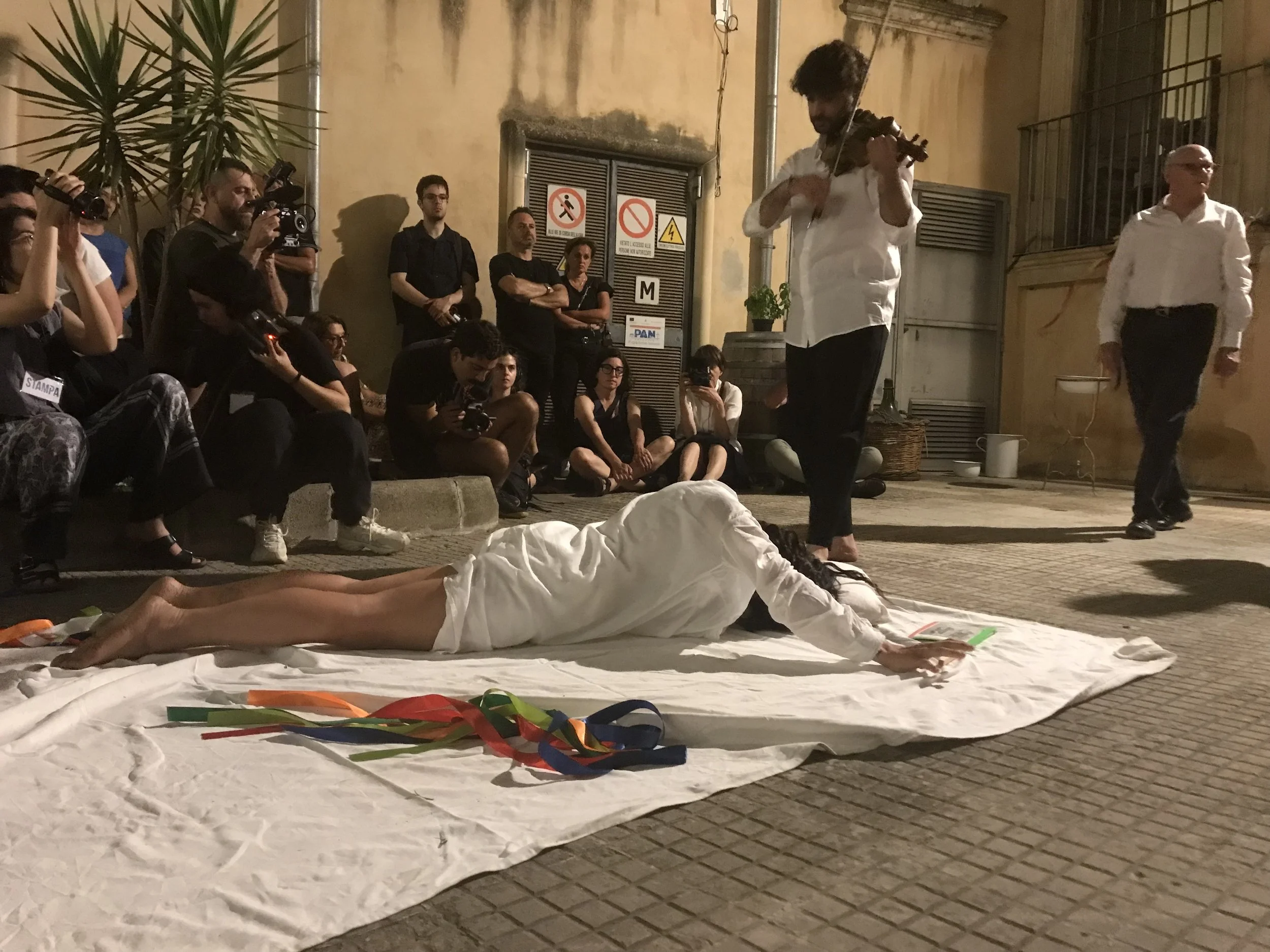
Enrica being Tarantata, Galatina 2024, photo: author’s own
3.
CASE OF A SPIDER
A spider is a strange case of a monster. The villain in Tarantata's story may not be a villain at all. And it certainly isn't a villain in the context of planetary environments. Spiders have a bad reputation. They are a source of irrational, uncanny terror. But in reality, they are crucial for a healthy habitat. Their beautiful webs are made out of one of the strongest materials in the world.
To Louise Bourgeois spider was a portrait of her mother. Always fixing tapestries, she was like a spider, always looking after her web, always repairing, mending. In fact, in the case of Arachne, the first spider, it is commonly thought that her metamorphosis was a punishment for arrogance. I find it very interesting, and more than a little significant, that her infamous tapestries mostly depicted violent acts of gods, mainly committed against women.
According to recent research, spider's web is considered part of its brain-mind. Spider builds an image of the world out of vibrations felt, registered, and translated through its web, like a message made out of seismic waves. Spider sees through spasmodic rhythm. It makes a world it inhabits out of its body.
In a way, data is corporeal.
And tarantata has built out an extension of her-self, and self of the Other, that is reaching beyond porous boundary of her body, and mirrors vibration of the cosmos felt through her spidery kin manifesting it in spasms/tremors of her dance.
Tomas Saraceno, works very much for, and importantly with, spiders. Across his many projects, he tirelessly advocates for changing our attitude towards arachnids and transforming arachnophobia in arachnophilia.
Can I think of tarantata, a spider-female-as a place?
A place made out of the spider-woman that contains the land, their beings morphed together. A female monstrous body is the monstrous body of the land, where land means soil and water, and all beings occupying it. She echoes the land that made her. She is a drum, and a voice.
Giovanna Parmigiani, who wrote on contemporary tarantism, proposes in its context, the concept of “the expanded present”, an analytical category that challenges that past, present and future existing within a linear conception of time. The previous, and the future lives “emerge through the process of recognising synchronicities of associations and connection to what it is to come to more-than-human worlds.” *
Artist Jazgul Madazimova works with female mourning and songs. In her continous preoccupation with nebulae, an astrophysical term for an exploding dying star she currently works on, the cosmos begins and ends, starts off from, and returns, to the female body, the nebula. A philosophical reflection on non-linear time and the expanded present, a profound philosophical reflection on passing and the nature of being; and the nature of being in the world, and the cosmic character of female body meet in Jazgul’s work, in endlessly recreaed ritual of mourning, and transformational strengh of ecstasy, and they meet in the she-spider dancing herself in and out of oblivion across Salentinian soil. Tarantata is a dark matter of the universe, staying on the margins, but necessary, like her kin, the spider.
*Giovanna Parmigiani, “The Spider Dance”
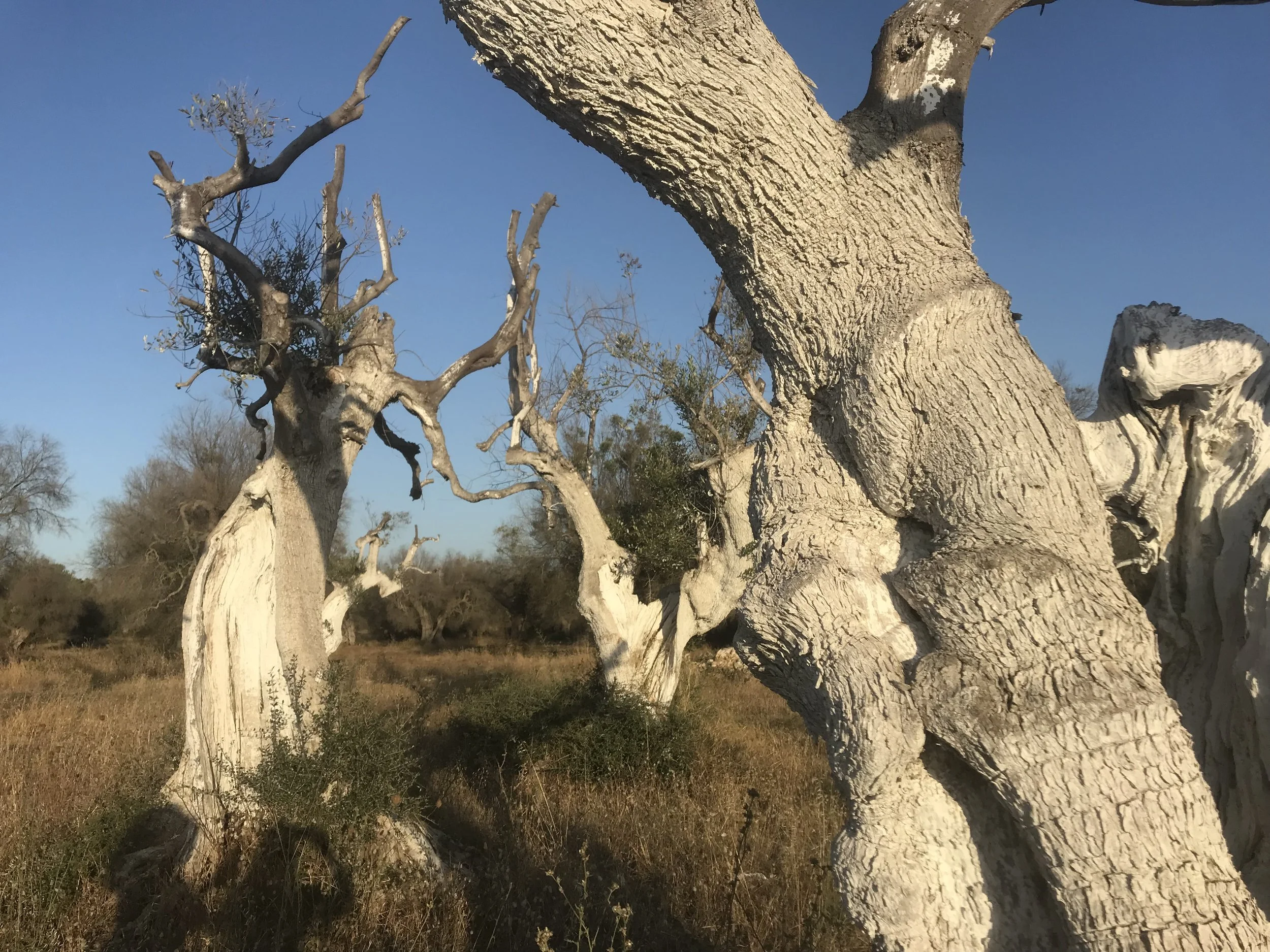
Campo dei Giganti, photo:author’s own
4.
While everything in the daily realm of living of a woman is defined by sharp edges of valuation created and enforced by patriarchal and capitalist language, tarantata’s boundaries between land, the other-spider and herself, are blurred and porous. She is more in- between, within the crack, as she becomes more, and other, than herself. She is a dark matter of the cosmos. Speaking the land’s whisper, dancing her rhythm, her body like a drum breathing/beating out dark dreams of a copper-shaded soil and bone-white rock she stands upon. Her change is binding the world anew.
Both Greek poetry and pizzica are used in this instance, as markings of bond with local universes. And while tarantate may be gone, or rather, changed, their heritage, their past monstrous lives and bodies are still present all around us, in the land, in efforts to work with it instead of working it, and in dancers and musicians themselves.
It is, in a way, a form of haunting. Present in the chapel where Giulia whispered her spasm. In the copper land and stony soil that we see. In olive trees that even though hurting, still fight to live. In confidence of a young woman who becomes pizzicata and lets her spine extend deep into the land.
In a raw, irregular beat of tamburello’s heart.
In Greek language there are two words for listening and an act of hearing: as my friend, extraordinary artist Kyriaki Goni explained: ακούω means listen, and hear as well. While αφουγκράζομαι means to listen carefully, it also means ‘I attend in order to hear every possible tiny sound’. Both have roots in ancient Greek.
If you’re really listening to the leaves falling or rock growing, your present circumstance vanishes.*
*Mariko Sama, Shogun, HBO
From the very beginning I felt there was a connection between woman-spider and the natural world, both marginalised, monstrous and other. Both suffer from a malady of breathlessness inflicted by numeric certainty of profit-driven agriculture. I find somehow very relevant that Xycella affects the lymphatic system of the olive tree. And so, I draw a line between one breath and another, rhythm of healing dance and rhythm of land, spasmodic chaos of cosmos and femininity breaking out through abandonment discovered in movement.
I decided to include research of the initiatives directed at healing the land, right here in Salento, working with Puglia’s environment so it can breathe again. And so, the state of breathlessness belongs to the condition of the soil and sky and sea too. And poetry is the rhythm of re-connection through conscious, ethical agriculture, and ways of healing aligned and enacted with the environment.
I believe that tarantata is poetry and breath exchanged between the human and land encapsulated in ecstasy.
In this context I would like to present a few initiatives which in my opinion work with these elements of ‘the right to breathe, relationship with the other and care’; Campo dei Giganti, Sylva Foundation and Amadeco Farm where work, or rather cooperation with the land, can be seen as poetry giving breath back to the environment. Like tarantata, they engage in a healing process.
The spider’s call is a call to try to see the world through vibrations, pulsating in becoming, to understand our position in the surrounding land as part within a living system, and an encouragement to perceive through our inner spider.
Can I think of tarantata, a spider female, as a place?
The spider -woman contains the land and they morphed together into being that is a place. The space between the suffocation and breath, and the infrathin difference between suffocation and breathlessness.
Experience of sharing life in a common space, of residence versus habitat, of creating a place, of care as learning, or as a collective and participatory experience, in poetic practice of environmental co-existing. It is equally the creation of a place and a process, with the spider (taratantata) being a place in endless becoming, where their union becomes a geographical entity. Or maybe it becomes a place of somewhere else. Spideress is a realm, a geography of being. Blurring the zones between human and beyond.
Landscape is a mind. Is a place. Is a body. Is beyond.
Can we think about the fictional reality of anthropocentric landscape as disintegrating, reassembling, dissolving, collapsing and emerging, moving forward into the past, and compressing down into the future in synchronicity?
In the film ‘Annihilation’ the alien organism changes surrounding land and its inhabitants, by creating elaborate chimeras out of them. At some point one of the scientists exploring the phenomenon speaks of alien intervention as if it was a prism. Multi-faceted mirror, reflecting the world in endless ways, creating new entanglements and hybridic beings in a rainbow of becoming. I always imagined this process as transparent in the extreme.
Tarantata is different, her becoming an-other is dark, opaque. She/them relate to the chthonic. Liminal and impenetrable. Belonging to them-her self. A dark matter of becoming.
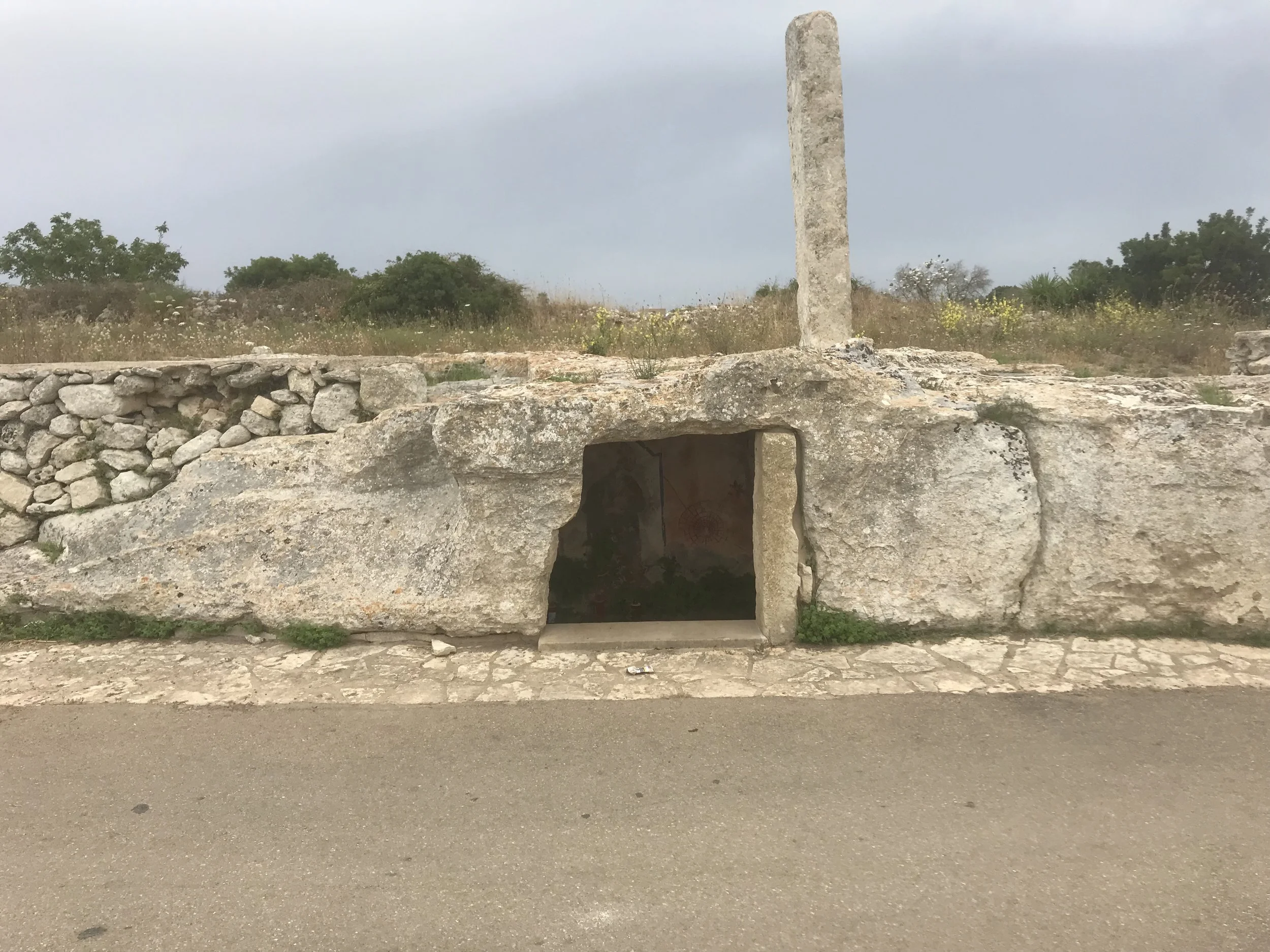
Tomb and Menhir associated with tarantism, Giurdignano, Salento,photo: author’s own
5.
I would like to begin with a quote from artwork rooted in a completely different tradition and context. Somehow, I think it shows how hauntings and possessions are shared experiences, whatever we are.
This is an excerpt from Bo Wang’s video work, entitled An Asian Ghost Story. The quote shares two of the characteristics of my proposal, and my understanding of tarantate themselves: a trance-like state bound to spasmodic, frenetic dance and a subconscious protest, an act of struggle for agency.
‘ It reminded her of another woman she saw a few days ago. She saw a woman waving, dancing, and rotating. In the beginning, she thought she was one of the other protesters, but her movement was so eccentric, as if she were possessed by an external power, and her rhythm belonged to another space and time. She rotates like a leaf in its own swirl.
The image of the woman really stayed with her. She saw herself in another woman, but didn’t really know why. She kept on asking me what I thought, as if, being a ghost, I should know all things abnormal.‘
La Poetessa, The Spideress
And in your dreams, were you afraid?
Tarantata is the mistress of dark suspension. Her spasm is a protest against the clockwise punch of the Anthropocene, and the poetry of the vibration of every breath felt against her web, in her lungs, and on her skin-hide. It is an instrument of resurrection and an emancipative turn into the undefiable. Her body is like a drum, beating the beat of the heart of the land she belongs to. Her bare feet reaching out, deep into the ground, the soil is her embrace, her spine like a column of dark fire. She dances herself out of time, in the dark matter of the poetic universe. Inaffable, liminal stretching beyond prescribed significations.
The periodic self-annihilation of tarantata is, in fact, a sacrifice, an act of self-killing necessary to re-tune the world. She resides in a world where there is no outside, no otherness, and no time. Place of dark matter, a void of space.
While everything in the daily realm of living of a woman has sharply defined edges of valuation applied by patriarchal and capitalist language, Tarantata’s boundaries between land, other-spider, and herself are blurred and porous. She is in-between, as she becomes more and more other than herself. She is a dark matter in the cosmos. Speaking the land whisper, dancing her rhythm, her body like a drum breathing out dark dreams of the copper and bone-white rocky soil she stands upon. Her change binding the world anew.
The spider’s call is a call to see the world through vibrations, to understand our position in the surrounding land as a living system, and through our inner spider. Can we post that Tarantate are the ones who listen to the murmur of the land-cosmos attentively? Challenging linear ideas and experiences of time and temporality by showing the interconnectedness of alternative historicities, healing, and place-making.
Is it a spider who invaded Tarantata’s body? Or does Tarantata make a space within herself for her arachnid sister to co-exist? To be transported, guided by a slender, silver thread that leads you into the depths of the earth.
Can we see the corporeal as that of the individual, and equally as a social (collective and egalitarian) body? The spasmodic frenetic movement of spideress is an anguish of all bodies breathing in collective. Can a tarantula's dance be considered a moment when it is given form? Where does a spider emerge from its hiding place, and become open to the murmuring vibrations of the world? While feeling the presence of the other, or perhaps searching for one’s own presence while being in place ‘somewhere else’. Elsewhere. Netherland?
Tarantata is not travelling to another place. She becomes another place. In ecstasy, she surpasses herself.
The text is a summary of my proposal and subsequent research during my time as curator at Domus Art Residency in Galatina, Salento, Italy in June, 2024.
https://www.domus-artistresidency.com/patrycja-wojciechowska
